Strategic Industrial Utility Management: Advanced Wastewater Separation
Managing industrial effluent remains a critical operational pillar for manufacturing plants, commercial facilities, and utility providers across Indonesia. Consequently, many industrial zones struggle to safely discharge water loaded with complex organic contaminants. Implementing a highly effective flotation unit wastewater treatment system allows facilities to seamlessly separate stubborn pollutants from raw wastewater.
Therefore, partnering with an expert consultant like PT. Gapura Liqua Solutions (GLS) becomes essential. By delivering end-to-end water management solutions, GLS ensures that industrial companies achieve uninterrupted production while easily meeting strict environmental discharge regulations.
The Growing Need for Effective Effluent Management
Overcoming High Suspended Solids and Oils
Rapid industrialization across various sectors, including food processing, petrochemicals, and textiles, generates highly contaminated wastewater. Typically, this effluent contains elevated levels of Total Suspended Solids (TSS) and Fats, Oils, and Grease (FOG). Because standard gravity settling clarifiers fail to capture these lightweight particles effectively, facilities experience severe treatment bottlenecks. Furthermore, untreated oils can smother downstream biological treatment phases, causing massive system failures. According to guidelines from the United States Environmental Protection Agency (EPA), controlling suspended solids is paramount to protecting local aquatic ecosystems from industrial runoff.
The Financial Cost of Poor Effluent Compliance
Additionally, regulatory bodies in Indonesia continually tighten industrial discharge limits. When a facility discharges water that exceeds allowable TSS or Chemical Oxygen Demand (COD) parameters, it faces heavy financial penalties and potential operational shutdowns. As a result, proactively investing in high-quality separation infrastructure prevents these costly regulatory breaches while simultaneously protecting a company’s public reputation.
Core Mechanics of flotation unit wastewater treatment
Designing a robust wastewater system requires a systematic, multi-barrier engineering approach. Conversely, a poorly configured process quickly leads to chemical waste, excessive sludge generation, and poor water clarity. Let us examine the fundamental operations within a flotation unit wastewater treatment plant.
Dissolved Air Flotation (DAF) Principles
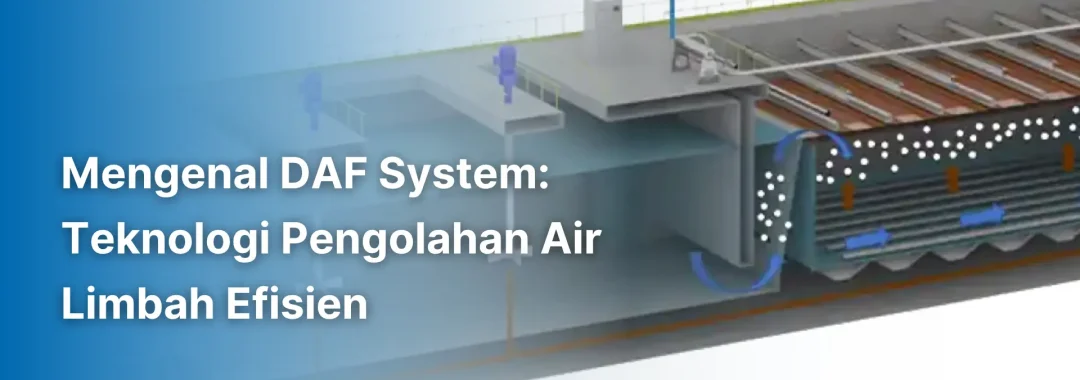
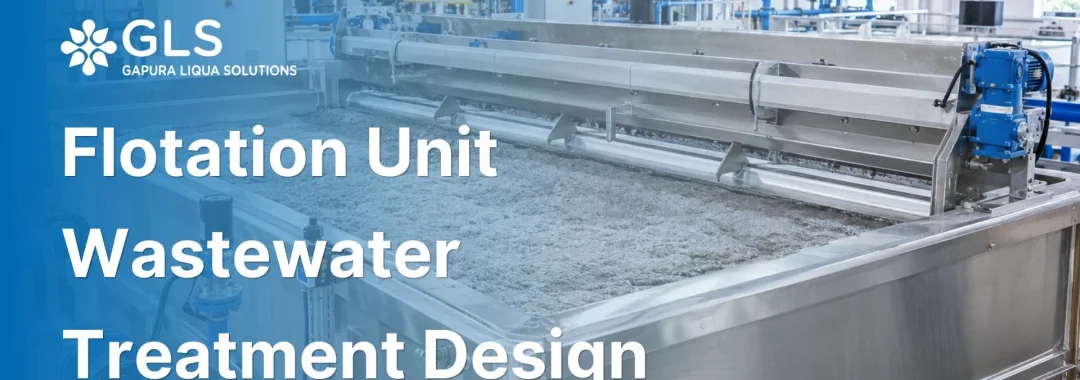
First, the heart of this separation technology relies on the injection of micro-bubbles. In a typical Dissolved Air Flotation (DAF) process, a portion of the clarified effluent is pressurized and saturated with air. Subsequently, this pressurized stream is released into the main flotation tank. Because of the sudden pressure drop, millions of microscopic air bubbles form instantly. These tiny bubbles attach themselves to suspended solids and oil droplets, drastically reducing their specific gravity. Consequently, the contaminants float rapidly to the surface, where mechanical skimmers scrape the accumulated sludge layer into a collection trough. You can learn more about how a DAF system works for wastewater directly on the GLS engineering blog.
Chemical Coagulation and Flocculation Integration
Second, to maximize the capture rate of the micro-bubbles, raw wastewater must undergo chemical pre-treatment. Initially, coagulants neutralize the electrical charges of fine particles, allowing them to clump together. Following this, polymer flocculants are introduced to bind these small clumps into larger, robust flocs. Ultimately, these large flocs provide a massive surface area for the air bubbles to grip, which dramatically increases the overall efficiency of the flotation unit wastewater treatment process. Resources from the Water Environment Federation (WEF) consistently highlight that proper chemical dosing is the most critical factor for optimizing flotation efficiency.
PT Gapura Liqua Solutions as Your Trusted Water Consultant
Customized Engineering and EPC Services
Navigating wastewater treatment complexities requires deep technical knowledge and strict execution discipline. PT. Gapura Liqua Solutions provides complete lifecycle support, spanning initial wastewater analytics, customized engineering design, procurement, and construction (EPC). Because no two industrial effluents are exactly alike, GLS engineers custom utility solutions that consistently fulfill specific environmental compliance frameworks.
Long-Term Operation and Maintenance (O&M)
Moreover, GLS delivers long-term Operation & Maintenance (O&M) services to guarantee system reliability. Consequently, industrial plants can focus entirely on their core commercial manufacturing outputs while GLS expertly manages wastewater compliance and sludge reduction strategies. You can explore our latest industrial project milestones, technological updates, and corporate announcements on the official PT. Gapura Liqua Solutions LinkedIn page.
Conclusion
In conclusion, managing high-strength industrial effluent effectively requires a strategic, engineered approach rather than temporary reactive fixes. Developing a highly optimized flotation unit wastewater treatment solution ensures long-term operational resilience, reduces costly regulatory fines, and protects vital downstream biological processes. Ultimately, partnering with an experienced consultant and EPC contractor like PT. Gapura Liqua Solutions empowers industrial plants to optimize their utility operations, lower lifetime costs, and achieve sustainable wastewater management.
FAQ Section
Q1: What types of contaminants does a flotation unit remove? A: A flotation unit is specifically designed to remove Total Suspended Solids (TSS), Fats, Oils, and Grease (FOG), and other lightweight organic matter that does not settle easily in standard gravity clarifiers.
Q2: Why is chemical pre-treatment necessary for this system? A: Chemicals like coagulants and flocculants bind microscopic particles into larger flocs. This increases the surface area, allowing the micro-bubbles to attach more easily and float the contaminants to the surface efficiently.
Q3: How does PT. Gapura Liqua Solutions assist with wastewater compliance? A: GLS acts as a comprehensive water treatment consultant, providing custom engineering, pilot testing, and long-term Operation & Maintenance (O&M) to ensure your facility’s effluent strictly meets all government discharge regulations.