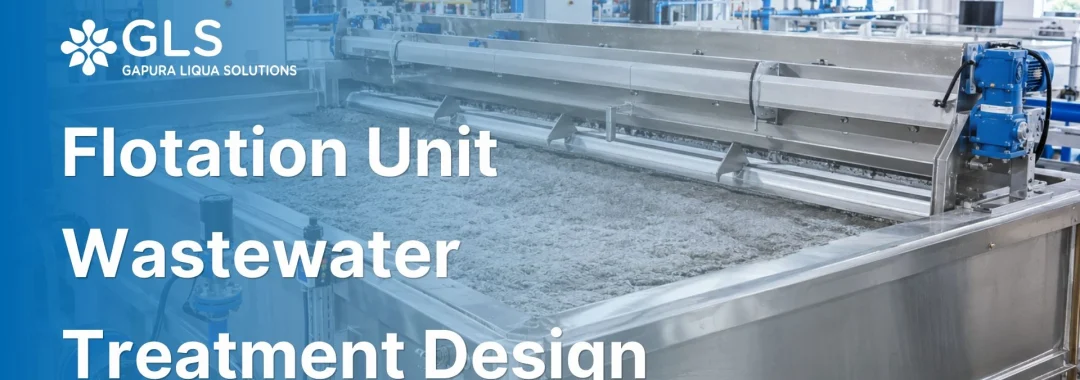
Industrial flotation unit wastewater treatment system engineered by PT Gapura Liqua Solutions for effective suspended solids removal.

Flotation Unit Wastewater Treatment Design

Strategic Industrial Utility Management: Advanced Wastewater Separation

Managing industrial effluent remains a critical operational pillar for manufacturing plants, commercial facilities, and utility providers across Indonesia. Consequently, many industrial zones struggle to safely discharge water loaded with complex organic contaminants. Implementing a highly effective flotation unit wastewater treatment system allows facilities to seamlessly separate stubborn pollutants from raw wastewater.

Therefore, partnering with an expert consultant like PT. Gapura Liqua Solutions (GLS) becomes essential. By delivering end-to-end water management solutions, GLS ensures that industrial companies achieve uninterrupted production while easily meeting strict environmental discharge regulations.

The Growing Need for Effective Effluent Management

Overcoming High Suspended Solids and Oils

Rapid industrialization across various sectors, including food processing, petrochemicals, and textiles, generates highly contaminated wastewater. Typically, this effluent contains elevated levels of Total Suspended Solids (TSS) and Fats, Oils, and Grease (FOG). Because standard gravity settling clarifiers fail to capture these lightweight particles effectively, facilities experience severe treatment bottlenecks. Furthermore, untreated oils can smother downstream biological treatment phases, causing massive system failures. According to guidelines from the United States Environmental Protection Agency (EPA), controlling suspended solids is paramount to protecting local aquatic ecosystems from industrial runoff.

The Financial Cost of Poor Effluent Compliance

Additionally, regulatory bodies in Indonesia continually tighten industrial discharge limits. When a facility discharges water that exceeds allowable TSS or Chemical Oxygen Demand (COD) parameters, it faces heavy financial penalties and potential operational shutdowns. As a result, proactively investing in high-quality separation infrastructure prevents these costly regulatory breaches while simultaneously protecting a company’s public reputation.

Core Mechanics of flotation unit wastewater treatment

Designing a robust wastewater system requires a systematic, multi-barrier engineering approach. Conversely, a poorly configured process quickly leads to chemical waste, excessive sludge generation, and poor water clarity. Let us examine the fundamental operations within a flotation unit wastewater treatment plant.

Dissolved Air Flotation (DAF) Principles

First, the heart of this separation technology relies on the injection of micro-bubbles. In a typical Dissolved Air Flotation (DAF) process, a portion of the clarified effluent is pressurized and saturated with air. Subsequently, this pressurized stream is released into the main flotation tank. Because of the sudden pressure drop, millions of microscopic air bubbles form instantly. These tiny bubbles attach themselves to suspended solids and oil droplets, drastically reducing their specific gravity. Consequently, the contaminants float rapidly to the surface, where mechanical skimmers scrape the accumulated sludge layer into a collection trough. You can learn more about how a DAF system works for wastewater directly on the GLS engineering blog.

Chemical Coagulation and Flocculation Integration

Second, to maximize the capture rate of the micro-bubbles, raw wastewater must undergo chemical pre-treatment. Initially, coagulants neutralize the electrical charges of fine particles, allowing them to clump together. Following this, polymer flocculants are introduced to bind these small clumps into larger, robust flocs. Ultimately, these large flocs provide a massive surface area for the air bubbles to grip, which dramatically increases the overall efficiency of the flotation unit wastewater treatment process. Resources from the Water Environment Federation (WEF) consistently highlight that proper chemical dosing is the most critical factor for optimizing flotation efficiency.

PT Gapura Liqua Solutions as Your Trusted Water Consultant

Customized Engineering and EPC Services

Navigating wastewater treatment complexities requires deep technical knowledge and strict execution discipline. PT. Gapura Liqua Solutions provides complete lifecycle support, spanning initial wastewater analytics, customized engineering design, procurement, and construction (EPC). Because no two industrial effluents are exactly alike, GLS engineers custom utility solutions that consistently fulfill specific environmental compliance frameworks.

Long-Term Operation and Maintenance (O&M)

Moreover, GLS delivers long-term Operation & Maintenance (O&M) services to guarantee system reliability. Consequently, industrial plants can focus entirely on their core commercial manufacturing outputs while GLS expertly manages wastewater compliance and sludge reduction strategies. You can explore our latest industrial project milestones, technological updates, and corporate announcements on the official PT. Gapura Liqua Solutions LinkedIn page.

Conclusion

In conclusion, managing high-strength industrial effluent effectively requires a strategic, engineered approach rather than temporary reactive fixes. Developing a highly optimized flotation unit wastewater treatment solution ensures long-term operational resilience, reduces costly regulatory fines, and protects vital downstream biological processes. Ultimately, partnering with an experienced consultant and EPC contractor like PT. Gapura Liqua Solutions empowers industrial plants to optimize their utility operations, lower lifetime costs, and achieve sustainable wastewater management.

FAQ Section

Q1: What types of contaminants does a flotation unit remove? A: A flotation unit is specifically designed to remove Total Suspended Solids (TSS), Fats, Oils, and Grease (FOG), and other lightweight organic matter that does not settle easily in standard gravity clarifiers.

Q2: Why is chemical pre-treatment necessary for this system? A: Chemicals like coagulants and flocculants bind microscopic particles into larger flocs. This increases the surface area, allowing the micro-bubbles to attach more easily and float the contaminants to the surface efficiently.

Q3: How does PT. Gapura Liqua Solutions assist with wastewater compliance? A: GLS acts as a comprehensive water treatment consultant, providing custom engineering, pilot testing, and long-term Operation & Maintenance (O&M) to ensure your facility’s effluent strictly meets all government discharge regulations.
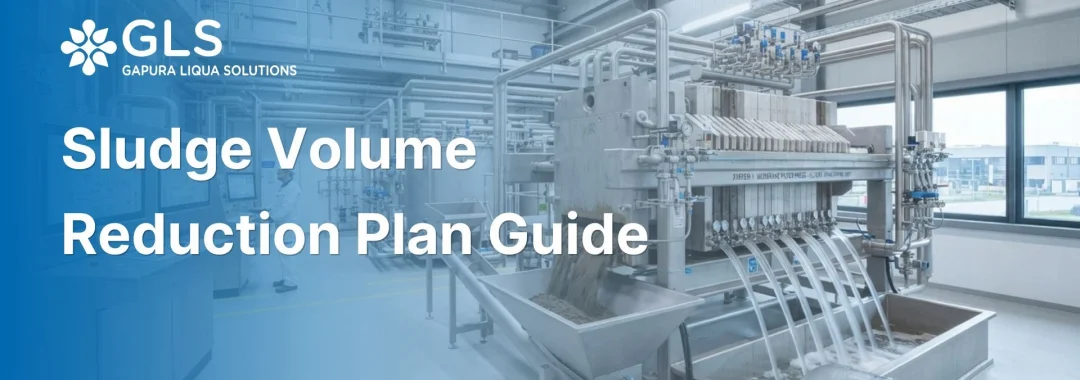
Industrial sludge volume reduction plan filter press equipment in a modern wastewater treatment plant

Sludge Volume Reduction Plan Guide

Strategic Industrial Wastewater Management: Implementing a Sludge Volume Reduction Plan

Industrial manufacturing facilities face growing pressure to manage operational wastewater efficiently. As regulatory bodies enforce strict discharge limits, handling residual sludge becomes a primary cost driver. Implementing a structured sludge volume reduction plan allows plant operators to lower logistics expenses, optimize equipment performance, and maintain long-term environmental compliance. By adopting modern engineering strategies and consulting with industry experts, industrial facilities can turn complex waste burdens into streamlined, sustainable operations.

Understanding the Industrial Sludge Challenge

Wastewater treatment generates substantial amounts of semi-solid sludge that require dewatering, transport, and hazardous material disposal. Therefore, unmanaged sludge volume quickly creates bottlenecks in day-to-day manufacturing operations.

Environmental and Operational Bottlenecks

High water content makes raw sludge heavy and volatile. Consequently, stored sludge emits odors, creates secondary contamination risks, and occupies valuable operational footprint within wastewater treatment plants (WWTPs). Regulatory agencies, including environmental protection bodies like the U.S. EPA Sustainable Water Infrastructure framework, emphasize effective solids handling to protect local ecosystems.

Financial Implications of Heavy Sludge Loads

Transporting untreated sludge with high moisture content means paying to transport excess water. Because hazardous waste handling fees are calculated by weight and volume, heavy sludge significantly inflates operational expenditure (OPEX).

Key Components of a Successful Sludge Volume Reduction Plan

Executing a thorough sludge volume reduction plan requires integrating mechanical, chemical, and biological technologies tailored to specific wastewater characteristics.

Chemical Conditioning and Coagulation

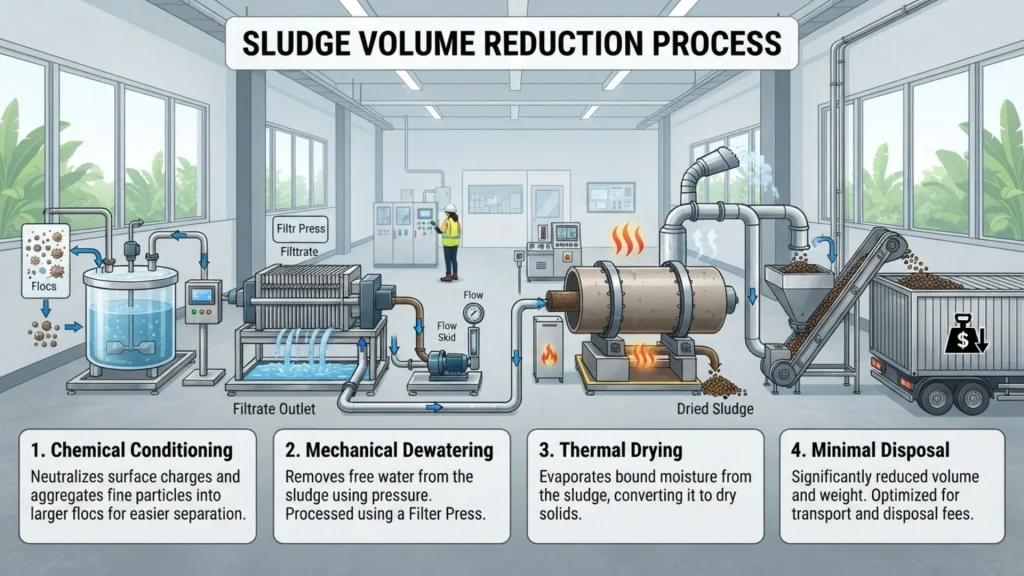
Before mechanical separation occurs, chemical conditioning neutralizes particle charges. Adding coagulants and polymers causes fine suspended solids to aggregate into larger flocs. As a result, free water releases much faster during subsequent mechanical dewatering stages.

Advanced Dewatering and Mechanical Drying

Mechanical dewatering remains the backbone of solid-liquid separation. Facilities utilize several high-efficiency technologies:

  • Filter Presses: Recessed plate and membrane filter presses produce dense cake solids with low residual moisture.
  • Centrifuges: High-speed decanter centrifuges continuously separate solids from liquid streams in compact footprints.
  • Screw Presses: Low-speed screw presses provide energy-efficient dewatering for biological and fibrous sludges.

Following mechanical dewatering, thermal dryers remove bound water to further reduce total volume. According to technical resources from the Water Environment Federation (WEF), thermal drying significantly reduces final cake weight, drastically lowering downstream transport costs.

An industrial diagram outlining a 4-step sludge volume reduction process consisting of chemical conditioning, mechanical dewatering via filter press, thermal drying, and minimal disposal into a truck.

Biological Treatment and Resource Recovery

Biological sludge reduction techniques, such as aerobic digestion and extended aeration, digest organic solids before dewatering. In addition, advanced systems enable resource recovery, transforming dried sludge into usable byproducts like soil conditioners or secondary fuel sources.

Partnering with PT. Gapura Liqua Solutions as Your Water Treatment Consultant

Selecting the right technologies requires deep technical insight into fluid dynamics, water chemistry, and site-specific operational constraints.

End-to-End System Auditing and Engineering

PT. Gapura Liqua Solutions acts as a total water solutions partner for industrial clients across Indonesia. GLS provides end-to-end engineering, procurement, and consulting services tailored to complex industrial utility demands. By conducting detailed facility audits, GLS engineers identify process bottlenecks and design customized dewatering systems that deliver maximum volume reduction.

Sustainable Operational Excellence

Beyond initial system design, GLS delivers long-term Operation and Maintenance (O&M) services. Through continuous monitoring and technical support, clients maintain consistent operational efficiency without distracting from their core business production goals. Explore real-world project milestones and technical insights on the official PT. Gapura Liqua Solutions LinkedIn page.

Conclusion

Managing wastewater residuals effectively requires a strategic approach rather than reactive fixes. Developing a robust sludge volume reduction plan ensures long-term operational resilience, reduces logistics overhead, and keeps facilities compliant with evolving environmental regulations. Partnering with an experienced consultant like PT. Gapura Liqua Solutions empowers industrial plants to optimize utility operations, lower lifetime costs, and achieve sustainable water management.

FAQ Section

Q1: What is a sludge volume reduction plan? A sludge volume reduction plan is a structured strategy using chemical, mechanical, and thermal techniques to remove water content from wastewater residuals, minimizing physical volume and disposal weight.

Q2: Why is sludge volume reduction important for industrial facilities? Reducing sludge volume lowers waste handling and transportation fees, ensures compliance with environmental discharge regulations, and improves overall plant efficiency.

Q3: How does PT. Gapura Liqua Solutions assist in sludge reduction? PT. Gapura Liqua Solutions provides complete consulting, engineering design, technology procurement, and long-term O&M services to optimize wastewater treatment systems for industrial clients.

Follow us on Social Media

Facebook Instagram LinkedIn
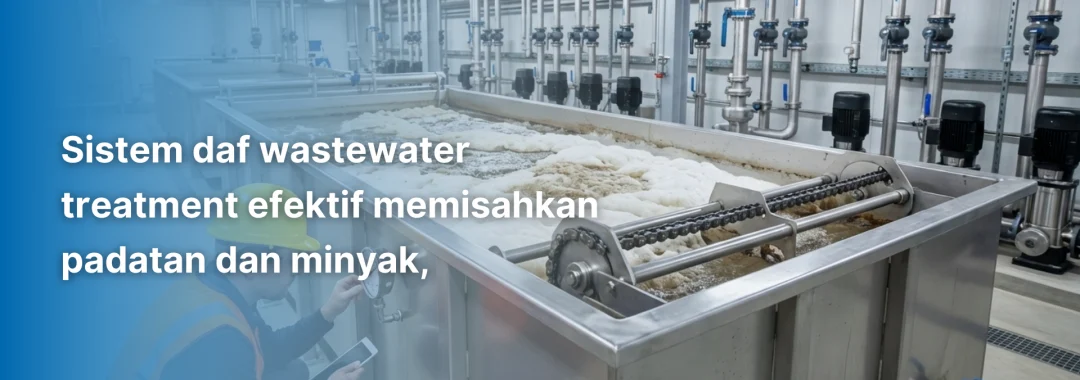
Teknisi memeriksa unit sistem daf wastewater treatment di fasilitas industri.

Sistem DAF Wastewater Treatment untuk Industri Indonesia

Sistem DAF Wastewater Treatment: Kunci Efisiensi Pengolahan Limbah Industri

Bagi para Head of Procurement dan Manajer Fasilitas di sektor industri, efisiensi Instalasi Pengolahan Air Limbah (IPAL) adalah prioritas non-negosiabel. Di tengah ketatnya regulasi lingkungan dan kebutuhan untuk menekan biaya operasional, penerapan sistem daf wastewater treatment (Dissolved Air Flotation) menjadi solusi strategis yang kian relevan, terutama bagi industri dengan beban pencemar organik dan padatan tinggi.

Artikel ini akan membahas secara mendalam urgensi teknologi DAF dalam rantai pengolahan air dan bagaimana PT. Gapura Liqua Solutions (GLS) mengintegrasikannya untuk menjamin keberlanjutan operasional Anda.

Tantangan Padatan Tersuspensi dan Minyak dalam Air Limbah

Limbah cair industri, khususnya dari sektor makanan-minuman, tekstil, dan minyak kelapa sawit, sering kali mengandung kadar Total Suspended Solids (TSS) serta lemak dan minyak (Fats, Oils, Grease – FOG) yang sangat tinggi. Tanpa penanganan awal yang tepat menggunakan sistem daf wastewater treatment, polutan ini menjadi ancaman serius bagi keseluruhan sistem utilitas pabrik.

Risiko Kerusakan pada Sistem Filtrasi Lanjut

Banyak industri kini beralih ke teknologi penggunaan kembali air (water reuse) menggunakan membran. Namun, membran Reverse Osmosis (RO) sangat sensitif terhadap fouling atau penyumbatan. TSS dan minyak yang lolos dari tahap awal akan menutupi pori-pori membran dengan cepat.

Hal ini menyebabkan penurunan kinerja yang drastis, seperti yang sering dibahas dalam analisis BWRO membrane performance. Tanpa perlindungan dari unit DAF yang andal, biaya penggantian membran akan melonjak dan frekuensi downtime untuk pencucian kimia (chemical cleaning) akan meningkat, mengganggu jadwal produksi.

Kepatuhan Regulasi Lingkungan di Indonesia

Pemerintah Indonesia, melalui Kementerian Lingkungan Hidup dan Kehutanan (KLHK), menerapkan standar baku mutu air limbah yang ketat. Kegagalan dalam memisahkan kontaminan fisik seperti TSS dan FOG tidak hanya berisiko merusak peralatan, tetapi juga membawa risiko hukum dan sanksi administratif. Implementasi sistem daf wastewater treatment yang terkalibrasi memastikan effluent pabrik Anda selalu berada dalam ambang batas aman sebelum dibuang atau diolah lebih lanjut.

Cara Kerja dan Keunggulan Teknologi DAF

Berbeda dengan sedimentasi konvensional yang mengandalkan gaya gravitasi untuk mengendapkan partikel berat, Dissolved Air Flotation (DAF) menggunakan prinsip pengapungan.

Mekanisme Pengapungan dengan Gelembung Mikro

Dalam proses ini, air yang telah dijenuhkan dengan udara bertekanan dilepaskan ke dalam tangki flotasi. Pelepasan tekanan ini menghasilkan jutaan gelembung mikro (microbubbles) yang menempel pada partikel padatan tersuspensi dan flok minyak. Gabungan gelembung-partikel ini memiliki densitas lebih ringan dari air, sehingga mengapung ke permukaan membentuk lapisan lumpur (sludge blanket) yang kemudian disapu bersih oleh mekanisme skimmer.

Teknologi ini sangat efektif untuk memisahkan partikel ringan yang sulit mengendap, menjadikan proses klarifikasi jauh lebih cepat dibandingkan clarifier konvensional.

Peran DAF sebagai Pre-Treatment Vital untuk RO

Dalam konteks desalinasi air laut (SWRO) atau daur ulang air limbah, DAF berfungsi sebagai benteng pertahanan pertama. Dengan mereduksi beban TSS dan organik secara signifikan, DAF melindungi unit Reverse Osmosis Membrane di hilir.

Integrasi ini adalah contoh nyata dari keunggulan sistem air RO yang didesain dengan benar: umur membran lebih panjang, konsumsi energi lebih rendah, dan kualitas air produk yang konsisten.

Mengapa Memilih PT. Gapura Liqua Solutions?

Memilih vendor untuk instalasi pengolahan air bukan sekadar membeli tangki besi; ini adalah kemitraan jangka panjang untuk keamanan utilitas. PT. Gapura Liqua Solutions (GLS) menawarkan keahlian end-to-end yang membedakan kami di pasar.

Kami tidak hanya menyediakan sistem daf wastewater treatment, tetapi mengintegrasikannya ke dalam solusi Total Water Management.

  • Rekayasa Presisi: Tim engineering kami mendesain sistem DAF yang disesuaikan dengan karakteristik spesifik limbah cair pabrik Anda (custom-engineered).
  • Dukungan Operasional: Kami menawarkan layanan Engineering, Procurement, and Construction (EPC) serta kontrak operasional jangka panjang, memastikan sistem berjalan optimal 24/7.
  • Ketersediaan Suku Cadang: Akses mudah ke komponen dan bahan kimia pengolahan air melalui toko resmi kami di Tokopedia.

Komitmen kami terhadap inovasi dan transparansi proyek dapat Anda pantau melalui pembaruan rutin di LinkedIn Gapura Liqua Solutions.

Kesimpulan

Investasi pada sistem daf wastewater treatment yang berkualitas adalah langkah proaktif untuk melindungi aset produksi dan mematuhi regulasi lingkungan. Dengan kemampuan memisahkan kontaminan membandel secara efisien, teknologi ini menjadi pondasi bagi sistem pengelolaan air industri yang berkelanjutan.

PT. Gapura Liqua Solutions siap menjadi mitra strategis Anda, mengubah tantangan limbah menjadi keunggulan operasional melalui solusi teknis yang teruji dan terpercaya.

Jangan biarkan masalah limbah menghambat pertumbuhan bisnis Anda. Hubungi Kami untuk Konsultasi Gratis

FAQ Section

Q: Apakah sistem DAF cocok untuk semua jenis air limbah industri? A: Sistem DAF sangat efektif untuk limbah yang mengandung padatan ringan, minyak, dan lemak (FOG) seperti pada industri makanan, sawit, dan tekstil. Untuk limbah dengan padatan berat yang mudah mengendap, sedimentasi konvensional mungkin lebih cocok. GLS dapat melakukan audit untuk menentukan solusi terbaik bagi Anda.

Q: Seberapa besar penghematan lahan jika menggunakan DAF dibandingkan clarifier biasa? A: DAF memiliki loading rate yang jauh lebih tinggi, sehingga footprint (kebutuhan lahan) instalasinya bisa lebih kecil dan kompak dibandingkan kolam sedimentasi gravitasi, sangat cocok untuk pabrik dengan lahan terbatas.

Q: Apakah GLS menyediakan bahan kimia koagulan dan flokulan untuk proses DAF? A: Ya, kami menyediakan paket lengkap termasuk pemilihan bahan kimia (chemical treatment) yang tepat untuk memaksimalkan pembentukan flok dan efisiensi pemisahan dalam unit DAF.

Q: Bagaimana sistem DAF membantu proses desalinasi air laut (SWRO)? A: Pada desalinasi, air laut sering mengandung alga dan residu organik yang bersifat ringan. DAF efektif mengangkat kontaminan ini sebelum air masuk ke sistem ultrafiltrasi atau RO, mencegah biofouling yang parah pada membran.

Follow us on Social Media

Facebook Instagram LinkedIn