Mastering Membrane Selection: understanding ultrafiltration pore sizes
Membrane separation plays a vital role in modern industrial water treatment. Ultrafiltration systems effectively remove suspended solids, bacteria, and macromolecules from water streams. To optimize filtration performance, understanding ultrafiltration pore sizes is essential for plant engineers. Selecting the correct pore size ensures high permeate quality while extending membrane lifespan.
Fundamental Principles of Ultrafiltration Pore Sizes
Ultrafiltration operates via physical exclusion, separating contaminants based on molecular size. Pores in ultrafiltration membranes are significantly smaller than microfiltration membranes.
Pore Size Range and Molecular Weight Cut-Off
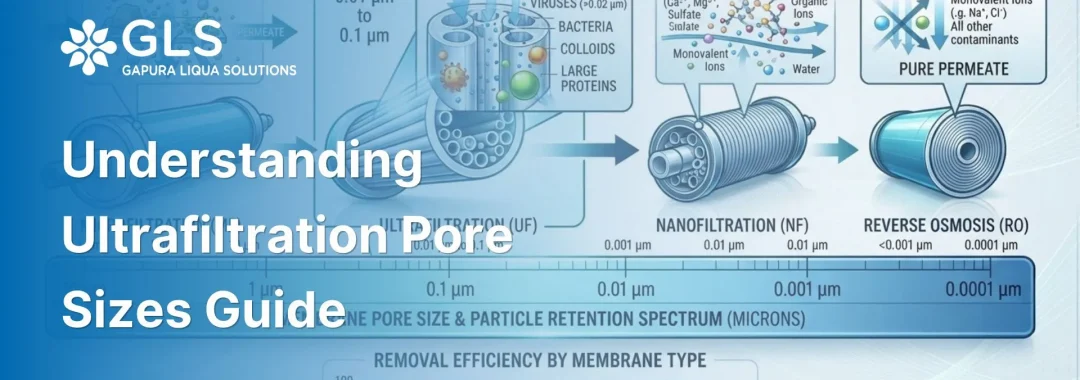
Ultrafiltration membranes typically feature pore sizes ranging from 0.01 to 0.1 microns. In addition, manufacturers measure membrane rating using Molecular Weight Cut-Off (MWCO). MWCO indicates the smallest solute mass that the membrane retains effectively. Typical ultrafiltration MWCO ratings range from 10,000 to 100,000 Daltons. Understanding these metrics helps facility operators select precise filtration levels for their feed water.
Contaminant Separation Mechanisms
Pore size determines which particles pass through into the clean permeate stream. Pores smaller than 0.02 microns easily block viruses, colloidal silica, and proteins. Meanwhile, larger pores target suspended solids, silt, and major bacterial contaminants. Guidelines from the Ministry of Public Works and Public Housing (PUPR) emphasize proper membrane selection. Choosing matching pore sizes prevents premature membrane fouling and operational shutdowns.
Impact of Pore Sizes on Industrial Water Treatment Operations
Selecting appropriate membrane pore sizes directly impacts overall plant efficiency and operating costs. Membrane pore size determines both flux rate and required feed pressure.
Balancing Permeate Flux and Operating Pressure
Smaller pore sizes yield higher filtrate purity but require greater operating pressure. Conversely, larger pores allow higher volumetric flux rates at lower operating pressures. Operating at excessive pressures increases energy consumption and accelerates mechanical wear. Therefore, engineers must balance target water quality against energy efficiency. Utilizing desalinasi air laut or brackish pre-treatment requires precise pore size selection.
Preventing Fouling and Extending Service Life
Incorrect pore sizing often causes severe internal pore blocking and membrane fouling. Particles close to pore diameter size can become trapped inside membrane channels. Chemical cleaning (CIP) becomes less effective when internal pore blockage occurs. Proper pre-filtration protects ultrafiltration membranes from heavy particulate loads. Understanding pore distribution ensures long-term operational stability for industrial facilities.
Partnering with PT Gapura Liqua Solutions for Advanced Membrane Systems
Engineering high-efficiency ultrafiltration systems requires deep technical expertise and field experience. Custom membrane selection guarantees maximum reliability across complex industrial water projects.
Expert EPC Engineering and System Integration
As a leading pengolahan air indonesia specialist, PT. Gapura Liqua Solutions designs tailored membrane filtration plants. Our process engineers analyze your raw water characteristics to determine ideal pore sizes. We deliver complete turnkey EPC solutions tailored to your operational goals. We ensure your utility operations comply fully with environmental discharge standards.
Comprehensive Operations and Maintenance (O&M) Services
Beyond EPC delivery, PT. Gapura Liqua Solutions provides expert O&M support. Our engineers monitor flux decline, trans-membrane pressure, and cleaning cycles continuously. We follow environmental compliance standards set by the Ministry of Environment and Forestry (KLHK). Discover our latest industrial membrane projects on the PT. Gapura Liqua Solutions LinkedIn page.
Conclusion
Understanding ultrafiltration pore sizes is fundamental to building reliable water treatment plants. Matching membrane pore size to water quality needs optimizes energy and filtration performance. With advanced membrane technology, facilities achieve clean process water and long-term efficiency. Partner with PT Gapura Liqua Solutions to optimize your industrial water infrastructure.
FAQ Section
Q1: What is the typical pore size range for ultrafiltration membranes? A: Ultrafiltration membrane pore sizes typically range from 0.01 to 0.1 microns, allowing them to reject bacteria, viruses, and macromolecular solids.
Q2: What is MWCO in ultrafiltration membrane specifications? A: MWCO (Molecular Weight Cut-Off) refers to the lowest molecular weight (in Daltons) at which 90% of a solute is retained by the membrane, usually ranging from 10,000 to 100,000 Daltons.
Q3: How does PT Gapura Liqua Solutions help select the right ultrafiltration pore size? A: PT Gapura Liqua Solutions performs detailed feed water analysis and pilot testing to design turnkey membrane systems optimized for your target water quality and flux requirements.
Follow us on Social Media


