Sustainable Media Filter Solutions: The Circular Water Loop for Luxury Hospitality
Most hotels are literally washing money down the drain during every backwash cycle. While silica sand has served as the industry standard for decades, it poses significant operational risks and hidden costs. For procurement heads and facility managers in Indonesia, the shift toward sustainable media filter solutions is no longer just an environmental preference; it is a financial necessity. Specifically, Activated Filter Media (AFM) technology allows resorts to transition toward a circular hospitality water loop. This transition simultaneously protects expensive utility assets and reduces the hotel’s environmental footprint.
Why Silica Sand Is Draining Your Resort’s Profits
Traditionally, hotels rely on mined silica sand for their filtration needs. However, sand filtration has a critical flaw: bio-fouling. Consequently, bacteria colonize the sand grains, secreting an alginate “glue” that binds particles together. This process leads to channeling, where water finds the path of least resistance without being filtered. Therefore, your system must backwash more frequently to maintain water quality. This frequency wastes thousands of liters of treated water and increases the chemical load required to keep pools and utilities sanitary.
The Hidden Operational Risks of Bio-Fouling and Channeling
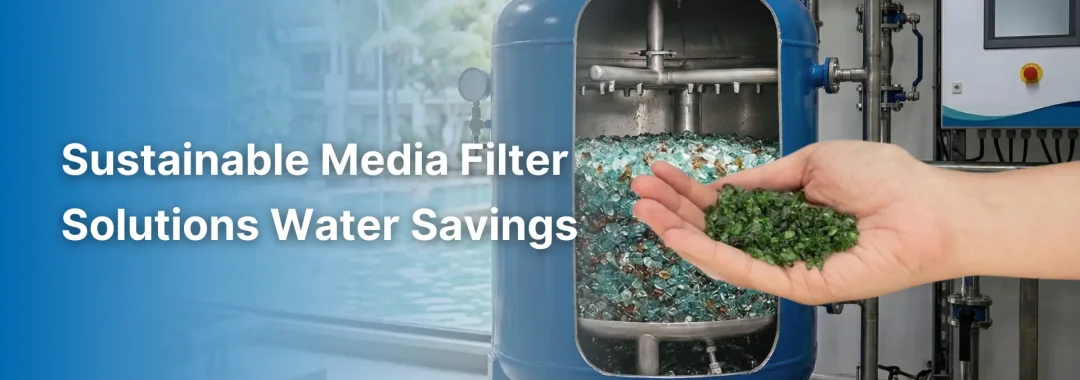
Furthermore, bio-fouling in sand filters creates trichloramines—the chemical responsible for the unpleasant “pool smell” and skin irritation. In contrast, implementing sustainable media filter solutions prevents the initial colonization of bacteria. By using upcycled, activated glass media, hotels eliminate the biological breeding ground found in sand. Specifically, this prevents the formation of “mud balls” in the filter bed, ensuring that every drop of water passes through a bioactive, efficient barrier.
High-Performance Protection: How Sustainable Media Filter Solutions Guard Your Assets
A filter should do more than just clean water; it must act as a high-performance shield for your most expensive equipment. In a luxury hotel, the chillers, boilers, and reverse osmosis units represent massive capital investments. When filtration fails, these assets suffer.
Optimizing RO Membrane Lifespan and Chiller Efficiency
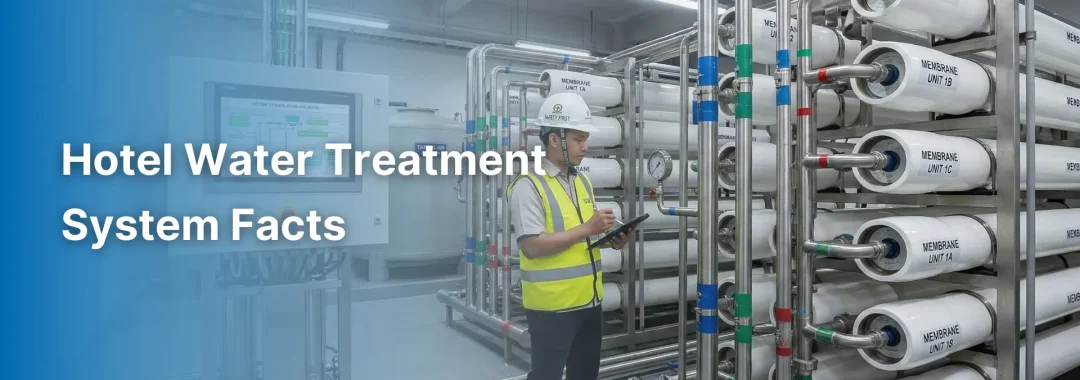
If your primary filtration allows fine particles or biological matter through, your Reverse Osmosis Membrane will foul prematurely. Consequently, you will face higher pressures and energy consumption. Moreover, ensuring optimal BWRO membrane performance requires consistent, high-purity feed water. By switching to sustainable media filter solutions, you provide a superior level of pre-filtration. This effectively prevents the scaling and organic fouling that lead to emergency repairs in boilers and chillers. Furthermore, understanding the keunggulan sistem air RO highlights how high-quality filtration acts as the foundation for energy-efficient utility management.
The Circular Hospitality Advantage: Saving Water and Chemicals
The financial impact of advanced filtration is immediate. Specifically, Activated Filter Media (AFM) requires up to 50% less water for backwashing compared to sand. Because the media is bio-resistant, it does not “stick” to contaminants as aggressively as sand does. Therefore, the backwash cycle is shorter and more effective. Additionally, hotels typically see a 30% reduction in chemical consumption. This is because the filter removes more organic precursors before they react with chlorine.
Achieving EarthCheck and Green Globe Certifications
For the modern hotel owner, ROI is not just about bills; it is about brand positioning. Many luxury travelers now prioritize properties with verified environmental credentials. Implementing sustainable media filter solutions contributes directly to points for EarthCheck or Green Globe certifications. By proving a reduction in water intensity and chemical usage, your facility secures a competitive edge in the global hospitality market.
Why Engineering Expertise Matters for Long-Term Reliability
Successful water management requires more than just high-quality media. It requires a partner who understands engineering, procurement, and long-term operations. PT. Gapura Liqua Solutions (GLS) provides end-to-end systems that allow clients to focus on their core business. We integrate seawater desalination and resource recovery into a seamless loop, ensuring that your facility never faces a water shortage or a compliance crisis. Our commitment to excellence is visible in our latest project updates on LinkedIn, where we showcase real-world water savings across Indonesia.
For hotels looking for immediate maintenance support, we offer high-performance filtration components through our official Tokopedia store. This ensures your facility manager has access to professional-grade tools for operational continuity.
Conclusion: Partnering for Operational Continuity with GLS
Ultimately, the choice of filter media determines the health of your entire water system. By adopting sustainable media filter solutions, you protect your physical assets, earn prestigious green certifications, and significantly reduce operational expenditure. PT. Gapura Liqua Solutions remains the ideal partner for the Indonesian hospitality sector, explicitly linking resource recovery with long-term reliability.
Ensure your hotel is not “washing money away” with outdated sand technology. Contact PT. Gapura Liqua Solutions today to audit your filtration system and implement a bioactive, circular water loop.
FAQ Section
Q: Can I replace my existing sand with a sustainable media filter without changing my tanks? A: Yes, in most cases. Sustainable media filter solutions like AFM are designed to fit into standard pressure vessels. You simply remove the sand and replace it with the upgraded media.
Q: How long does Activated Filter Media (AFM) last compared to sand? A: While sand usually needs replacing every 2-3 years due to bio-fouling and attrition, AFM is bio-resistant and much harder. Therefore, it can last for the entire lifespan of the filtration system without losing its efficiency.
Q: Does switching to AFM help with legionella prevention? A: Specifically, yes. Because sustainable media filters do not allow the formation of a biofilm, they significantly reduce the breeding ground for pathogens like Legionella in the filter bed.
Q: Is there an ROI for switching if our water costs are low? A: Absolutely. The ROI comes not just from water savings, but from reduced chemical costs and the extended lifespan of your RO membranes, boilers, and chillers.
Follow us on Social Media