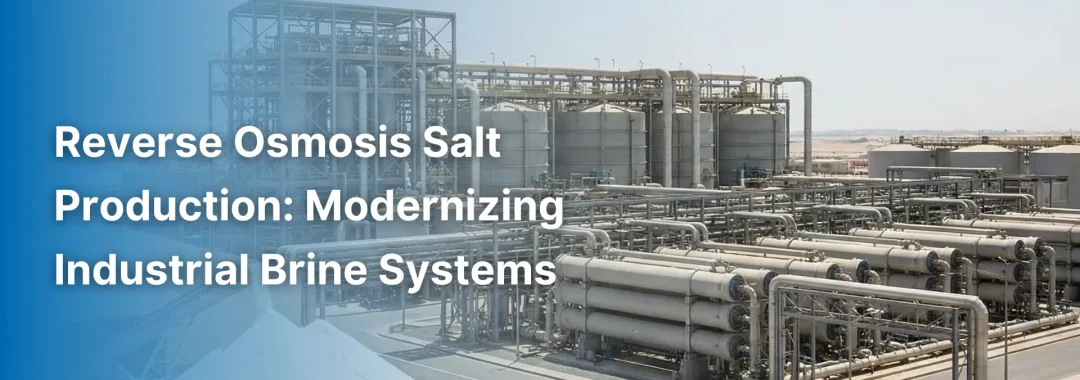
Reverse Osmosis Salt Production: Modernizing Industrial Brine Systems
For industrial salt manufacturers in Indonesia, the biggest barrier to profitability is the cost of energy. Traditionally, evaporating water from brine to crystallize salt requires massive amounts of heat. However, modern technology offers a more efficient path. Reverse osmosis salt production is rapidly becoming the industry standard for pre-concentrating brine, allowing facilities to remove water mechanically rather than thermally.
Consequently, adopting this technology is not merely an upgrade; it is a strategic necessity. Reverse osmosis salt production systems allow plants to boost capacity without significantly increasing their fuel consumption.
The Energy Challenge in Traditional Salt Manufacturing
Evaporating water by boiling it is expensive. Specifically, thermal crystallizers consume vast amounts of steam or gas. Furthermore, open evaporation ponds are slow and weather-dependent. These traditional methods limit production speed and keep operational costs high.
Reducing Reliance on Thermal Evaporation
Reverse osmosis salt production solves this by acting as a “pre-concentrator.” Instead of boiling weak brine, the RO system removes up to 50% of the water using high-pressure pumps. Therefore, only the highly concentrated brine enters the thermal stage. This drastically cuts the energy required per ton of salt produced.
How Reverse Osmosis Salt Production Works
The process is straightforward but requires precision engineering. Essentially, saline water is pushed through specialized membranes that separate fresh water from dissolved salts.
Mechanical Pre-Concentration Strategy Shutterstock
In a reverse osmosis salt production setup, hydraulic pressure overcomes osmotic pressure. First, raw seawater or brine feeds into the system. Then, fresh water passes through the membrane as “permeate,” leaving behind a concentrated brine stream. This process is far more energy-efficient than phase-change (boiling) methods.
Removing Impurities for Higher Purity
Moreover, this technology improves quality. Standard evaporation concentrates everything, including unwanted magnesium and sulfates. In contrast, specific Reverse Osmosis Membrane elements can be selected to reject specific ions. As a result, the final brine stream is not only more concentrated but also purer. For more on membrane capabilities, review our data on BWRO membrane performance.
Commercial Benefits for Indonesian Industry
Switching to membrane-based concentration offers multiple advantages. First, it lowers the carbon footprint of the facility. Second, the recovered fresh water can be reused for cooling towers or cleaning, reducing raw water intake. Finally, understanding the advantages of RO systems helps management justify the investment through rapid ROI.
Partnering with Gapura Liqua Solutions
Implementing a high-salinity system requires robust engineering to prevent corrosion and fouling. Therefore, PT. Gapura Liqua Solutions (GLS) provides end-to-end support. We design reverse osmosis salt production systems tailored to your specific brine chemistry.
We ensure long-term reliability with comprehensive maintenance plans and spare parts availability via our official Tokopedia store. In fact, you can see our engineering expertise in action on our LinkedIn project updates.
Conclusion
Ultimately, the future of salt manufacturing lies in hybrid systems. Integrating reverse osmosis salt production technology reduces energy waste and enhances product value.
Therefore, optimize your production line today. Contact PT. Gapura Liqua Solutions to discuss how we can engineer a more profitable brine concentration system for your business.
FAQ
Q: How much energy does reverse osmosis salt production save?
A: It varies, but replacing the initial thermal evaporation stage with RO can reduce energy consumption for that specific concentration step by up to 90%. Consequently, the overall plant energy bill drops significantly.
Q: Can RO concentrate brine to dry salt?
A: No. Reverse osmosis salt production is a pre-concentration step. It typically concentrates brine up to 70,000–100,000 ppm. You still need a thermal crystallizer or evaporation pond to turn that concentrated brine into solid salt.
Q: What about membrane scaling from calcium?
A: Scaling is a challenge. However, we mitigate this by using Nanofiltration (NF) as a pretreatment to remove hardness (calcium/magnesium) or by dosing specific anti-scalants, ensuring the RO membranes remain clean.
Q: Is the equipment expensive to maintain?
A: While membranes need periodic replacement (every 3-5 years), the operational cost savings from reduced fuel/steam consumption usually cover the maintenance costs many times over.
Follow us on Social Media


