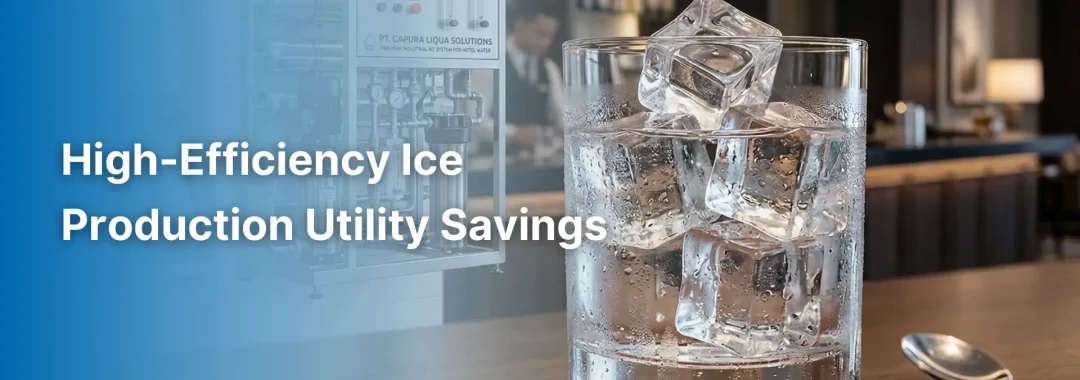
A close-up of crystal clear ice cubes produced by a machine utilizing high-efficiency ice production methods with RO water filtration.

High-Efficiency Ice Production Utility Savings

High-Efficiency Ice Production: Maximizing ROI Through Water Purity

In the luxury hospitality and commercial kitchen sectors, ice is more than just a frozen utility; it is a critical component of the guest experience. However, many facilities overlook the quality of the water entering their ice machines. Achieving high-efficiency ice production requires more than just a high-end machine. Specifically, it requires high-purity feed water that protects your equipment while optimizing physical freezing processes. Consequently, using untreated water leads to cloudy ice and skyrocketing maintenance costs. Therefore, savvy owners are turning to Reverse Osmosis (RO) to secure their bottom line.

Why Traditional Water Sources Kill Your Ice Machine

Tap water in many parts of Indonesia contains high concentrations of dissolved minerals like calcium and magnesium. These minerals do not simply disappear when water freezes. Instead, they remain in the machine, causing catastrophic mechanical issues.

The Hidden Cost of Scale and Mineral Deposits

When water turns into ice, minerals drop out of the solution and attach to the evaporator plates. This creates a rock-hard layer of scale. Consequently, this layer acts as an insulator, which forces the ice machine to work harder to reach freezing temperatures. Moreover, scale buildup is the primary cause of evaporator failure. Notably, replacing an evaporator can cost thousands of dollars, often representing a significant portion of the machine’s initial value. In contrast, preventative filtration stops these minerals before they enter the system.

Achieving High-Efficiency Ice Production with Reverse Osmosis

Integrating a Reverse Osmosis system is the most effective way to guarantee high-efficiency ice production. By removing up to 99% of dissolved solids, RO technology ensures that the freezing cycle is as pure and efficient as possible.

Shorter Freezing Cycles and Reduced Electricity Bills

Pure water behaves differently than mineral-heavy water. Specifically, impurities lower the freezing point of water, a phenomenon known as freezing-point depression. Because RO water is nearly free of solutes, it reaches a solid state more quickly. As a result, the ice machine completes its cycles faster. Shorter cycles directly translate to lower electricity bills, which significantly improves your long-term ROI. Furthermore, understanding the keunggulan sistem air RO is essential for any manager looking to optimize utility costs.

Crystal Clear Ice: Elevating the Premium Guest Experience

Cloudy ice is the result of trapped air and minerals. While it may seem like a minor aesthetic issue, it negatively impacts the guest experience. In contrast, RO water produces crystal-clear ice that melts slowly and does not alter the flavor of premium beverages. This clarity signals high standards of hygiene and luxury to your customers. Moreover, ensuring high BWRO membrane performance allows your facility to maintain this quality even when using brackish groundwater sources.

The Engineer’s Perspective: Zero Scale and Fewer Emergency Calls

From a maintenance standpoint, untreated water is a nightmare. Chief Engineers frequently deal with “ice machine down” emergency calls caused by clogged water lines or scale-jammed harvest cycles. Implementing an RO system serves as a robust preventative maintenance strategy. By eliminating the source of scale, you reduce the frequency of descaling procedures and emergency repairs. Consequently, your technical team can focus on other critical tasks rather than reactive maintenance. Using a high-quality Reverse Osmosis Membrane ensures that your machine receives the most consistent water quality possible.

Implementing a Total Water Solution for Hospitality Operations

PT. Gapura Liqua Solutions (GLS) provides end-to-end systems that allow your facility to operate without worrying about water availability or quality. We understand that your ice machine is a $10,000+ asset that needs protection. Therefore, we design systems that integrate seamlessly with your existing plumbing. Whether you are dealing with high-salinity seawater or local tap water, our EPC services provide a customized path to high-efficiency ice production. For those looking for immediate components, our official Tokopedia store offers the necessary parts to keep your systems running.

Conclusion: Protecting Your $10,000 Asset with GLS Expertise

Ultimately, the ROI of a water treatment system is found in what you save. By achieving high-efficiency ice production, you reduce electricity consumption, extend the life of your ice machine, and elevate your brand image. PT. Gapura Liqua Solutions remains the ideal partner for Indonesian hospitality, explicitly linking seawater desalination, resource recovery, and long-term reliability to your business success. You can see our commitment to engineering excellence through our latest project updates on LinkedIn.

Protect your utilities and your profits today. Contact PT. Gapura Liqua Solutions to audit your water quality and implement a solution that secures your facility’s operational continuity.

FAQ

Q: Does RO water really freeze faster than tap water? A: Yes. Because RO water is free from dissolved minerals, it has a higher freezing point than contaminated water. Consequently, the machine reaches the solid state more quickly, resulting in high-efficiency ice production.

Q: Will an RO system eliminate the need for descaling my ice machine? A: While it cannot remove 100% of minerals in all conditions, it removes up to 99%. This drastically reduces scale buildup, often extending the time between required descaling from months to years.

Q: Is the investment in an RO system worth it for a small ice machine? A: If the machine is critical to your guest experience and electricity costs are a concern, the ROI is usually achieved within 12–18 months through energy savings and avoided repair costs.

Q: Can GLS handle the installation in a remote resort location? A: Absolutely. PT. Gapura Liqua Solutions has a proven track record of implementing water solutions across the Indonesian archipelago, from North Jakarta to remote coastal resorts.

Follow us on Social Media

Facebook Gapura Liqua - high-efficiency ice production Instagram Gapura Liqua - high-efficiency ice production LinkedIn Gapura Liqua - high-efficiency ice production

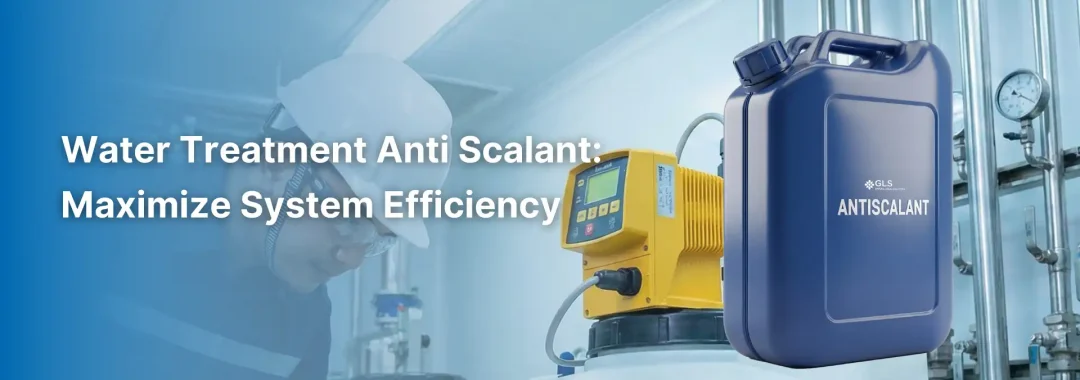
Industrial engineer inspecting a water treatment anti scalant dosing tank at a manufacturing plant.

Water Treatment Anti Scalant: Maximize System Efficiency

Water Treatment Anti Scalant: Maximizing Industrial Efficiency in Indonesia

For Facility Managers and Heads of Procurement across Indonesia, maintaining the longevity of industrial assets is a daily challenge. Whether operating cooling towers, boilers, or advanced desalination units, the threat of mineral deposition is constant. Implementing a robust water treatment anti scalant program is not merely a maintenance task; it is a strategic necessity to ensure operational continuity and cost control.

PT. Gapura Liqua Solutions (GLS) recognizes that in the competitive B2B landscape, unplanned downtime is unacceptable. This article explores how the correct chemical strategy protects your infrastructure and why choosing the right partner matters.

The Critical Role of Anti Scalant in Facility Management

Raw water sources in Indonesia often contain high levels of dissolved minerals, including calcium, magnesium, and silica. When water is heated in boilers or pressurized in Reverse Osmosis (RO) systems, these minerals precipitate out of the solution. Without a reliable water treatment anti scalant, these precipitates form hard scale deposits on heat transfer surfaces and membrane pores.

Understanding the Physics of Mineral Scaling

Scaling acts as an insulator. In boilers, even a thin layer of scale can drastically reduce heat transfer efficiency, forcing the system to burn more fuel to achieve the same output. In membrane systems, scale blocks the flow of water.

A high-performance water treatment anti scalant works by interfering with the crystal growth process. It utilizes mechanisms such as threshold inhibition to keep supersaturated salts dissolved in the water, allowing them to pass through the system without adhering to surfaces. This protection is vital for maintaining BWRO membrane performance over long operational periods.

The Financial Impact of Untreated Water

The cost of neglecting chemical treatment is two-fold:

  1. Energy Waste: Scaled systems require significantly more energy (electricity or fuel) to operate.
  2. Asset Depreciation: Heavy scaling can lead to overheating in boilers or irreversible fouling in membranes, necessitating expensive premature replacements.

By investing in a quality water treatment anti scalant, companies can convert unpredictable repair costs into manageable, planned operational expenses (OPEX).

Selecting the Right Water Treatment Anti Scalant

Not all chemicals are created equal. The effectiveness of a water treatment anti scalant depends heavily on the specific water chemistry of your site.

Tailoring Chemistry to Water Quality

A “one-size-fits-all” chemical often fails to address specific contaminants like silica or iron. For example, the Reverse Osmosis Membrane used in seawater desalination requires a different chemical profile than a low-pressure brackish water system.

GLS conducts thorough water analysis to recommend the precise formulation required. This ensures that the chemical acts effectively against the specific scaling potential of your feed water, aligning with the operational advantages of RO water systems designed by experts.

Dosing Precision and Monitoring

Applying the correct dosage is just as important as selecting the right chemical. Under-dosing leads to scaling, while over-dosing can be wasteful and cause bio-fouling issues. Modern dosing systems, supported by GLS technical teams, ensure that the water treatment anti scalant is injected at the optimal rate, maximizing protection while minimizing waste.

Why Procurement Leaders Partner with Gapura Liqua Solutions

In the industrial sector, supply chain reliability is paramount. PT. Gapura Liqua Solutions offers more than just products; we provide “Total Water Solutions.”

  • Technical Expertise: Our engineers understand the entire water cycle, from intake to discharge.
  • Availability: We ensure a steady supply of critical chemicals to prevent stock-outs. For quick procurement of standard components, you can also visit our Tokopedia store.
  • Trust: We are trusted by major industries to protect their critical utilities.

You can view our latest projects and technical updates on our LinkedIn Activity, demonstrating our commitment to excellence in the field.

Conclusion

The efficiency of your plant is directly tied to the quality of your water treatment program. A superior water treatment anti scalant is the guardian of your expensive machinery, preventing the silent accumulation of scale that drains profits and energy.

PT. Gapura Liqua Solutions is ready to audit your system and provide a tailored chemical strategy that guarantees results. Don’t wait for scale to stop your production.

Are you ready to secure your facility’s efficiency? Contact Us for a Consultation

FAQ Section

Q: Can water treatment anti scalant remove existing scale? A: Generally, anti scalants are designed to prevent new scale from forming. To remove existing hard scale, an acid cleaning or specialized descaling procedure (CIP) is usually required before restarting the preventative dosing program.

Q: Is water treatment anti scalant safe for all membrane types? A: Most modern formulations are compatible with standard composite membranes. However, it is crucial to verify compatibility with your specific membrane manufacturer (e.g., cellulose acetate vs. polyamide) to avoid damage. GLS experts can assist with this verification.

Q: How do I determine the correct dosage rate? A: Dosage is calculated based on water analysis (specifically hardness, alkalinity, and silica levels), pH, temperature, and system recovery rate. GLS uses specialized software to calculate the precise dosing required to prevent scaling without wastage.

Follow us on Social Media

Facebook Instagram LinkedIn