Securing Plant Utilities with Industrial Brackish Water Solutions
Industrial facility managers in Indonesia constantly battle the challenge of securing consistent, high-quality water supplies. Consequently, as coastal aquifers face seawater intrusion and inland groundwater sources degrade, raw water salinity is steadily increasing. Therefore, relying on standard filtration is no longer sufficient. Implementing advanced industrial brackish water solutions provides a decisive approach to overcoming these utility hurdles. Indeed, this technology separates dissolved salts efficiently, ensuring strict operational compliance while protecting vital plant infrastructure.
Furthermore, integrating advanced desalination is not merely a reactive measure. Instead, it serves as the foundational step toward sustainable resource recovery and long-term operational longevity.
The Problem with High Salinity Groundwater
Factories across the manufacturing, food, and petrochemical sectors require pristine water to operate properly. Therefore, managing brackish water streams effectively becomes a top priority for procurement and facility teams.
Scaling, Corrosion, and Equipment Failure
Brackish water contains moderate levels of dissolved salts, typically ranging between 1,000 and 10,000 parts per million (ppm) of Total Dissolved Solids (TDS). Because these minerals do not settle via gravity, they easily pass through conventional media filters. Subsequently, these hard minerals create severe scaling inside boilers, cooling towers, and heat exchangers.
Furthermore, high chloride concentrations accelerate pipeline corrosion. Thus, facilities face a high risk of catastrophic equipment failure and skyrocketing maintenance costs if these parameters remain unchecked.
How Industrial Brackish Water Solutions Provide the Answer
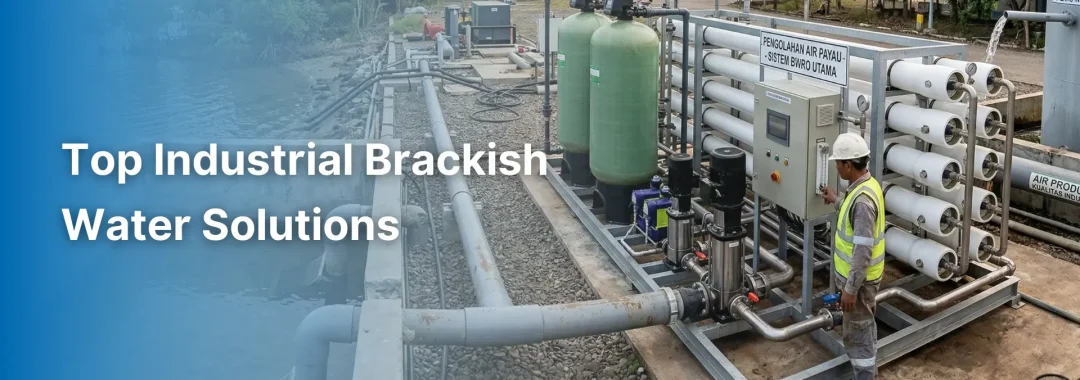
To resolve these contamination issues, engineers utilize membrane-based separation technologies. Specifically, highly engineered industrial brackish water solutions force pressurized water through microscopic barriers to remove dissolved impurities.
The Mechanics of Reverse Osmosis (RO)
The core technology driving these solutions is Reverse Osmosis (RO). First, high-pressure pumps push the saline feed water against a semi-permeable membrane. Next, the membrane allows pure water molecules to pass through while rejecting up to 99% of dissolved salts and organics.
Ultimately, this process produces a highly purified permeate stream ready for industrial use. To fully understand the operational benefits, you can explore the advantages of RO systems on our dedicated technical page.
Pre-Treatment and Membrane Protection
By removing heavy particulate loads early, comprehensive pre-treatment effectively protects downstream filtration assets. For instance, feeding correctly pre-treated water significantly enhances BWRO membrane performance. Additionally, utilizing properly specified Reverse Osmosis Membrane elements prevents premature fouling and ensures maximum lifecycle value. Should your facility require immediate consumable replacements, securing high-quality components is critical for maintaining flow rates.
Ensuring Long-Term Reliability and Efficiency
Environmental compliance and operational efficiency go hand in hand. Thus, utilizing robust industrial brackish water solutions helps facilities avoid sudden production halts. Moreover, integrating this separation technology promotes resource recovery. Facilities can safely recycle polished effluent or recover concentrated brines, drastically lowering daily water consumption and aligning with green industry standards.
Partnering with PT. Gapura Liqua Solutions
Sourcing reliable equipment and expert engineering remains a top priority for decision-makers. Therefore, PT. Gapura Liqua Solutions (GLS) offers comprehensive engineering, procurement, and construction (EPC) services. We tailor every installation to meet your specific water chemistry and production demands.
Additionally, we provide easy access to critical spare parts and consumables via our official Tokopedia store. Furthermore, you can view our successful, real-world implementations through our recent LinkedIn project updates, showcasing our deep commitment to engineering excellence.
Conclusion
Ultimately, establishing modern industrial brackish water solutions secures your facility’s operational future and process stability. PT. Gapura Liqua Solutions acts as your ideal expert partner in this critical journey. We explicitly link our expertise in seawater desalination (SWRO), advanced resource recovery, and long-term operations to guarantee your facility’s success. Therefore, do not leave your water supply to chance. Contact PT. Gapura Liqua Solutions today to discuss your next water treatment project and achieve total operational peace of mind.
FAQ
Q: What defines water as “brackish” in an industrial context? A: Brackish water possesses a salinity level between fresh water and seawater. Typically, it contains Total Dissolved Solids (TDS) ranging from 1,000 to 10,000 parts per million (ppm). Because it is highly corrosive and causes scaling, it requires specialized membrane treatment before industrial use.
Q: How do industrial brackish water solutions differ from seawater systems (SWRO)? A: While both utilize reverse osmosis, brackish water systems operate at significantly lower pressures because the incoming water has a lower osmotic pressure than seawater. Consequently, BWRO systems consume much less energy and utilize different membrane specifications compared to SWRO plants.
Q: Can a BWRO system help my facility achieve zero liquid discharge (ZLD)? A: Yes. Integrating a BWRO system is a highly effective step in resource recovery. By purifying and recycling wastewater or brackish sources, the system drastically reduces liquid waste volume, which represents a crucial phase in achieving full Zero Liquid Discharge (ZLD) objectives.
Q: Does GLS provide long-term maintenance for these treatment plants? A: Absolutely. PT. Gapura Liqua Solutions provides comprehensive Operations and Maintenance (O&M) contracts. Specifically, we handle everything from routine chemical dosing and membrane cleaning to full facility operation, ensuring your system runs optimally for decades.
Follow us on Social Media