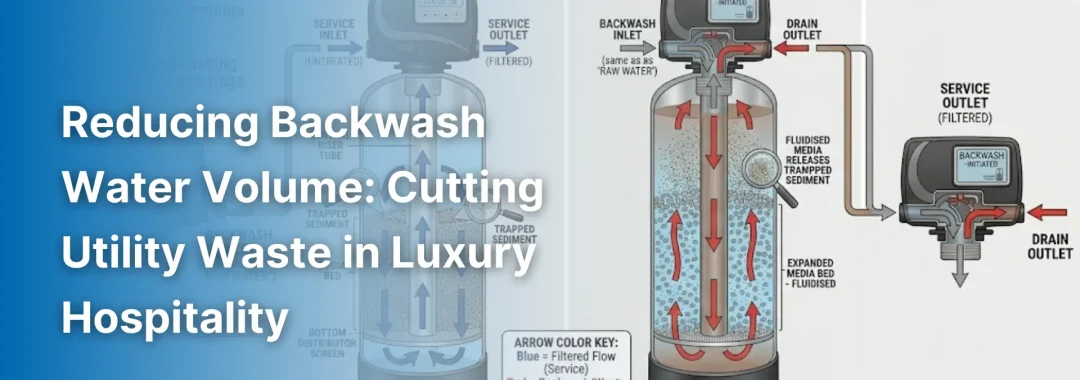
An industrial technician inspecting a high-efficiency AFM filtration tank designed for reducing backwash water volume in a luxury resort

Reducing Backwash Water Volume Guide

Reducing Backwash Water Volume: Cutting Utility Waste in Luxury Hospitality

For many luxury resorts and industrial facilities in Indonesia, water is often viewed as an unavoidable operational expense. However, facility managers frequently overlook the massive inefficiencies hidden within their filtration rooms. Traditional silica sand filters are essentially “leaking buckets” for hotel profits. Specifically, every time a technician initiates a cleaning cycle, the facility loses thousands of liters of treated, heated, and chemically dosed water. Therefore, focusing on reducing backwash water volume has become the single most effective strategy for optimizing utility expenditure (OPEX) and improving the facility’s bottom line.

By moving away from traditional mined sand and embracing advanced “Precision Water” technology, hotels can stop washing money away. Indeed, transitioning to a circular hospitality water loop is no longer just an environmental goal; it is a financial necessity.

The Hidden Cost of Sand: Why You are Washing Money Away

Standard silica sand filtration has a fundamental biological flaw. Within days of installation, bacteria colonize the sand grains and create a protective layer known as biofilm. This biofilm essentially glues the sand together, leading to a phenomenon called “channeling.”

The Biofilm and Channeling Dilemma

When channeling occurs, water finds the path of least resistance, bypassing the filter media entirely. Consequently, the filter loses its efficiency, and the system must backwash more frequently to compensate. This cycle results in excessive water waste. Furthermore, these bacteria react with chlorine to create trichloramines, which cause the unpleasant “pool smell” and skin irritation that lead to guest complaints. Achieving high standards in luxury hospitality requires a bioactive solution that addresses the root of this biological problem.

Reducing Backwash Water Volume with Activated Filter Media (AFM)

The most effective solution for modern facility managers is the implementation of Activated Filter Media (AFM). Unlike sand, AFM is an upcycled, activated glass media that is 100% bio-resistant. Because bacteria cannot grow on the surface of AFM, the media remains clean and free-flowing for years.

50% Less Water, 30% Fewer Chemicals

By preventing biofilm and channeling, AFM makes the filtration process significantly more efficient. Specifically, reducing backwash water volume by up to 50% is a standard outcome when switching from sand to AFM. Since the media does not stick to itself, the backwash process is shorter and requires a lower flow rate to be effective. Additionally, because the filter removes more organic precursors, facilities typically see a 30% reduction in chlorine and other chemical consumption. This dramatic reduction helps hotels secure prestigious certifications such as EarthCheck or Green Globe.

Beyond Savings: Protecting Your Downstream RO Assets

A filter is more than just a cleaning tool; it is a shield for your facility’s most expensive machinery. When primary filtration allows fine particles or biological matter to pass through, your downstream assets suffer. For instance, poor filtration is a leading cause of premature fouling in a Reverse Osmosis Membrane.

Maintaining superior BWRO membrane performance requires consistent, ultra-clean feed water. By successfully reducing backwash water volume and increasing filtration precision, you protect your chillers, boilers, and RO units from the scaling and organic load that cause emergency downtime. Understanding the keunggulan sistem air RO alongside precision media filtration ensures a high-yield investment for your property.

Partnering with Gapura Liqua Solutions for Long-Term Reliability

Successful utility management requires an expert partner who understands the total water cycle. PT. Gapura Liqua Solutions (GLS) provides end-to-end engineering, procurement, and long-term operations. We integrate seawater desalination and resource recovery into a seamless loop, ensuring your facility remains compliant and efficient. Our commitment to operational continuity is visible in our latest project updates on LinkedIn, where we demonstrate real-world utility savings for major Indonesian resorts.

For facilities looking for immediate maintenance support, we offer professional-grade filtration components through our official Tokopedia store. This ensures your technical team has the reliable parts needed to prevent utility loss.

Conclusion: Securing ROI and Operational Continuity

Ultimately, the goal of any facility manager is to achieve maximum reliability at the lowest possible cost. Reducing backwash water volume is the cornerstone of this objective. By adopting Activated Filter Media, you protect your physical assets, earn green certifications, and achieve a clear ROI within 18 to 24 months. PT. Gapura Liqua Solutions remains the ideal partner for the Indonesian hospitality and industrial sectors, explicitly linking resource recovery with long-term reliability.

Stop washing your facility’s profits away with outdated sand technology. Contact PT. Gapura Liqua Solutions today to audit your utility room and implement a bioactive, circular water strategy.

FAQ

Q: How does reducing backwash water volume improve my chiller’s efficiency? A: Precision filtration with AFM removes the fine particles that cause scale buildup in chillers and boilers. By keeping these heat-exchange surfaces clean, the equipment operates at peak efficiency, lowering your overall energy bill.

Q: Is Activated Filter Media (AFM) more expensive than sand? A: While the initial cost of AFM is higher than mined sand, the ROI is achieved rapidly. Specifically, the savings in water, electricity, and chemicals, along with the extended life of your RO membranes, typically cover the investment within 24 months.

Q: Can AFM be used in seawater desalination systems (SWRO)? A: Absolutely. Reducing backwash water volume in SWRO systems is critical because the intake water has already been treated and pressurized. AFM provides superior pre-filtration that protects expensive high-pressure pumps and membranes.

Q: Does GLS provide maintenance services for these systems? A: Yes. PT. Gapura Liqua Solutions offers Management Service Agreements to ensure that your filtration and desalination systems remain optimized for decades.

Follow us on Social Media

Facebook Instagram LinkedIn
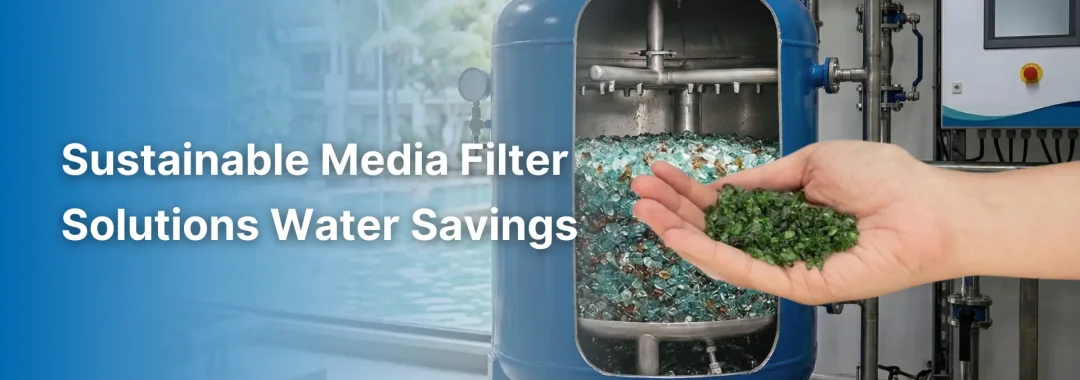
An industrial filter cross-section showcasing sustainable media filter solutions like AFM glass media used in luxury hotel water treatment.

Sustainable Media Filter Solutions Water Savings

Sustainable Media Filter Solutions: The Circular Water Loop for Luxury Hospitality

Most hotels are literally washing money down the drain during every backwash cycle. While silica sand has served as the industry standard for decades, it poses significant operational risks and hidden costs. For procurement heads and facility managers in Indonesia, the shift toward sustainable media filter solutions is no longer just an environmental preference; it is a financial necessity. Specifically, Activated Filter Media (AFM) technology allows resorts to transition toward a circular hospitality water loop. This transition simultaneously protects expensive utility assets and reduces the hotel’s environmental footprint.

Why Silica Sand Is Draining Your Resort’s Profits

Traditionally, hotels rely on mined silica sand for their filtration needs. However, sand filtration has a critical flaw: bio-fouling. Consequently, bacteria colonize the sand grains, secreting an alginate “glue” that binds particles together. This process leads to channeling, where water finds the path of least resistance without being filtered. Therefore, your system must backwash more frequently to maintain water quality. This frequency wastes thousands of liters of treated water and increases the chemical load required to keep pools and utilities sanitary.

The Hidden Operational Risks of Bio-Fouling and Channeling

Furthermore, bio-fouling in sand filters creates trichloramines—the chemical responsible for the unpleasant “pool smell” and skin irritation. In contrast, implementing sustainable media filter solutions prevents the initial colonization of bacteria. By using upcycled, activated glass media, hotels eliminate the biological breeding ground found in sand. Specifically, this prevents the formation of “mud balls” in the filter bed, ensuring that every drop of water passes through a bioactive, efficient barrier.

High-Performance Protection: How Sustainable Media Filter Solutions Guard Your Assets

A filter should do more than just clean water; it must act as a high-performance shield for your most expensive equipment. In a luxury hotel, the chillers, boilers, and reverse osmosis units represent massive capital investments. When filtration fails, these assets suffer.

Optimizing RO Membrane Lifespan and Chiller Efficiency

If your primary filtration allows fine particles or biological matter through, your Reverse Osmosis Membrane will foul prematurely. Consequently, you will face higher pressures and energy consumption. Moreover, ensuring optimal BWRO membrane performance requires consistent, high-purity feed water. By switching to sustainable media filter solutions, you provide a superior level of pre-filtration. This effectively prevents the scaling and organic fouling that lead to emergency repairs in boilers and chillers. Furthermore, understanding the keunggulan sistem air RO highlights how high-quality filtration acts as the foundation for energy-efficient utility management.

The Circular Hospitality Advantage: Saving Water and Chemicals

The financial impact of advanced filtration is immediate. Specifically, Activated Filter Media (AFM) requires up to 50% less water for backwashing compared to sand. Because the media is bio-resistant, it does not “stick” to contaminants as aggressively as sand does. Therefore, the backwash cycle is shorter and more effective. Additionally, hotels typically see a 30% reduction in chemical consumption. This is because the filter removes more organic precursors before they react with chlorine.

Achieving EarthCheck and Green Globe Certifications

For the modern hotel owner, ROI is not just about bills; it is about brand positioning. Many luxury travelers now prioritize properties with verified environmental credentials. Implementing sustainable media filter solutions contributes directly to points for EarthCheck or Green Globe certifications. By proving a reduction in water intensity and chemical usage, your facility secures a competitive edge in the global hospitality market.

Why Engineering Expertise Matters for Long-Term Reliability

Successful water management requires more than just high-quality media. It requires a partner who understands engineering, procurement, and long-term operations. PT. Gapura Liqua Solutions (GLS) provides end-to-end systems that allow clients to focus on their core business. We integrate seawater desalination and resource recovery into a seamless loop, ensuring that your facility never faces a water shortage or a compliance crisis. Our commitment to excellence is visible in our latest project updates on LinkedIn, where we showcase real-world water savings across Indonesia.

For hotels looking for immediate maintenance support, we offer high-performance filtration components through our official Tokopedia store. This ensures your facility manager has access to professional-grade tools for operational continuity.

Conclusion: Partnering for Operational Continuity with GLS

Ultimately, the choice of filter media determines the health of your entire water system. By adopting sustainable media filter solutions, you protect your physical assets, earn prestigious green certifications, and significantly reduce operational expenditure. PT. Gapura Liqua Solutions remains the ideal partner for the Indonesian hospitality sector, explicitly linking resource recovery with long-term reliability.

Ensure your hotel is not “washing money away” with outdated sand technology. Contact PT. Gapura Liqua Solutions today to audit your filtration system and implement a bioactive, circular water loop.

FAQ Section

Q: Can I replace my existing sand with a sustainable media filter without changing my tanks? A: Yes, in most cases. Sustainable media filter solutions like AFM are designed to fit into standard pressure vessels. You simply remove the sand and replace it with the upgraded media.

Q: How long does Activated Filter Media (AFM) last compared to sand? A: While sand usually needs replacing every 2-3 years due to bio-fouling and attrition, AFM is bio-resistant and much harder. Therefore, it can last for the entire lifespan of the filtration system without losing its efficiency.

Q: Does switching to AFM help with legionella prevention? A: Specifically, yes. Because sustainable media filters do not allow the formation of a biofilm, they significantly reduce the breeding ground for pathogens like Legionella in the filter bed.

Q: Is there an ROI for switching if our water costs are low? A: Absolutely. The ROI comes not just from water savings, but from reduced chemical costs and the extended lifespan of your RO membranes, boilers, and chillers.

Follow us on Social Media

Facebook Gapura Liqua - sustainable media filter solutions Instagram Gapura Liqua - sustainable media filter solutions LinkedIn Gapura Liqua - sustainable media filter solutions
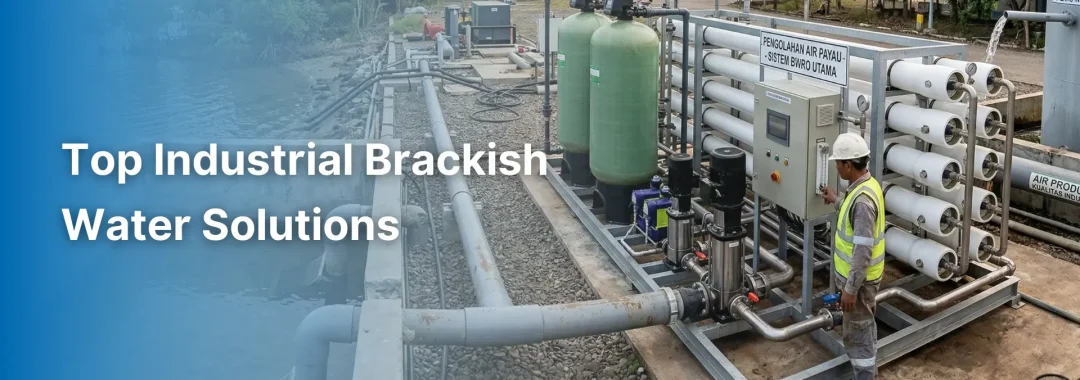
An industrial facility manager inspecting the pressure vessels of high-efficiency industrial brackish water solutions designed by Gapura Liqua Solutions.

Top Industrial Brackish Water Solutions

Securing Plant Utilities with Industrial Brackish Water Solutions

Industrial facility managers in Indonesia constantly battle the challenge of securing consistent, high-quality water supplies. Consequently, as coastal aquifers face seawater intrusion and inland groundwater sources degrade, raw water salinity is steadily increasing. Therefore, relying on standard filtration is no longer sufficient. Implementing advanced industrial brackish water solutions provides a decisive approach to overcoming these utility hurdles. Indeed, this technology separates dissolved salts efficiently, ensuring strict operational compliance while protecting vital plant infrastructure.

Furthermore, integrating advanced desalination is not merely a reactive measure. Instead, it serves as the foundational step toward sustainable resource recovery and long-term operational longevity.

The Problem with High Salinity Groundwater

Factories across the manufacturing, food, and petrochemical sectors require pristine water to operate properly. Therefore, managing brackish water streams effectively becomes a top priority for procurement and facility teams.

Scaling, Corrosion, and Equipment Failure

Brackish water contains moderate levels of dissolved salts, typically ranging between 1,000 and 10,000 parts per million (ppm) of Total Dissolved Solids (TDS). Because these minerals do not settle via gravity, they easily pass through conventional media filters. Subsequently, these hard minerals create severe scaling inside boilers, cooling towers, and heat exchangers.

Furthermore, high chloride concentrations accelerate pipeline corrosion. Thus, facilities face a high risk of catastrophic equipment failure and skyrocketing maintenance costs if these parameters remain unchecked.

How Industrial Brackish Water Solutions Provide the Answer

To resolve these contamination issues, engineers utilize membrane-based separation technologies. Specifically, highly engineered industrial brackish water solutions force pressurized water through microscopic barriers to remove dissolved impurities.

The Mechanics of Reverse Osmosis (RO)

The core technology driving these solutions is Reverse Osmosis (RO). First, high-pressure pumps push the saline feed water against a semi-permeable membrane. Next, the membrane allows pure water molecules to pass through while rejecting up to 99% of dissolved salts and organics.

Ultimately, this process produces a highly purified permeate stream ready for industrial use. To fully understand the operational benefits, you can explore the advantages of RO systems on our dedicated technical page.

Pre-Treatment and Membrane Protection

By removing heavy particulate loads early, comprehensive pre-treatment effectively protects downstream filtration assets. For instance, feeding correctly pre-treated water significantly enhances BWRO membrane performance. Additionally, utilizing properly specified Reverse Osmosis Membrane elements prevents premature fouling and ensures maximum lifecycle value. Should your facility require immediate consumable replacements, securing high-quality components is critical for maintaining flow rates.

Ensuring Long-Term Reliability and Efficiency

Environmental compliance and operational efficiency go hand in hand. Thus, utilizing robust industrial brackish water solutions helps facilities avoid sudden production halts. Moreover, integrating this separation technology promotes resource recovery. Facilities can safely recycle polished effluent or recover concentrated brines, drastically lowering daily water consumption and aligning with green industry standards.

Partnering with PT. Gapura Liqua Solutions

Sourcing reliable equipment and expert engineering remains a top priority for decision-makers. Therefore, PT. Gapura Liqua Solutions (GLS) offers comprehensive engineering, procurement, and construction (EPC) services. We tailor every installation to meet your specific water chemistry and production demands.

Additionally, we provide easy access to critical spare parts and consumables via our official Tokopedia store. Furthermore, you can view our successful, real-world implementations through our recent LinkedIn project updates, showcasing our deep commitment to engineering excellence.

Conclusion

Ultimately, establishing modern industrial brackish water solutions secures your facility’s operational future and process stability. PT. Gapura Liqua Solutions acts as your ideal expert partner in this critical journey. We explicitly link our expertise in seawater desalination (SWRO), advanced resource recovery, and long-term operations to guarantee your facility’s success. Therefore, do not leave your water supply to chance. Contact PT. Gapura Liqua Solutions today to discuss your next water treatment project and achieve total operational peace of mind.

FAQ

Q: What defines water as “brackish” in an industrial context? A: Brackish water possesses a salinity level between fresh water and seawater. Typically, it contains Total Dissolved Solids (TDS) ranging from 1,000 to 10,000 parts per million (ppm). Because it is highly corrosive and causes scaling, it requires specialized membrane treatment before industrial use.

Q: How do industrial brackish water solutions differ from seawater systems (SWRO)? A: While both utilize reverse osmosis, brackish water systems operate at significantly lower pressures because the incoming water has a lower osmotic pressure than seawater. Consequently, BWRO systems consume much less energy and utilize different membrane specifications compared to SWRO plants.

Q: Can a BWRO system help my facility achieve zero liquid discharge (ZLD)? A: Yes. Integrating a BWRO system is a highly effective step in resource recovery. By purifying and recycling wastewater or brackish sources, the system drastically reduces liquid waste volume, which represents a crucial phase in achieving full Zero Liquid Discharge (ZLD) objectives.

Q: Does GLS provide long-term maintenance for these treatment plants? A: Absolutely. PT. Gapura Liqua Solutions provides comprehensive Operations and Maintenance (O&M) contracts. Specifically, we handle everything from routine chemical dosing and membrane cleaning to full facility operation, ensuring your system runs optimally for decades.

Follow us on Social Media

Facebook Gapura Liqua - industrial brackish water solutions Instagram Gapura Liqua - industrial brackish water solutions LinkedIn Gapura Liqua - industrial brackish water solutions