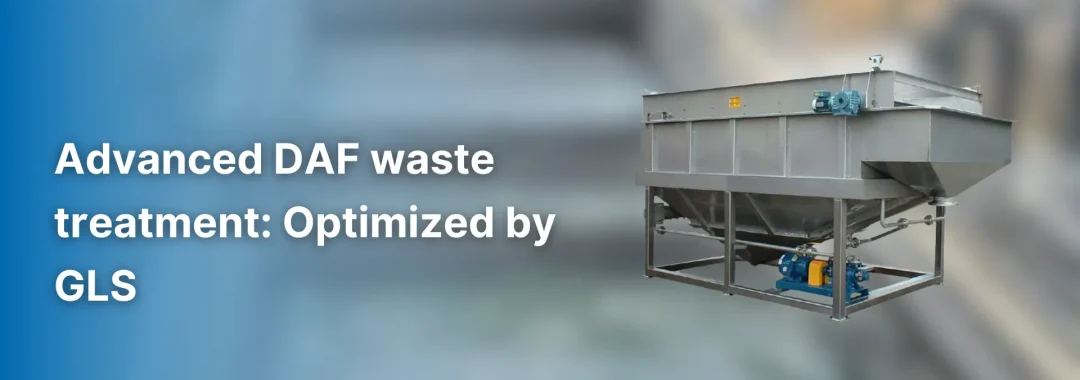
Advanced DAF waste treatment unit showing high-efficiency flotation for Indonesian industrial wastewater.

Advanced DAF waste treatment: Optimized by GLS

Enhancing Industrial Efficiency with Advanced DAF Waste Treatment

In the rapidly evolving industrial landscape of Indonesia, “business as usual” no longer applies to wastewater management. As environmental regulations tighten and water scarcity increases, procurement heads are prioritizing advanced DAF waste treatment to safeguard their operations. Dissolved Air Flotation (DAF) has evolved from a simple separation tool into a high-tech solution capable of handling the most challenging industrial effluents.

Navigating the Complexities of Wastewater Compliance

Facilities Managers in sectors such as petrochemicals and food production face a significant hurdle: removing non-settleable solids and emulsified oils. These contaminants often bypass traditional treatment stages, leading to non-compliance with Indonesian environmental standards. Therefore, relying on outdated infrastructure can result in both ecological damage and severe financial penalties.

Why Conventional Settling Often Falls Short

Traditional sedimentation relies on gravity. However, many industrial pollutants are buoyant or have a density similar to water, making gravity settling painstakingly slow and often ineffective. In contrast, advanced DAF waste treatment uses a pressurized air system to force these particles to the surface. Consequently, this method is significantly faster and requires a much smaller physical footprint than massive clarifiers.

Technical Superiority of Advanced DAF Waste Treatment

The “advanced” nature of modern DAF systems lies in the precision of micro-bubble generation and chemical dosing. By optimizing the coagulation and flocculation process before the water enters the flotation tank, the system ensures that even the smallest colloidal particles are captured. This results in water that is not just “treated” but is often suitable for internal recycling processes.

Synergizing Micro-bubble Technology with Resource Recovery

Beyond mere waste removal, advanced DAF waste treatment acts as a gateway to resource recovery. For many Indonesian industries, the sludge harvested from the DAF process can be repurposed or processed for energy. This shift from “waste disposal” to “resource management” is a hallmark of the total water solutions provided by PT. Gapura Liqua Solutions.

Protecting Your Assets: From DAF to Membrane Systems

A critical role of the DAF system is the protection of downstream technology. If your plant utilizes an industrial reverse osmosis membrane, the DAF unit serves as the primary shield against fouling. By ensuring a low Silt Density Index (SDI), the DAF process maintains optimal bwro membrane performance and extends the interval between expensive maintenance cycles.

Why PT. Gapura Liqua Solutions is Your Expert Partner

PT. Gapura Liqua Solutions (GLS) stands at the forefront of the water treatment industry in Indonesia. We provide end-to-end expertise, ensuring that your advanced DAF waste treatment system is not a standalone box, but a fully integrated component of your utility infrastructure. Our focus on keunggulan sistem air RO and long-term operational continuity makes us the partner of choice for procurement heads who value reliability over the lowest initial bid.

From specialized components available on Tokopedia to large-scale engineering, procurement, and operations (EPO), GLS delivers the technical depth required for modern industry.

Conclusion

Investing in advanced DAF waste treatment is more than a compliance move; it is a commitment to operational excellence and resource recovery. By choosing a system designed for high performance and low maintenance, you ensure the longevity of your facility and the quality of your output. PT. Gapura Liqua Solutions is ready to help you navigate these technical challenges with a partnership built on transparency and expertise. To secure your facility’s water future, contact us today for a technical consultation.

FAQ Section

  • What makes DAF “advanced”? It involves automated chemical dosing, precise micro-bubble control, and integrated monitoring systems that adapt to changing wastewater quality in real-time.
  • Does DAF reduce COD and BOD? Yes, by effectively removing organic solids and fats, it significantly reduces Chemical Oxygen Demand and Biological Oxygen Demand levels.
  • Can GLS retrofit an old settling tank with DAF? Absolutely. We specialize in upgrading existing infrastructure to modern advanced DAF waste treatment standards.

Follow us on Social Media

Facebook Instagram LinkedIn
Dissolved Air Flotation (DAF) system for industrial wastewater treatment removing oil, grease, and suspended solids

DAF System Wastewater Treatment: Remove Oil & Grease

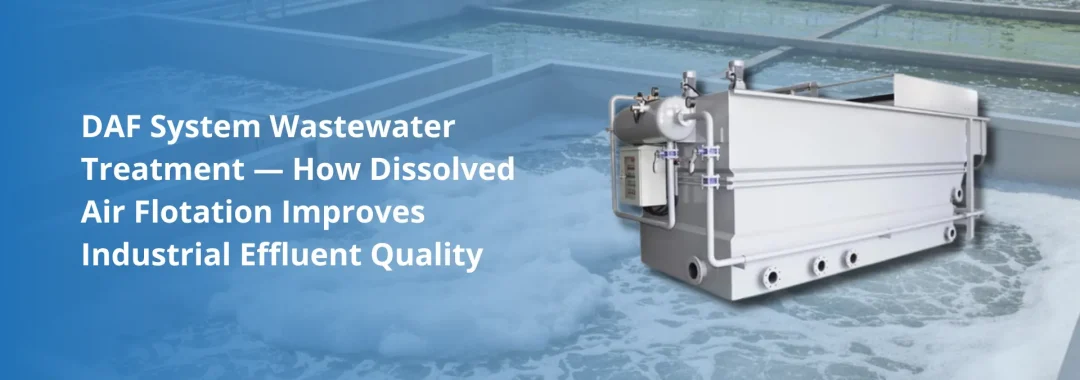
DAF System Wastewater Treatment — How Dissolved Air Flotation Improves Industrial Effluent Quality

The DAF system wastewater treatment (Dissolved Air Flotation) is a highly efficient clarification technology used to remove oil, grease (FOG), suspended solids (TSS), and colloidal materials from industrial wastewater. Its compact design and impressive removal efficiency make DAF one of the most widely used technologies across industries such as food processing, hotels, palm oil mills, fisheries, textile, and manufacturing.

Industries in Indonesia increasingly rely on DAF systems to meet strict discharge requirements and improve the effectiveness of downstream treatment processes.


What Is a DAF System in Wastewater Treatment?

DAF stands for Dissolved Air Flotation, a proven method in wastewater treatment that removes oil, grease, suspended solids (TSS), and fine particles from industrial effluent. Thanks to its compact design and strong removal results, DAF is one of the most widely used technologies in industries such as food processing, hotels, palm oil mills, fisheries, textiles, and manufacturing.

A DAF system works by injecting microbubbles into wastewater. These bubbles attach to suspended particles such as oil, grease, solids, and sludge. Consequently, the particles float to the surface, where a skimmer removes them easily.

DAF is especially effective in industries with high FOG content. In such cases, sedimentation alone is not enough.

This process also works together with chemicals, such as our Special Coagulant. These chemicals neutralize the charge on particles before flotation, which allows higher efficiency.

How the DAF System Wastewater Treatment Works

The DAF wastewater treatment process follows four main stages:

1. Coagulation & Flocculation

First, operators add coagulants and flocculants to the water. These chemicals bond small particles together into larger, floatable flocs.

2. Air Saturation

Next, the system pressurizes part of the treated water and dissolves it with air.

3. Microbubble Release & Flotation

Third, when the pressure releases in the DAF tank, microbubbles (30–50 microns) form. These microbubbles attach to pollutants and lift them to the surface.

4. Skimming

Finally, a mechanical skimmer removes the floating sludge, while clear water exits at the bottom.

After DAF, RO systems often provide the final polish. You can read more about this in our article on Reverse Osmosis Cleaning Agent.

Why Industries Prefer DAF for Wastewater Treatment

DAF removes up to 90–95% of oil, grease, and suspended solids. In fact, that is a much better result than sedimentation tanks can deliver.

In addition, DAF units need far less space, so they suit hotels, resorts, and industrial estates.

Moreover, removing solids early reduces the load on aeration systems and membranes.

Furthermore, DAF has minimal moving parts and uses chemicals efficiently, which lowers operational costs.

Even better, DAF stays effective when wastewater quality changes between production cycles.

Industries that benefit most from DAF include:

  • Food & beverage industries
  • Hotels and resorts dealing with kitchen and laundry effluent
  • Palm oil mills (POME pretreatment)
  • Seafood processing plants
  • Industrial parks & central WWTP facilities
  • Textile and dyeing industries

Each application uses DAF to remove contaminant loads quickly before filtration or biological processes.

To support DAF performance, GLS also offers complementary chemicals and filtration products. For example, explore our Liqua-Zen Z468 collection for scale control and system optimization.

References

Researchers around the world have studied technologies like Dissolved Air Flotation. Authoritative references include:

  • U.S. EPA guidance on Dissolved Air Flotation
  • Water Environment Federation on industrial wastewater treatment
  • WaterWorld magazine on DAF system applications

These sources discuss the principles, performance, and case studies of flotation systems across industries.

Conclusion

In summary, DAF is one of the most reliable and versatile technologies for industrial effluent treatment in Indonesia. It removes high concentrations of oil, grease, and solids, so it serves as a crucial pre-treatment step that improves overall plant performance.

With PT. Gapura Liqua Solutions (GLS), industries can implement tailored DAF systems. As a result, they gain compliance, lower operational costs, and stronger downstream processes.

Oil and grease: 90–99%; TSS: 80–95%; COD/BOD: 30–50% for the particulate fraction only. In contrast, soluble COD requires biological treatment after DAF.F systems that ensure compliance, lower operational costs, and enhance downstream processes.

Typical DAF removal efficiency for industrialwastewater?

Oil and grease: 90–99%; TSS: 80–95%; COD/BOD: 30–50% (particulate fraction only).Soluble COD needs biological treatment after DAF.

How to size a DAF unit for my flow rate?

Surface loading rate 10–20 m³/m²·h (conventional) or 30–50 m³/m²·h (high-rate withlamella). Recycle ratio 15–30% of feed. GLS provides a free sizing calculator.

Can DAF handle high-temperature wastewater(60–80 °C)?

Standard DAF is limited to 40 °C because air solubility drops. For hot streams useinduced air flotation or cool the feed first. GLS designs heat-exchanger plus DAFpackages.

What chemicals are dosed before DAF?

Coagulant (PAC/alum 20–100 ppm), flocculant (anionic polymer 0,5–2 ppm), and pHadjustment (6–8 optimum). Jar test is required; GLS includes it in the design package.

DAF vs API separator for oil & gas producedwater?

API relies on gravity with a large footprint and handles oil above 150 ppm. DAF usesmicro-bubbles, is 10× smaller, and removes emulsified oil at 50–150 ppm. GLS oftencombines API → DAF → polishing.