How a Sludge Dewatering Unit Works to Cut Industrial Costs
For industrial facility managers in Indonesia, wastewater treatment generates a massive byproduct: liquid sludge. Consequently, handling, transporting, and disposing of this heavy, water-logged waste creates a severe financial burden. Therefore, implementing advanced mechanical separation is not just an option; it is a critical necessity. Understanding exactly how a sludge dewatering unit works provides the foundation for optimizing your plant’s efficiency and achieving strict environmental compliance.
Furthermore, integrating advanced solid-liquid separation serves as a foundational step toward sustainable manufacturing. By converting liquid liabilities into manageable solids, businesses can protect their bottom line.
The Problem with High-Volume Liquid Waste
Factories across the manufacturing, food, and petrochemical sectors continuously generate heavy effluent. Often, standard clarifiers produce a sludge that contains up to 98% water. Therefore, managing this waste stream effectively becomes a top priority for procurement teams.
Environmental and Financial Impacts
Transporting liquid waste is incredibly expensive because companies essentially pay to move water. Moreover, environmental regulations in Indonesia heavily penalize improper disposal of wet sludge. High moisture content increases the risk of toxic leaching and foul odors. Subsequently, facilities face a high risk of regulatory failure and environmental penalties if these parameters remain unchecked. Thus, a proactive approach to volume reduction is mandatory.
Understanding How a Sludge Dewatering Unit Works
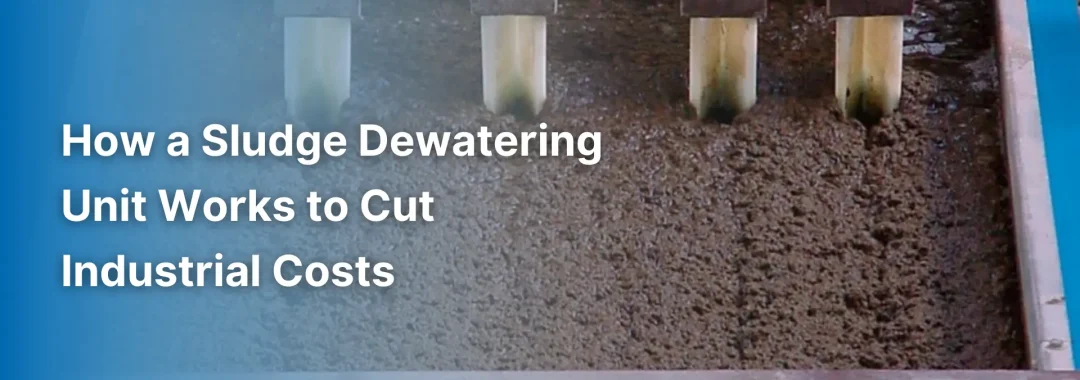
To resolve these logistical nightmares, engineers utilize mechanical dewatering. Specifically, a sludge dewatering unit works by applying force to separate the water from the solid particles, creating a dry “cake.”
The Role of Chemical Conditioning
The mechanics behind this process begin with chemistry. First, the system injects specialized polymers into the liquid sludge. Next, these chemicals cause the microscopic solid particles to clump together in a process called flocculation. Because these larger flocs release trapped water more easily, chemical conditioning is absolutely vital. Ultimately, when a sludge dewatering unit works efficiently, it relies heavily on this precise chemical pre-treatment to maximize water extraction.
Mechanical Separation Technologies
Following chemical dosing, the thickened sludge enters the mechanical phase. Several technologies exist, including filter presses, decanter centrifuges, and multi-disc screw presses. For instance, a filter press uses high-pressure hydraulic plates to squeeze the water out through porous cloths. Alternatively, a centrifuge spins the waste at high speeds, using centrifugal force to push the heavier solids outward. Regardless of the specific machinery, the sludge dewatering unit works to transform a watery mess into a stackable, solid cake, thereby reducing total waste volume by up to 80%. You can explore more about this topic in our comprehensive guide on Sludge Dewatering Equipment.
Integrating Dewatering with Advanced Water Systems
By extracting the water from the sludge, facilities can route the recovered liquid back to the head of the wastewater treatment plant. Consequently, this recovered water can undergo further polishing. For example, feeding cleaner recovered water significantly enhances BWRO membrane performance. Additionally, understanding the advantages of RO systems highlights the necessity of excellent pre-treatment. Should your facility require maintenance for these polishing stages, securing high-quality Reverse Osmosis Membrane elements is critical for maintaining consistent flow rates.
Partnering with PT. Gapura Liqua Solutions
Sourcing reliable equipment and expert engineering remains a top priority for decision-makers. Therefore, PT. Gapura Liqua Solutions (GLS) offers comprehensive engineering, procurement, and construction (EPC) services. We tailor every installation to meet your specific effluent chemistry.
Additionally, we provide easy access to critical spare parts and consumables via our official Tokopedia store. Furthermore, you can view our successful, real-world implementations through our recent LinkedIn project updates, which thoroughly showcase our commitment to engineering excellence.
Conclusion
Ultimately, establishing a modern solid-liquid separation system secures your facility’s operational future and environmental standing. Because a sludge dewatering unit works to drastically cut disposal costs, it delivers an exceptional return on investment. PT. Gapura Liqua Solutions acts as your ideal expert partner in this critical journey. We explicitly link our expertise in seawater desalination, advanced resource recovery, and long-term operations to guarantee your facility’s success. Therefore, contact PT. Gapura Liqua Solutions today to discuss your next water treatment project and achieve total operational peace of mind.
FAQ
Q: How much can a sludge dewatering unit reduce my waste volume? A: By extracting water from the liquid sludge, a mechanical dewatering unit can reduce the total volume of your waste by 70% to 80%. Consequently, this drastically lowers transportation and tipping fees at disposal sites.
Q: Does the dewatering process require chemicals? A: Yes. Most systems require the addition of polymer flocculants. Specifically, these chemicals bind the small solid particles together, allowing the mechanical press or centrifuge to squeeze out the water much more effectively.
Q: What happens to the water that is squeezed out of the sludge? A: The extracted water, known as filtrate or centrate, is highly concentrated with dissolved organics. Therefore, it is typically routed back to the front of your wastewater treatment plant for proper biological treatment and polishing.
Q: Can GLS integrate a dewatering system into an existing wastewater plant? A: Absolutely. PT. Gapura Liqua Solutions specializes in retrofitting and upgrading existing infrastructure. We can seamlessly integrate a filter press or screw press into your current flow path to solve specific compliance issues and optimize resource recovery.