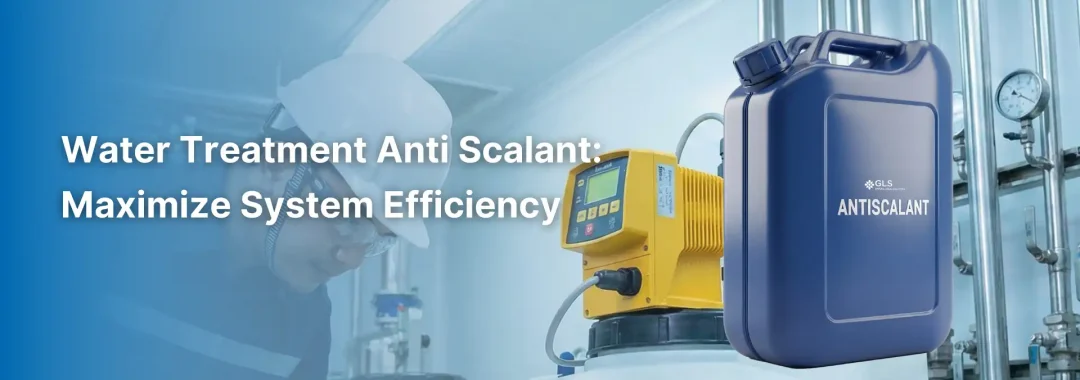
Industrial engineer inspecting a water treatment anti scalant dosing tank at a manufacturing plant.

Water Treatment Anti Scalant: Maximize System Efficiency

Water Treatment Anti Scalant: Maximizing Industrial Efficiency in Indonesia

For Facility Managers and Heads of Procurement across Indonesia, maintaining the longevity of industrial assets is a daily challenge. Whether operating cooling towers, boilers, or advanced desalination units, the threat of mineral deposition is constant. Implementing a robust water treatment anti scalant program is not merely a maintenance task; it is a strategic necessity to ensure operational continuity and cost control.

PT. Gapura Liqua Solutions (GLS) recognizes that in the competitive B2B landscape, unplanned downtime is unacceptable. This article explores how the correct chemical strategy protects your infrastructure and why choosing the right partner matters.

The Critical Role of Anti Scalant in Facility Management

Raw water sources in Indonesia often contain high levels of dissolved minerals, including calcium, magnesium, and silica. When water is heated in boilers or pressurized in Reverse Osmosis (RO) systems, these minerals precipitate out of the solution. Without a reliable water treatment anti scalant, these precipitates form hard scale deposits on heat transfer surfaces and membrane pores.

Understanding the Physics of Mineral Scaling

Scaling acts as an insulator. In boilers, even a thin layer of scale can drastically reduce heat transfer efficiency, forcing the system to burn more fuel to achieve the same output. In membrane systems, scale blocks the flow of water.

A high-performance water treatment anti scalant works by interfering with the crystal growth process. It utilizes mechanisms such as threshold inhibition to keep supersaturated salts dissolved in the water, allowing them to pass through the system without adhering to surfaces. This protection is vital for maintaining BWRO membrane performance over long operational periods.

The Financial Impact of Untreated Water

The cost of neglecting chemical treatment is two-fold:

  1. Energy Waste: Scaled systems require significantly more energy (electricity or fuel) to operate.
  2. Asset Depreciation: Heavy scaling can lead to overheating in boilers or irreversible fouling in membranes, necessitating expensive premature replacements.

By investing in a quality water treatment anti scalant, companies can convert unpredictable repair costs into manageable, planned operational expenses (OPEX).

Selecting the Right Water Treatment Anti Scalant

Not all chemicals are created equal. The effectiveness of a water treatment anti scalant depends heavily on the specific water chemistry of your site.

Tailoring Chemistry to Water Quality

A “one-size-fits-all” chemical often fails to address specific contaminants like silica or iron. For example, the Reverse Osmosis Membrane used in seawater desalination requires a different chemical profile than a low-pressure brackish water system.

GLS conducts thorough water analysis to recommend the precise formulation required. This ensures that the chemical acts effectively against the specific scaling potential of your feed water, aligning with the operational advantages of RO water systems designed by experts.

Dosing Precision and Monitoring

Applying the correct dosage is just as important as selecting the right chemical. Under-dosing leads to scaling, while over-dosing can be wasteful and cause bio-fouling issues. Modern dosing systems, supported by GLS technical teams, ensure that the water treatment anti scalant is injected at the optimal rate, maximizing protection while minimizing waste.

Why Procurement Leaders Partner with Gapura Liqua Solutions

In the industrial sector, supply chain reliability is paramount. PT. Gapura Liqua Solutions offers more than just products; we provide “Total Water Solutions.”

  • Technical Expertise: Our engineers understand the entire water cycle, from intake to discharge.
  • Availability: We ensure a steady supply of critical chemicals to prevent stock-outs. For quick procurement of standard components, you can also visit our Tokopedia store.
  • Trust: We are trusted by major industries to protect their critical utilities.

You can view our latest projects and technical updates on our LinkedIn Activity, demonstrating our commitment to excellence in the field.

Conclusion

The efficiency of your plant is directly tied to the quality of your water treatment program. A superior water treatment anti scalant is the guardian of your expensive machinery, preventing the silent accumulation of scale that drains profits and energy.

PT. Gapura Liqua Solutions is ready to audit your system and provide a tailored chemical strategy that guarantees results. Don’t wait for scale to stop your production.

Are you ready to secure your facility’s efficiency? Contact Us for a Consultation

FAQ Section

Q: Can water treatment anti scalant remove existing scale? A: Generally, anti scalants are designed to prevent new scale from forming. To remove existing hard scale, an acid cleaning or specialized descaling procedure (CIP) is usually required before restarting the preventative dosing program.

Q: Is water treatment anti scalant safe for all membrane types? A: Most modern formulations are compatible with standard composite membranes. However, it is crucial to verify compatibility with your specific membrane manufacturer (e.g., cellulose acetate vs. polyamide) to avoid damage. GLS experts can assist with this verification.

Q: How do I determine the correct dosage rate? A: Dosage is calculated based on water analysis (specifically hardness, alkalinity, and silica levels), pH, temperature, and system recovery rate. GLS uses specialized software to calculate the precise dosing required to prevent scaling without wastage.

Follow us on Social Media

Facebook Instagram LinkedIn
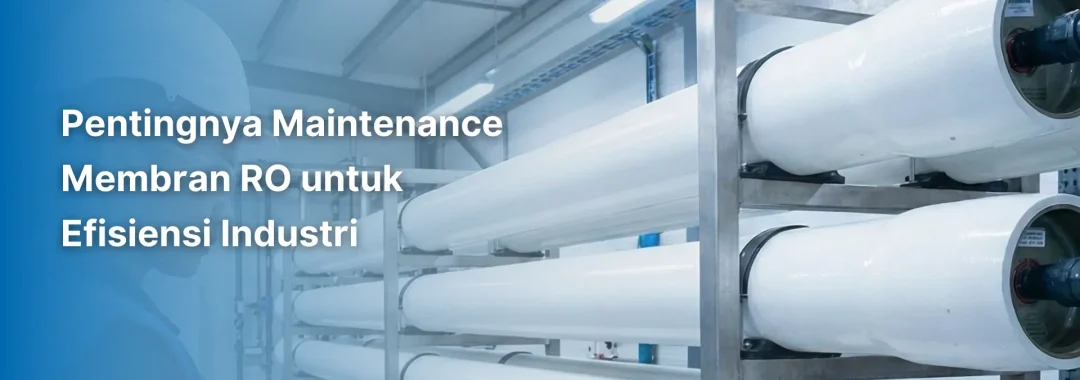
Teknisi industri melakukan maintenance membran RO dan pengecekan sistem desalinasi.

Pentingnya Maintenance Membran RO untuk Efisiensi Industri

Pentingnya Maintenance Membran RO untuk Keandalan Operasional Industri

Dalam ekosistem industri modern, air bukan sekadar utilitas pendukung, melainkan komponen kritis yang menentukan kelancaran produksi. Bagi perusahaan yang mengandalkan teknologi desalinasi atau pengolahan air payau, memahami pentingnya maintenance membran RO (Reverse Osmosis) adalah langkah strategis untuk mengamankan aset dan efisiensi biaya.

PT. Gapura Liqua Solutions (GLS) memahami bahwa tantangan utama bagi manajer fasilitas dan kepala pengadaan saat ini bukan hanya tentang membeli peralatan, tetapi memastikan peralatan tersebut beroperasi secara kontinyu tanpa gangguan. Artikel ini akan membahas secara mendalam risiko pengabaian perawatan dan solusi teknis untuk menjaga performa sistem air Anda.

Risiko Fatal Akibat Mengabaikan Perawatan Membran

Sistem RO bekerja dengan prinsip filtrasi tingkat tinggi yang sangat sensitif terhadap kotoran. Tanpa jadwal perawatan yang ketat, kinerja sistem akan menurun drastis dalam waktu singkat. Oleh karena itu, kesadaran akan pentingnya maintenance membran RO harus dimiliki oleh setiap tim operasional.

Ancaman Fouling dan Scaling pada Kualitas Air

Musuh utama dari membran RO adalah fouling (penumpukan materi organik/biologis) dan scaling (kerak mineral). Ketika kontaminan ini menutupi permukaan membran, pori-pori mikroskopis akan tersumbat. Akibatnya, kualitas air hasil olahan (permeate) akan menurun dan tidak memenuhi standar industri yang ketat.

Kondisi ini sering kali diperparah oleh fluktuasi kualitas air baku. Pemahaman mendalam mengenai BWRO membrane performance sangat diperlukan untuk mengidentifikasi gejala awal penurunan kinerja sebelum terjadi kerusakan permanen pada elemen membran.

Dampak Finansial: Lonjakan Energi dan Umur Aset Pendek

Mengabaikan perawatan tidak hanya berdampak pada kualitas air, tetapi juga pada neraca keuangan perusahaan. Membran yang kotor membutuhkan tekanan pompa yang jauh lebih tinggi untuk mendorong air melewatinya. Hal ini secara langsung menyebabkan lonjakan konsumsi listrik yang signifikan.

Selain itu, penggantian membran secara dini akibat kerusakan permanen memakan biaya investasi (CAPEX) yang besar. Padahal, dengan memahami pentingnya maintenance membran RO, umur pakai membran dapat diperpanjang hingga bertahun-tahun, mengubah biaya tak terduga menjadi pengeluaran operasional (OPEX) yang terencana dan efisien.

Strategi Pemeliharaan untuk Memaksimalkan Kinerja BWRO dan SWRO

Untuk menjaga keandalan sistem, pendekatan reaktif (memperbaiki saat rusak) harus ditinggalkan. Industri harus beralih ke pendekatan preventif dan prediktif.

Implementasi Cleaning-in-Place (CIP) yang Efektif

Salah satu metode perawatan utama adalah Cleaning-in-Place (CIP). Proses ini melibatkan sirkulasi bahan kimia pembersih khusus ke dalam sistem membran untuk melarutkan kerak dan kotoran tanpa perlu membongkar unit.

Keberhasilan CIP sangat bergantung pada ketepatan pemilihan bahan kimia, suhu, dan pH. Prosedur ini krusial untuk mengembalikan flux (laju alir) ke titik optimal. Anda dapat mempelajari lebih lanjut mengenai spesifikasi teknis komponen ini di halaman produk Reverse Osmosis Membrane kami.

Monitoring Rutin sebagai Langkah Preventif

Selain pembersihan fisik, pemantauan data operasional harian seperti tekanan, konduktivitas, dan laju alir adalah wajib. Data ini berfungsi sebagai indikator kesehatan sistem. Deteksi dini terhadap anomali tekanan (differential pressure) memungkinkan teknisi untuk mengambil tindakan korektif sebelum terjadi telescoping atau kerusakan fisik pada membran.

Pendekatan sistematis ini merupakan salah satu keunggulan sistem air RO yang dikelola dengan standar profesional, menjamin pasokan air yang stabil untuk kebutuhan pabrik.

Mengapa Memilih PT. Gapura Liqua Solutions sebagai Mitra Anda?

Memilih mitra untuk perawatan sistem air industri adalah keputusan jangka panjang. PT. Gapura Liqua Solutions (GLS) hadir bukan sekadar sebagai vendor, tetapi sebagai mitra ahli yang memberikan solusi end-to-end.

Kami mengintegrasikan teknologi desalinasi air laut (SWRO) dan pengolahan air payau dengan fokus pada keandalan jangka panjang. Berikut adalah alasan mengapa profesional industri mempercayakan sistem mereka kepada kami:

  1. Keahlian Teknis Mendalam: Tim kami terdiri dari insinyur berpengalaman yang memahami karakteristik air di Indonesia.
  2. Solusi Resource Recovery: Kami tidak hanya memurnikan air, tetapi juga membantu klien mengeksplorasi potensi pemulihan sumber daya dari limbah cair.
  3. Ketersediaan Suku Cadang: Kami menjamin ketersediaan komponen vital untuk meminimalkan downtime. Anda bahkan dapat mengecek ketersediaan komponen pendukung melalui kanal resmi kami di Tokopedia.

Komitmen kami terhadap inovasi dan layanan pelanggan juga tercermin dalam aktivitas proyek terbaru kami, yang dapat Anda lihat melalui pembaruan di LinkedIn Gapura Liqua Solutions. Kepercayaan klien adalah bukti nyata dedikasi kami.

Kesimpulan

Pada akhirnya, keberlanjutan operasional industri sangat bergantung pada keandalan utilitas pendukungnya. Menyadari pentingnya maintenance membran RO adalah langkah awal untuk mencegah kerugian besar di masa depan. Dengan perawatan yang tepat, Anda tidak hanya menghemat biaya energi dan penggantian suku cadang, tetapi juga memastikan lini produksi berjalan tanpa henti.

PT. Gapura Liqua Solutions siap membantu Anda merancang strategi perawatan yang komprehensif, mulai dari audit sistem, penyediaan bahan kimia, hingga kontrak servis berkala. Jangan biarkan masalah air menghambat target produksi Anda.

Apakah Anda siap meningkatkan efisiensi sistem water treatment Anda? Hubungi Kami untuk Konsultasi Gratis

FAQ Section

Q: Seberapa sering maintenance membran RO harus dilakukan? A: Frekuensi perawatan bergantung pada kualitas air baku. Namun, Cleaning-in-Place (CIP) umumnya disarankan ketika terjadi penurunan aliran (flux) sebesar 10-15% atau kenaikan tekanan operasional sebesar 10-15% dari kondisi awal.

Q: Apa tanda-tanda membran RO perlu segera diganti? A: Tanda utamanya adalah ketika proses pembersihan (CIP) tidak lagi mampu mengembalikan performa aliran atau kualitas air (rejection rate) ke standar yang diinginkan, atau terjadi kerusakan fisik pada membran.

Q: Apakah GLS menyediakan layanan kontrak servis untuk perawatan membran? A: Ya, PT. Gapura Liqua Solutions menyediakan layanan Operation & Maintenance (O&M) jangka panjang untuk memastikan sistem Anda dikelola oleh tenaga ahli, sehingga Anda bisa fokus pada bisnis inti.

Q: Mengapa biaya energi sistem RO saya meningkat tajam? A: Peningkatan biaya energi biasanya disebabkan oleh fouling atau scaling pada membran. Pompa harus bekerja lebih keras (tekanan lebih tinggi) untuk menembus membran yang tersumbat, sehingga konsumsi listrik meningkat.

Follow us on Social Media

Facebook Instagram LinkedIn
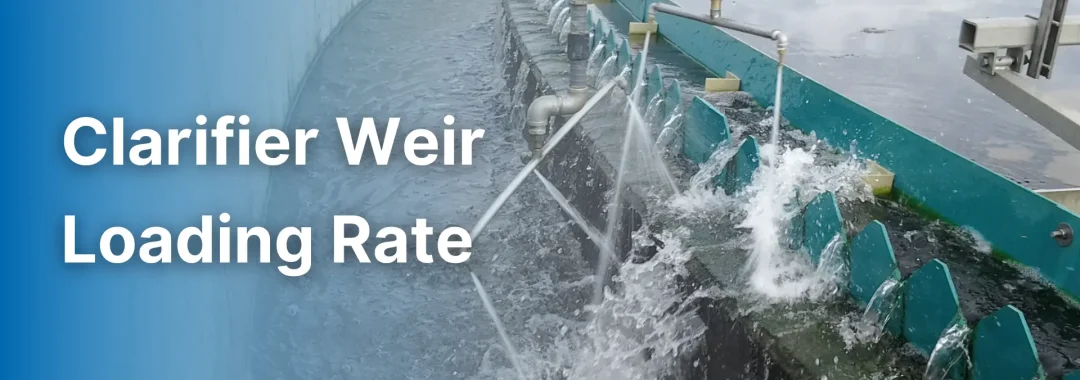
Industrial water technician inspecting the V-notch weir of a clarifier to ensure the clarifier weir loading rate is within optimal limits.

Clarifier Weir Loading Rate

Clarifier Weir Loading Rate: The Key to Sedimentation Success

In industrial water treatment, the primary clarifier is the workhorse that removes the bulk of suspended solids. However, facility managers often overlook a critical hydraulic parameter: the clarifier weir loading rate. This metric, which measures the volume of water flowing over a specific length of the weir per day, determines whether your system settles solids effectively or allows them to escape.

Ignoring the clarifier weir loading rate can lead to turbulent exit velocities. This turbulence pulls settled sludge back into the clean water stream, compromising the entire treatment chain.

Dangers of Exceeding the Design Weir Loading

When the clarifier weir loading rate is too high, the suction velocity at the outlet exceeds the settling velocity of the particles. Instead of sinking, light flocs are drawn out of the tank. This “carryover” results in high turbidity effluent that fails to meet design specifications.

Impact on Downstream Filtration Assets

The consequences of poor clarification cascade downstream. Excess solids rapidly clog media filters and foul cartridge filters. Ultimately, this load reaches the Reverse Osmosis Membrane. Particulate fouling significantly degrades BWRO membrane performance, necessitating frequent cleaning and shortening asset life.

For facilities managing sludge, efficient upstream separation is also vital for downstream processes like dewatering. You can learn more about this in our guide on sludge dewatering equipment.

Optimizing Clarifier Weir Loading Rate for Industry

Standard engineering practices typically recommend a clarifier weir loading rate between 120 and 370 m³/m·day for conventional settling tanks. Keeping the rate within this range ensures a laminar, gentle flow that allows gravity to do its work.

Importance of Weir Leveling and V-Notch Design

A common issue in Indonesian factories is uneven weirs due to ground settling or poor installation. If a weir is not level, flow concentrates in low spots, creating localized high-velocity zones that far exceed the design clarifier weir loading rate.

To mitigate this, V-notch weirs are the industry standard. They provide a predictable discharge profile and maintain uniform flow distribution around the tank perimeter, even if the tank level fluctuates slightly.

Retrofitting Strategies for Better Hydraulics

If your facility is struggling with carryover, you may not need a new tank. Often, correcting the clarifier weir loading rate can be achieved by installing Stamford baffles or extending the weir length using inboard launders.

Additionally, ensuring proper separation in the initial stages reduces the load on secondary systems. For industries handling heavy solids, reviewing applications like industrial decant tanks can provide insights into managing batch settling effectively.

Partnering with Gapura Liqua Solutions

Hydraulic design requires precision. PT. Gapura Liqua Solutions (GLS) offers expert engineering services to audit and optimize your weir loading rate. We analyze your current flow conditions and implement modifications to ensure peak performance.

From hydraulic troubleshooting to supplying essential components via our official Tokopedia store, GLS is your partner in water security. See our engineering teams in action via our project updates on LinkedIn.

Conclusion

Ultimately, clear water starts with calm hydraulics. Managing your weir loading rate is the most cost-effective way to prevent solids carryover and protect your expensive membranes.

Therefore, ensure your primary treatment is up to the task. Contact PT. Gapura Liqua Solutions today for a hydraulic assessment of your clarifier system.

FAQ

Q: How do you calculate clarifier weir loading rate? A: It is calculated by dividing the total daily flow (m³/day) by the total length of the overflow weir (meters). The formula is: Clarifier Weir Loading Rate = Q / L.

Q: What is the typical limit for weir loading? A: For most industrial settling tanks, we aim for a weir loading rate below 370 m³/m·day. If light flocs like alum or biological sludge are present, a lower rate (e.g., <250 m³/m·day) is recommended to prevent carryover.

Q: Can I increase the capacity of my clarifier without building a new one? A: Potentially. You can increase the effective weir length by installing “finger weirs” or serpentine weirs inside the tank. This reduces the weir loading rate per meter, allowing you to push more flow through the system without increasing exit velocity.

Q: Why is my weir flow uneven? A: Uneven flow usually means the weir plate is not level. Even a few millimeters of difference can cause water to rush to the low side, creating a high-velocity current that pulls sludge with it. Re-leveling the V-notch plates is the solution.

Follow us on Social Media

Facebook Gapura Liqua - clarifier weir loading rate Instagram Gapura Liqua - clarifier weir loading rate LinkedIn Gapura Liqua - clarifier weir loading rate
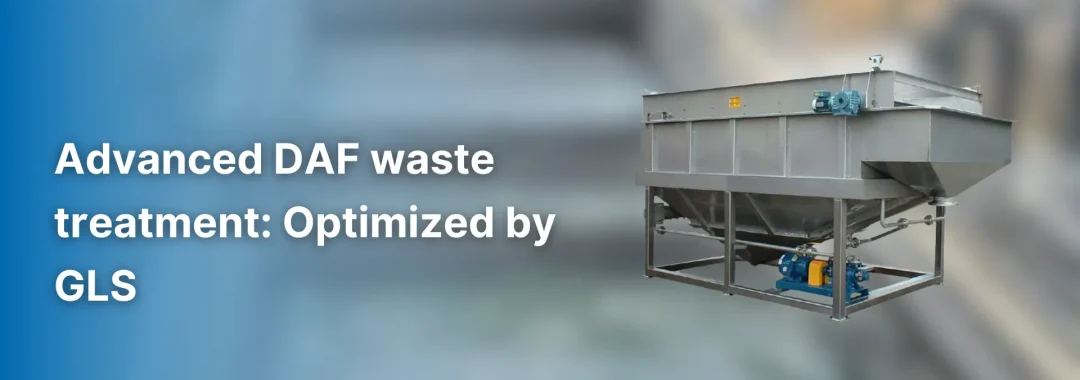
Advanced DAF waste treatment unit showing high-efficiency flotation for Indonesian industrial wastewater.

Advanced DAF waste treatment: Optimized by GLS

Enhancing Industrial Efficiency with Advanced DAF Waste Treatment

In the rapidly evolving industrial landscape of Indonesia, “business as usual” no longer applies to wastewater management. As environmental regulations tighten and water scarcity increases, procurement heads are prioritizing advanced DAF waste treatment to safeguard their operations. Dissolved Air Flotation (DAF) has evolved from a simple separation tool into a high-tech solution capable of handling the most challenging industrial effluents.

Navigating the Complexities of Wastewater Compliance

Facilities Managers in sectors such as petrochemicals and food production face a significant hurdle: removing non-settleable solids and emulsified oils. These contaminants often bypass traditional treatment stages, leading to non-compliance with Indonesian environmental standards. Therefore, relying on outdated infrastructure can result in both ecological damage and severe financial penalties.

Why Conventional Settling Often Falls Short

Traditional sedimentation relies on gravity. However, many industrial pollutants are buoyant or have a density similar to water, making gravity settling painstakingly slow and often ineffective. In contrast, advanced DAF waste treatment uses a pressurized air system to force these particles to the surface. Consequently, this method is significantly faster and requires a much smaller physical footprint than massive clarifiers.

Technical Superiority of Advanced DAF Waste Treatment

The “advanced” nature of modern DAF systems lies in the precision of micro-bubble generation and chemical dosing. By optimizing the coagulation and flocculation process before the water enters the flotation tank, the system ensures that even the smallest colloidal particles are captured. This results in water that is not just “treated” but is often suitable for internal recycling processes.

Synergizing Micro-bubble Technology with Resource Recovery

Beyond mere waste removal, advanced DAF waste treatment acts as a gateway to resource recovery. For many Indonesian industries, the sludge harvested from the DAF process can be repurposed or processed for energy. This shift from “waste disposal” to “resource management” is a hallmark of the total water solutions provided by PT. Gapura Liqua Solutions.

Protecting Your Assets: From DAF to Membrane Systems

A critical role of the DAF system is the protection of downstream technology. If your plant utilizes an industrial reverse osmosis membrane, the DAF unit serves as the primary shield against fouling. By ensuring a low Silt Density Index (SDI), the DAF process maintains optimal bwro membrane performance and extends the interval between expensive maintenance cycles.

Why PT. Gapura Liqua Solutions is Your Expert Partner

PT. Gapura Liqua Solutions (GLS) stands at the forefront of the water treatment industry in Indonesia. We provide end-to-end expertise, ensuring that your advanced DAF waste treatment system is not a standalone box, but a fully integrated component of your utility infrastructure. Our focus on keunggulan sistem air RO and long-term operational continuity makes us the partner of choice for procurement heads who value reliability over the lowest initial bid.

From specialized components available on Tokopedia to large-scale engineering, procurement, and operations (EPO), GLS delivers the technical depth required for modern industry.

Conclusion

Investing in advanced DAF waste treatment is more than a compliance move; it is a commitment to operational excellence and resource recovery. By choosing a system designed for high performance and low maintenance, you ensure the longevity of your facility and the quality of your output. PT. Gapura Liqua Solutions is ready to help you navigate these technical challenges with a partnership built on transparency and expertise. To secure your facility’s water future, contact us today for a technical consultation.

FAQ Section

  • What makes DAF “advanced”? It involves automated chemical dosing, precise micro-bubble control, and integrated monitoring systems that adapt to changing wastewater quality in real-time.
  • Does DAF reduce COD and BOD? Yes, by effectively removing organic solids and fats, it significantly reduces Chemical Oxygen Demand and Biological Oxygen Demand levels.
  • Can GLS retrofit an old settling tank with DAF? Absolutely. We specialize in upgrading existing infrastructure to modern advanced DAF waste treatment standards.

Follow us on Social Media

Facebook Instagram LinkedIn
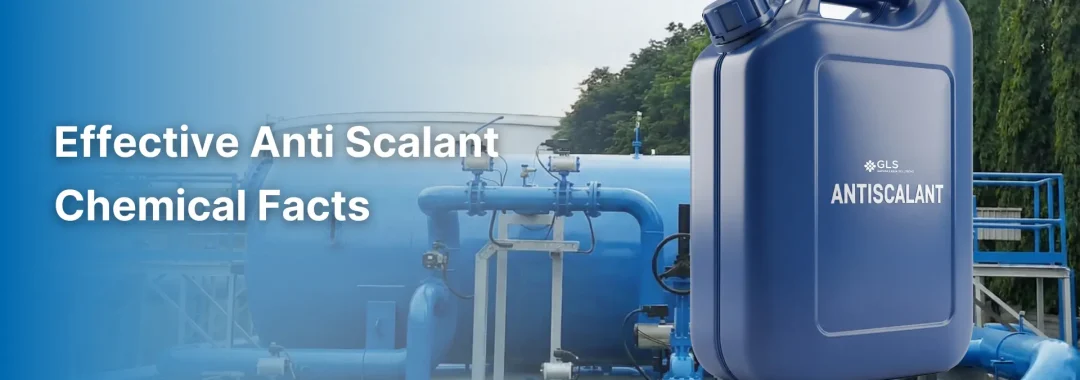
Industrial technician adjusting a chemical dosing pump to administer an effective anti scalant chemical into an RO system to prevent fouling.

Effective Anti Scalant Chemical Facts

Effective Anti Scalant Chemical: Effective Anti Scalant Chemical: Protecting Your Industrial Assets

For industrial facility managers in Indonesia, maintaining the efficiency of a Seawater Reverse Osmosis (SWRO) or Brackish Water Reverse Osmosis (BWRO) plant is a constant battle against chemistry. However, as the system extracts pure water, the remaining salts concentrate rapidly. Consequently, this leads to a high risk of mineral precipitation. To combat this issue, deploying an effective anti scalant chemical is not just an option; it is a necessity for operational continuity.

Moreover, without the correct chemical intervention, scale formation can irreversibly damage expensive membrane elements. As a result, this leads to skyrocketing operational costs and critical production downtime.

Understanding the Threat of Membrane Scaling

Scaling occurs when dissolved minerals in the feed water exceed their solubility limits. In industrial settings, specific compounds like calcium carbonate, calcium sulfate, or reactive silica often drive this process.

How Mineral Precipitation Occurs

First, high-pressure pumps force water through the membrane. Then, the concentration of salts on the feed surface increases significantly. Unless you intervene with an effective anti scalant chemical, these salts crystallize. Subsequently, they form a hard, rock-like layer on the membrane surface. This layer blocks the flow of water. Therefore, the pumps must work harder and consume more energy to maintain production rates.

Why an Effective Anti Scalant Chemical is Critical

Implementing a robust dosing strategy is the first line of defense. Specifically, the primary function of an effective anti scalant chemical involves interfering with crystal growth. This action keeps minerals dissolved even when they are supersaturated.

Reducing Energy Consumption and Cleaning Frequency

When membranes are clean, they operate at optimal pressure. Conversely, scale buildup causes a spike in differential pressure, which leads to higher electricity bills. Furthermore, frequent scaling necessitates frequent Chemical Cleaning (CIP). CIP procedures require downtime and aggressive chemicals that can degrade membrane life over time. Thus, a proper antiscalant strategy minimizes these interruptions.

Extending Membrane Lifespan

Membranes are significant capital assets. In addition to saving energy, preventing physical damage from sharp crystals extends their service life. Simultaneously, reducing the frequency of harsh cleanings protects the membrane surface. For more details on maintaining optimal performance, you can review our guide on BWRO membrane performance.

Selecting the Right Formulation

Antiscalant formulations vary significantly. Therefore, the deployment of an effective anti scalant chemical depends entirely on the specific water chemistry of your site.

  • For instance, high silica water requires specific dispersants to prevent silica polymerization.
  • On the other hand, high hardness water requires strong threshold inhibitors for calcium salts.

Using the wrong generic chemical can be as damaging as using none at all. Consequently, proper selection requires a detailed water analysis and projection software simulation.

Comprehensive Support from Gapura Liqua Solutions

At PT. Gapura Liqua Solutions (GLS), we understand that chemical dosing is part of a larger ecosystem. Hence, we provide end-to-end support, from water analysis to the supply of premium chemicals and the maintenance of dosing equipment.

We ensure that your strategy utilizes an effective anti scalant chemical perfectly aligned with your system’s design limits. For example, procurement managers looking for reliable supplies can access critical components via our official Tokopedia store. Additionally, understanding the advantages of RO systems can help in justifying the investment in high-quality pre-treatment.

We have successfully implemented these strategies across various industries, ensuring long-term reliability. In fact, you can see examples of our operational success in our recent project updates on LinkedIn.

Conclusion

Ultimately, the integrity of your water treatment plant relies on proactive protection. Using an effective anti scalant chemical program is the most cost-effective insurance policy against fouling and failure.

Therefore, do not let mineral scaling compromise your production targets. Partner with experts who understand the science of water. Contact PT. Gapura Liqua Solutions today for a chemical audit and ensure your assets are protected for the long haul.

FAQ

Q: What makes a chemical an “effective anti scalant”?
A: An effective anti scalant chemical must have high threshold inhibition capabilities, meaning it can prevent precipitation even at low dosages. It should also be compatible with your specific membrane type (polyamide or cellulose acetate) and effective against the specific mix of ions in your feed water.

Q: How do I know if I am using the right dosage?
A: Dosage is calculated based on feed water analysis (TDS, pH, temperature, ion concentration) and recovery rate. Under-dosing leads to scaling; over-dosing can cause biofouling. GLS engineers can calculate the precise ppm required for your system.

Q: Can anti scalant remove existing scale?
A: No. Even an effective anti scalant chemical is strictly preventative. To remove existing scale, you must perform a Clean-in-Place (CIP) using low pH (acid) cleaners for minerals or high pH (alkaline) cleaners for organics.

Follow us on Social Media

Facebook Gapura Liqua - effective anti scalant chemical Instagram Gapura Liqua - effective anti scalant chemical LinkedIn Gapura Liqua - effective anti scalant chemical
Large industrial manufacturing plant with smoke stacks, illustrating the operational scale that benefits from an Industrial Management Service Agreement by Gapura Liqua Solutions.

Industrial Management Service Agreement Value

Industrial Management Service Agreement: Securing Your Water Operations

For facility managers and procurement heads in Indonesia, the stability of utilities is non-negotiable. However, managing a complex Seawater Reverse Osmosis (SWRO) plant or a wastewater treatment facility in-house often becomes a distraction from core business activities. This is where an Industrial Management Service Agreement becomes a critical strategic asset.

Rather than struggling with fluctuating maintenance costs and technical staffing issues, forward-thinking companies are leveraging MSAs to ensure reliability. An Industrial Management Service Agreement is not just a contract; it is a partnership that guarantees water availability while optimizing operational expenses.

Understanding the Industrial Management Service Agreement

An Industrial Management Service Agreement (MSA) defines a long-term relationship between a facility owner and a specialized service provider. In the context of water treatment, this agreement transfers the responsibility for day-to-day operations, maintenance, and performance monitoring to experts.

Unlike simple ad-hoc repair services, an MSA focuses on comprehensive asset management. It encompasses everything from routine monitoring to complex troubleshooting, ensuring that the water treatment plant operates at peak efficiency. By adopting an Industrial Management Service Agreement, companies effectively shift the burden of operational risk to a partner equipped to handle it.

Why Implement an Industrial Management Service Agreement?

The decision to outsource operations through an MSA is often driven by the need for financial stability and risk mitigation.

Transforming Variable Costs into Fixed Costs

One of the most significant advantages of an Industrial Management Service Agreement is financial predictability. In-house management often faces unexpected spikes in costs due to emergency repairs, sudden spare part requirements, or inefficient chemical usage.

An MSA typically structures these costs into a fixed monthly fee. This allows procurement departments to forecast budgets accurately, eliminating unpleasant surprises at the end of the fiscal year. Furthermore, professional management often reduces energy and chemical consumption, lowering the overall Total Cost of Ownership (TCO).

Mitigating Technical and Compliance Risks

Water treatment standards in Indonesia are becoming increasingly stringent. Failure to meet effluent standards can result in severe penalties, including a downgrade in PROPER ratings. An Industrial Management Service Agreement includes strict Service Level Agreements (SLAs) regarding water quality.

This means the service provider is contractually obligated to deliver water that meets specific parameters. Consequently, the risk of non-compliance is shifted from the facility owner to the specialist partner, ensuring peace of mind regarding environmental regulations.

The Value of Specialized Expertise

Modern water treatment technologies, such as high-pressure SWRO and Ultrafiltration, require specialized knowledge. Maintaining a team of certified engineers in-house is both difficult and expensive.

Through an Industrial Management Service Agreement, your facility gains immediate access to a pool of experts. These professionals stay updated with the latest technologies, such as advanced Reverse Osmosis Membrane cleaning techniques and energy recovery optimization. This expertise ensures that your assets are not just running, but are being optimized to extend their lifespan.

Partnering with Gapura Liqua Solutions

PT. Gapura Liqua Solutions (GLS) understands that every facility has unique needs. We do not offer a one-size-fits-all solution. Instead, we tailor every Industrial Management Service Agreement to align with your specific operational goals and risk appetite.

From full comprehensive operations to supervision-only contracts, GLS provides the technical backbone your business needs. We manage the supply chain for critical consumables and spare parts, many of which are readily available through our official store on Tokopedia, ensuring minimal downtime.

Conclusion

In a competitive industrial landscape, operational reliability is the foundation of success. An Industrial Management Service Agreement offers the most effective path to securing your water supply, controlling costs, and managing risks.

Do not let water utility challenges hinder your production targets. Partner with a trusted expert who prioritizes your operational continuity. Contact PT. Gapura Liqua Solutions today to discuss how we can structure an MSA that drives value for your business.

FAQ

Q: What is the primary difference between a warranty and an MSA?

A: A warranty covers equipment defects for a limited time. In contrast, an Industrial Management Service Agreement covers the ongoing performance, labor, and maintenance of the entire system, ensuring it operates correctly throughout the contract duration.

Q: Can an MSA help with environmental compliance in Indonesia?

A: Yes. A robust MSA includes performance guarantees that align with Indonesian environmental regulations (such as PROPER). The service provider assumes the responsibility for maintaining effluent quality within legal limits.

Q: Does GLS provide spare parts under the MSA?

A: This depends on the specific contract structure. We offer comprehensive MSAs that include all spare parts and chemicals, as well as “labor-plus-supervision” models where parts are billed separately.

Q: Is an MSA suitable for older water treatment plants?

A: Absolutely. In fact, older plants often benefit most from an Industrial Management Service Agreement. Our experts can optimize aging assets, perform necessary retrofits, and extend the remaining useful life of the equipment.

Two engineers in safety gear reviewing a clipboard in front of a water treatment plant, symbolizing the reliability of an Industrial Management Service Agreement.

Secure your operations and transfer risk. An Industrial Management Service Agreement ensures your water systems are managed by experts, allowing you to focus on production.

Follow us on Social Media

Facebook Instagram LinkedIn
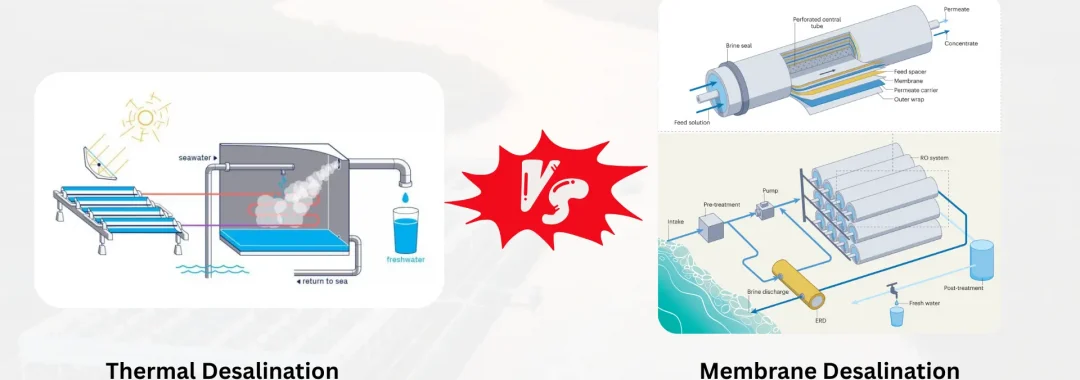
Comparison diagram of thermal vs membrane desalination showing evaporation and condensation process versus reverse osmosis filtration system.

Thermal vs Membrane Desalination for Industries

Introduction — Why Thermal vs Membrane Desalination Matters

Global industries — from hospitality to power generation — rely on desalination systems to secure sustainable water resources. Among the most widely used technologies are thermal vs membrane desalination, two core processes that define how saltwater is transformed into freshwater for industrial use. As demand grows, choosing the right desalination system becomes crucial for efficiency, cost, and sustainability.

In simple terms, desalinasi adalah proses menghilangkan kadar garam dari air laut atau air payau agar menjadi air bersih yang dapat digunakan untuk berbagai kebutuhan industri.

👉 Learn the fundamentals of desalination from ScienceDirect Topics.


Understanding Thermal Desalination Systems

Thermal desalination, one of the two main approaches in thermal vs membrane desalination, uses heat to evaporate seawater, then condenses the vapor into fresh water — leaving salt and minerals behind. It’s a time-tested process, often applied in large-scale plants that can also recover waste heat from power generation.

Main Types of Thermal Desalination

  • Multi-Stage Flash (MSF)
  • Multi-Effect Distillation (MED)
  • Vapor Compression (VC)

Thermal systems are reliable and handle high-salinity feed water, making them ideal for coastal power plants and heavy industries. However, they are energy-intensive and require significant capital investment.

📖 Learn more about phase-change desalination technologies in this MDPI review on thermal desalination.

Internal link: For a broader explanation of proses desalinasi air laut, visit Proses Desalinasi Air Laut.


Understanding Membrane Desalination Systems

Membrane desalination is a pressure-driven process that pushes water through a semi-permeable membrane, separating dissolved salts and impurities. The most common form, Reverse Osmosis (RO), dominates today’s desalination market due to its scalability and energy efficiency.

Types of Membrane Desalination

  • Reverse Osmosis (RO)
  • Electrodialysis (ED)
  • Forward Osmosis (FO)
  • Capacitive Deionization (CDI)

Membrane systems are compact, energy-efficient, and modular — perfect for food & beverage, hospitality, and manufacturing industries. They require effective pre-treatment and anti-scaling control to prevent fouling.

💧 Learn more in this MDPI study on membrane-based desalination systems.

Internal links:


Key Differences in Thermal vs Membrane Desalination

CriteriaThermal DesalinationMembrane Desalination
Core ProcessEvaporation & condensationFiltration through membranes
Energy SourceHeat / SteamElectricity / Pressure
Cost per m³HigherModerate to Low
Water TypeHigh-salinity seawaterBrackish & lower salinity
MaintenanceModerateHigher (membrane fouling)
Ideal IndustriesPower, Oil & GasHospitality, F&B, Manufacturing

📘 For advanced comparisons, read Elsevier’s study on hybrid desalination systems.

Internal link opportunity:
See Sistem Desalinasi RO for RO-based system examples used in membrane desalination.


Hybrid Desalination Systems: Combining Thermal and Membrane Technologies

Hybrid desalination integrates membrane (RO) and thermal (MED/MSF) technologies to improve efficiency and reduce waste. These systems:

  • Optimize energy consumption using waste heat
  • Improve water recovery rates
  • Minimize brine disposal volumes

🔗 Explore how industries reuse waste heat for thermal desalination on SciELO.

Internal link idea: Showcase a real-world case by linking to GLS Completes Desalination Project.


Environmental & Economic Impact of Desalination Types

Thermal systems consume more energy but can utilize residual heat from industrial operations, reducing total emissions. Membrane systems, while energy-efficient, must manage chemical usage and brine disposal.

🧪 For an in-depth environmental comparison, explore the MDPI report on advances in desalination methods.
🌍 For sustainable development insights, visit the UNESCO Water Portal.


Which Desalination Type Is Right for Your Industry?

IndustryRecommended SystemReason
Power & EnergyThermal / HybridUses waste heat efficiently
Hospitality & ResortsMembraneCompact, low-energy systems
Food & BeverageMembraneHigh purity, consistent output
Oil & GasThermalHandles high-salinity feed
Municipal SupplyHybridBalances efficiency and cost

💡 The right thermal vs membrane desalination choice depends on salinity, energy source, and budget. For a tailored solution, contact PT Gapura Liqua Solutions, Indonesia’s trusted partner for complete water treatment and desalination systems.


Conclusion — Choosing Between Thermal and Membrane Desalination

Both thermal and membrane desalination play essential roles in modern water management.

  • Choose thermal for high-salinity, large-scale, or power-linked operations.
  • Choose membrane for energy-efficient, modular, and scalable applications.

By understanding thermal vs membrane desalination, industries can make smarter, sustainable decisions.

With years of expertise in water treatment engineering, Gapura Liqua Solutions delivers end-to-end solutions for both technologies — helping businesses achieve reliable, efficient, and environmentally responsible water supply systems.

Follow us on Social Media

Facebook Instagram LinkedIn