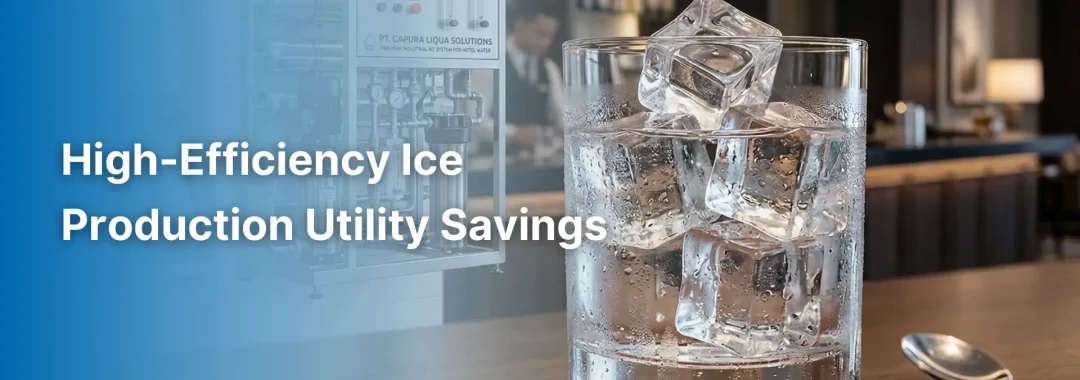
A close-up of crystal clear ice cubes produced by a machine utilizing high-efficiency ice production methods with RO water filtration.

High-Efficiency Ice Production Utility Savings

High-Efficiency Ice Production: Maximizing ROI Through Water Purity

In the luxury hospitality and commercial kitchen sectors, ice is more than just a frozen utility; it is a critical component of the guest experience. However, many facilities overlook the quality of the water entering their ice machines. Achieving high-efficiency ice production requires more than just a high-end machine. Specifically, it requires high-purity feed water that protects your equipment while optimizing physical freezing processes. Consequently, using untreated water leads to cloudy ice and skyrocketing maintenance costs. Therefore, savvy owners are turning to Reverse Osmosis (RO) to secure their bottom line.

Why Traditional Water Sources Kill Your Ice Machine

Tap water in many parts of Indonesia contains high concentrations of dissolved minerals like calcium and magnesium. These minerals do not simply disappear when water freezes. Instead, they remain in the machine, causing catastrophic mechanical issues.

The Hidden Cost of Scale and Mineral Deposits

When water turns into ice, minerals drop out of the solution and attach to the evaporator plates. This creates a rock-hard layer of scale. Consequently, this layer acts as an insulator, which forces the ice machine to work harder to reach freezing temperatures. Moreover, scale buildup is the primary cause of evaporator failure. Notably, replacing an evaporator can cost thousands of dollars, often representing a significant portion of the machine’s initial value. In contrast, preventative filtration stops these minerals before they enter the system.

Achieving High-Efficiency Ice Production with Reverse Osmosis

Integrating a Reverse Osmosis system is the most effective way to guarantee high-efficiency ice production. By removing up to 99% of dissolved solids, RO technology ensures that the freezing cycle is as pure and efficient as possible.

Shorter Freezing Cycles and Reduced Electricity Bills

Pure water behaves differently than mineral-heavy water. Specifically, impurities lower the freezing point of water, a phenomenon known as freezing-point depression. Because RO water is nearly free of solutes, it reaches a solid state more quickly. As a result, the ice machine completes its cycles faster. Shorter cycles directly translate to lower electricity bills, which significantly improves your long-term ROI. Furthermore, understanding the keunggulan sistem air RO is essential for any manager looking to optimize utility costs.

Crystal Clear Ice: Elevating the Premium Guest Experience

Cloudy ice is the result of trapped air and minerals. While it may seem like a minor aesthetic issue, it negatively impacts the guest experience. In contrast, RO water produces crystal-clear ice that melts slowly and does not alter the flavor of premium beverages. This clarity signals high standards of hygiene and luxury to your customers. Moreover, ensuring high BWRO membrane performance allows your facility to maintain this quality even when using brackish groundwater sources.

The Engineer’s Perspective: Zero Scale and Fewer Emergency Calls

From a maintenance standpoint, untreated water is a nightmare. Chief Engineers frequently deal with “ice machine down” emergency calls caused by clogged water lines or scale-jammed harvest cycles. Implementing an RO system serves as a robust preventative maintenance strategy. By eliminating the source of scale, you reduce the frequency of descaling procedures and emergency repairs. Consequently, your technical team can focus on other critical tasks rather than reactive maintenance. Using a high-quality Reverse Osmosis Membrane ensures that your machine receives the most consistent water quality possible.

Implementing a Total Water Solution for Hospitality Operations

PT. Gapura Liqua Solutions (GLS) provides end-to-end systems that allow your facility to operate without worrying about water availability or quality. We understand that your ice machine is a $10,000+ asset that needs protection. Therefore, we design systems that integrate seamlessly with your existing plumbing. Whether you are dealing with high-salinity seawater or local tap water, our EPC services provide a customized path to high-efficiency ice production. For those looking for immediate components, our official Tokopedia store offers the necessary parts to keep your systems running.

Conclusion: Protecting Your $10,000 Asset with GLS Expertise

Ultimately, the ROI of a water treatment system is found in what you save. By achieving high-efficiency ice production, you reduce electricity consumption, extend the life of your ice machine, and elevate your brand image. PT. Gapura Liqua Solutions remains the ideal partner for Indonesian hospitality, explicitly linking seawater desalination, resource recovery, and long-term reliability to your business success. You can see our commitment to engineering excellence through our latest project updates on LinkedIn.

Protect your utilities and your profits today. Contact PT. Gapura Liqua Solutions to audit your water quality and implement a solution that secures your facility’s operational continuity.

FAQ

Q: Does RO water really freeze faster than tap water? A: Yes. Because RO water is free from dissolved minerals, it has a higher freezing point than contaminated water. Consequently, the machine reaches the solid state more quickly, resulting in high-efficiency ice production.

Q: Will an RO system eliminate the need for descaling my ice machine? A: While it cannot remove 100% of minerals in all conditions, it removes up to 99%. This drastically reduces scale buildup, often extending the time between required descaling from months to years.

Q: Is the investment in an RO system worth it for a small ice machine? A: If the machine is critical to your guest experience and electricity costs are a concern, the ROI is usually achieved within 12–18 months through energy savings and avoided repair costs.

Q: Can GLS handle the installation in a remote resort location? A: Absolutely. PT. Gapura Liqua Solutions has a proven track record of implementing water solutions across the Indonesian archipelago, from North Jakarta to remote coastal resorts.

Follow us on Social Media

Facebook Gapura Liqua - high-efficiency ice production Instagram Gapura Liqua - high-efficiency ice production LinkedIn Gapura Liqua - high-efficiency ice production

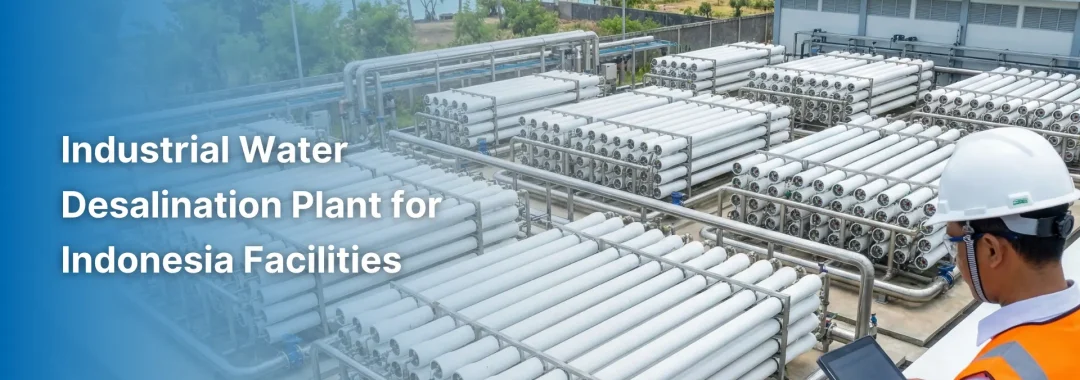
Engineer monitoring an industrial water desalination plant system at a coastal facility in Indonesia.

Industrial Water Desalination Plant for Indonesia Facilities

Industrial Water Desalination Plant: Securing Business Continuity in Indonesia

For Facilities Managers and Heads of Procurement in Indonesia, water is not merely a utility; it is the lifeblood of production. As industrial zones expand and climate patterns shift, relying solely on groundwater or municipal supplies is increasingly risky. Implementing a robust industrial water desalination plant is no longer just an option—it is a strategic necessity for safeguarding operational continuity.

This article examines how modern desalination systems solve critical supply issues and why selecting the right engineering partner is paramount for long-term success.

The Strategic Necessity of Desalination for Facilities

Indonesia’s vast coastline offers abundant seawater resources, yet many industries still struggle with clean water availability. An industrial water desalination plant converts this inexhaustible resource into high-purity process water, insulating your business from drought, regulatory restrictions on groundwater extraction, and municipal supply interruptions.

Mitigating Risks of Unreliable Water Supply

Inconsistent water quality can wreak havoc on expensive machinery. High salinity and contaminants lead to rapid corrosion, scaling, and frequent downtime. By deploying a dedicated industrial water desalination plant, facilities gain control over their water quality parameters. This autonomy prevents unexpected production halts and protects capital assets from premature degradation, directly impacting the bottom line.

Technical Components of an Efficient Industrial Water Desalination Plant

Modern desalination is far more than just filtration; it is a sophisticated integration of hydraulics and chemistry. To ensure commercial viability, the system must balance output quality with energy efficiency.

Advanced Membrane Technology and Pre-treatment

The heart of any Seawater Reverse Osmosis (SWRO) system is the membrane. However, the lifespan of these membranes depends heavily on pre-treatment. Effective removal of suspended solids prevents fouling, which is a common cause of efficiency loss.

At PT. Gapura Liqua Solutions (GLS), we utilize high-performance Reverse Osmosis Membrane technology designed to withstand high pressure and challenging feed water conditions. Understanding BWRO membrane performance is also critical for facilities dealing with brackish sources, ensuring that the specific rejection rates meet industrial standards.

Energy Efficiency and Resource Recovery

Historically, desalination was viewed as energy-intensive. Today, technologies such as Energy Recovery Devices (ERDs) have revolutionized the economics of the industrial water desalination plant. Furthermore, forward-thinking companies are now looking beyond water. Through resource recovery, brine (waste stream) can be processed to extract valuable minerals, turning waste into value.

You can learn more about the specific advantages of RO water systems and how they contribute to a circular economy in our technical insights.

Why Procurement Leaders Partner with Gapura Liqua Solutions

Selecting a vendor for an industrial water desalination plant involves evaluating technical capability, local support, and long-term reliability. PT. Gapura Liqua Solutions stands out as a premier partner for Indonesian industries.

We provide end-to-end solutions, from Engineering and Procurement to Construction and long-term Operations (EPC + O&M). Our “Total Water Solutions” approach means you can focus on your core business while we manage water availability and compliance.

  • Local Expertise: We understand the unique water chemistry of the Indonesian archipelago.
  • Supply Chain Security: We ensure the availability of critical consumables and spare parts, also accessible via our Tokopedia official store for ease of procurement.
  • Proven Track Record: Our projects demonstrate high reliability in challenging environments.

For a glimpse into our recent project activities and industry updates, you can view our latest LinkedIn Activity.

Conclusion

Investing in an industrial water desalination plant is a decisive move toward operational resilience. It mitigates the risks of water scarcity and ensures that your facility meets global standards for sustainability and efficiency. However, the technology is only as good as the partner who installs and maintains it.

PT. Gapura Liqua Solutions combines technical excellence with local understanding to deliver systems that last. We invite you to discuss your specific water requirements with our engineering team.

Are you ready to secure your facility’s water future? Contact Us for a Consultation

FAQ Section

Q: What is the typical lifespan of an industrial water desalination plant? A: With proper maintenance and high-quality components, a plant can operate efficiently for over 20 years. The membranes typically require replacement every 3 to 5 years depending on the feed water quality and pre-treatment efficacy.

Q: How does GLS handle the high energy consumption associated with desalination? A: We design our systems using advanced Energy Recovery Devices (ERDs) and high-efficiency pumps. This significantly reduces the energy footprint, making the operational costs competitive with traditional water sourcing methods.

Q: Can the plant handle variable feed water quality, such as seasonal changes in seawater? A: Yes. Our engineering team designs the pre-treatment and SWRO systems with flexibility in mind. We analyze seasonal data to ensure the system remains stable regardless of fluctuations in turbidity or salinity.

Q: Does GLS provide support after the installation is complete? A: Absolutely. We offer comprehensive Operation & Maintenance (O&M) contracts. Our team manages routine monitoring, chemical cleaning (CIP), and spare parts supply to ensure zero unplanned downtime.

Follow us on Social Media

Facebook Instagram LinkedIn
Brackish water adalah air payau yang terdapat di muara sungai dan pesisir

Brackish Water Adalah: Definisi, Contoh, dan Solusi Desalination

Air merupakan sumber kehidupan, namun tidak semua air dapat langsung digunakan untuk kebutuhan sehari-hari maupun industri. Salah satu jenis air yang sering ditemui di berbagai wilayah pesisir adalah brackish water atau air payau. Artikel ini akan membahas brackish water adalah, karakteristiknya, serta solusi pengolahan melalui desalination.


Apa Itu Brackish Water?

Secara sederhana, brackish water adalah air yang memiliki kadar garam lebih tinggi dari air tawar namun lebih rendah dibandingkan air laut. Salinitasnya biasanya berkisar antara 0,5 – 30 ppt (parts per thousand). Brackish water sering ditemukan di:

  • Muara sungai (estuary)
  • Tambak atau rawa pesisir
  • Intrusi air laut ke sumur dangkal
  • Wilayah dengan kondisi geologi tertentu

Karena kandungan garamnya, air payau tidak bisa dikonsumsi langsung dan membutuhkan proses pengolahan khusus.


Tantangan Brackish Water

  1. Salinitas sedang – Tidak setinggi laut, namun tetap dapat merusak pipa, peralatan, atau instalasi industri.
  2. Kualitas fluktuatif – Tergantung musim, pasang surut, dan lokasi geografis.
  3. Kontaminan tambahan – Selain garam, sering juga mengandung logam berat, sedimen, dan mikroorganisme.

Hal ini membuat pengolahan brackish water membutuhkan teknologi yang tepat.


Solusi: Desalination untuk Brackish Water

Desalination adalah proses untuk menghilangkan garam dari air sehingga layak untuk dikonsumsi atau digunakan dalam industri. Teknologi desalination untuk brackish water umumnya menggunakan:

  • Brackish Water Reverse Osmosis (BWRO): Membran RO khusus untuk mengolah air payau dengan efisiensi tinggi.
  • Nanofiltration (NF): Alternatif untuk mengurangi kandungan garam sebagian.
  • Hybrid System: Kombinasi RO, filtrasi, dan pretreatment untuk hasil optimal.

👉 Lihat lebih lanjut tentang brackish water treatment yang kami sediakan untuk berbagai kebutuhan industri.


Teknologi yang Digunakan

  1. Brackish Water RO Membrane
    Membran ini dirancang khusus untuk menurunkan kadar TDS (Total Dissolved Solids) hingga tingkat yang aman. Pelajari detail tentang brackish water RO membrane yang cocok untuk kebutuhan hotel, industri, maupun perumahan.
  2. Desalination Technologies
    Selain BWRO, terdapat juga teknologi desalination technologies yang relevan untuk pengolahan air laut maupun air payau dengan skala besar.

Pentingnya Pengolahan Brackish Water di Indonesia

Indonesia, sebagai negara kepulauan dengan garis pantai terpanjang kedua di dunia, memiliki banyak area dengan potensi brackish water. Dengan meningkatnya kebutuhan air bersih di sektor hospitality, industri, hingga perkotaan, teknologi desalination menjadi solusi berkelanjutan.

Dengan memilih partner yang tepat, Anda dapat mengoptimalkan ketersediaan air bersih tanpa harus khawatir terhadap dampak lingkungan.


Kesimpulan

Brackish water adalah air dengan kadar garam sedang yang membutuhkan pengolahan khusus. Dengan teknologi desalination seperti BWRO, air payau dapat diubah menjadi sumber air bersih yang aman, efisien, dan berkelanjutan.

Untuk informasi lebih lanjut mengenai layanan dan teknologi pengolahan air, kunjungi halaman kami di Facebook atau Instagram.

Follow us on Social Media

Facebook Instagram LinkedIn