Sustainable HVAC Scale Prevention: The Key to Cooling Efficiency and Asset ROI
In the intensive cooling environments of Indonesia’s luxury hospitality and industrial sectors, facility managers often view water as an unavoidable utility bill. However, treating water as a passive expense is a strategic mistake. Water quality dictates the performance of your entire air conditioning network, acting either as a seamless heat-exchange medium or as a destructive force. Implementing sustainable HVAC scale prevention is the most effective way to transform this “hidden cost” into a controllable operational expense (OPEX). By addressing water purity at the source, facilities can protect their most expensive assets while achieving significant energy savings.
Traditional water management is often a “leaking bucket” for profits. Specifically, inefficient filtration and untreated mineral loads waste water, consume excessive chemicals, and slowly destroy downstream equipment such as chillers and cooling towers.
The Hidden Cost of Water: Why Poor Quality Destroys HVAC Performance
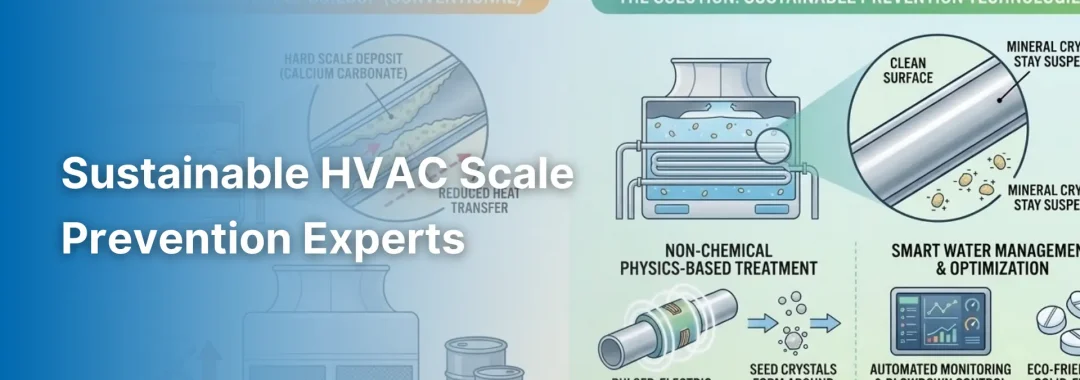
Scale is an invisible thief of energy. In cooling towers and chillers, minerals such as calcium carbonate and silica precipitate out of the water, forming a rock-hard layer on heat-exchange surfaces. Consequently, this layer acts as a thermal insulator, forcing the HVAC system to consume significantly more electricity to achieve the same cooling effect.
Scaling as an Insulator: The “Leaking Bucket” of Energy Waste
Even a thin layer of scale can reduce heat transfer efficiency by over 10%. For a large-scale resort or manufacturing plant, this inefficiency results in thousands of dollars of wasted energy every month. Furthermore, mineral deposits harbor bacteria and accelerate localized corrosion, leading to premature equipment failure. Therefore, relying on standard treatment methods often proves insufficient for modern luxury hospitality standards, where 100% uptime is expected.
Implementing Sustainable HVAC Scale Prevention Strategies
To stop “washing money away,” facilities must transition toward an advanced sustainability architecture. This involves moving beyond basic sand filtration toward high-performance, bioactive systems.
Transitioning from Traditional Sand to Activated Filter Media (AFM)
Most facilities rely on mined silica sand, which is prone to bio-fouling and “channeling.” In contrast, a modern approach involves using AFM S vs NG Media. This upcycled glass media is bio-resistant, preventing the bacterial growth that leads to uneven water flow and scale precursors bypassing the filter. By using AFM, hotels can cut backwash water waste by 50% while providing the ultra-clean water necessary for sustainable HVAC scale prevention.
High-Recovery RO for Superior Heat Exchange Protection
Following primary filtration, high-purity Reverse Osmosis (RO) water provides the ultimate defense against scale. By removing up to 99% of dissolved solids, RO water ensures that heat-exchange surfaces remain pristine. To achieve this, selecting a high-quality Reverse Osmosis Membrane is essential. Moreover, maintaining optimal BWRO membrane performance ensures that the system provides high-quality permeate with minimal energy consumption. Understanding the keunggulan sistem air RO is the first step for any facility manager looking to eliminate scaling emergency calls.
The Economic Logic: Calculating ROI and Facility OPEX Reduction
Transitioning to advanced water systems is not just an environmental choice; it is a high-yield investment. A well-engineered water loop typically delivers a clear ROI within 18 to 24 months. These savings are realized through reduced electricity bills, lower chemical consumption, and the extended lifespan of chillers and boilers. By focusing on sustainable HVAC scale prevention, procurement heads can shift budgets from “emergency repairs” to “preventative optimization,” significantly strengthening the company’s bottom line.
Partnering with PT. Gapura Liqua Solutions for Operational Continuity
Managing complex utility networks requires a partner who understands the total water cycle. PT. Gapura Liqua Solutions (GLS) provides end-to-end engineering, procurement, and long-term operations. We integrate seawater desalination and resource recovery into a seamless loop, ensuring your facility remains compliant and efficient. Our commitment to excellence is showcased in our latest project updates on LinkedIn, where we demonstrate utility savings for Indonesia’s premier properties.
For immediate maintenance needs, we provide professional-grade components through our official Tokopedia store. Additionally, we offer a Management Service Agreement to ensure your systems are maintained by experts, guaranteeing operational continuity.
Conclusion: Securing Long-Term Reliability and Resource Recovery
Ultimately, the performance of your cooling network is only as good as the water within it. By adopting sustainable HVAC scale prevention, you protect your physical assets, reduce utility waste, and ensure the long-term reliability of your facility. PT. Gapura Liqua Solutions remains the ideal partner for the Indonesian industrial and hospitality sectors, explicitly linking seawater desalination, resource recovery, and expert operations to your business success.
Stop letting scale drain your profits. Contact PT. Gapura Liqua Solutions today to audit your cooling network and implement a high-efficiency water strategy.
FAQ
Q: Can sustainable HVAC scale prevention really lower my electricity bill? A: Absolutely. By preventing scale buildup on heat-exchange surfaces, the chillers can operate at peak efficiency. Even a 1mm layer of scale can increase energy consumption by 10% or more.
Q: Why is AFM better than sand for HVAC pre-filtration? A: Specifically, Activated Filter Media (AFM) is bio-resistant and prevents the formation of biofilm. This eliminates “channeling” and ensures that minerals and organics are captured before they enter the cooling loop, providing superior sustainable HVAC scale prevention.
Q: How often should we audit our cooling tower water quality? A: For optimal performance, water quality should be monitored continuously with automated sensors. However, a comprehensive laboratory audit should be performed at least quarterly to adjust chemical dosing and filtration settings.
Q: Does GLS provide operational support for existing HVAC systems? A: Yes. PT. Gapura Liqua Solutions offers Management Service Agreements to optimize both new and existing water treatment infrastructure, ensuring long-term reliability.
Follow us on Social Media