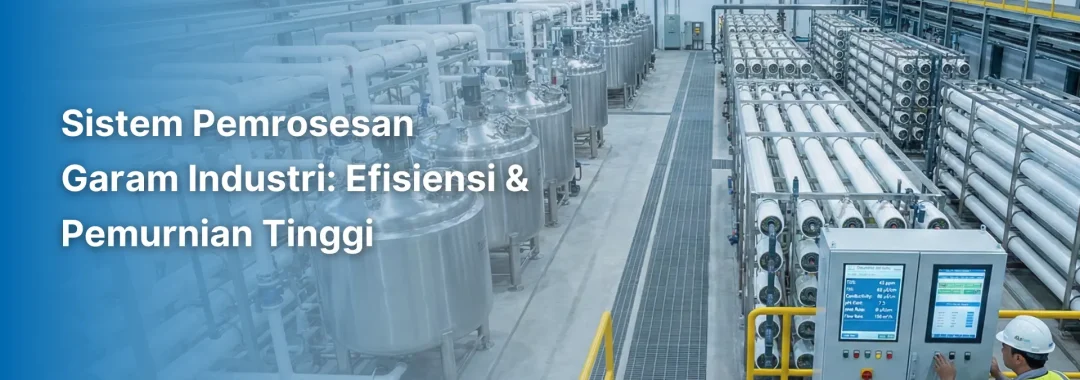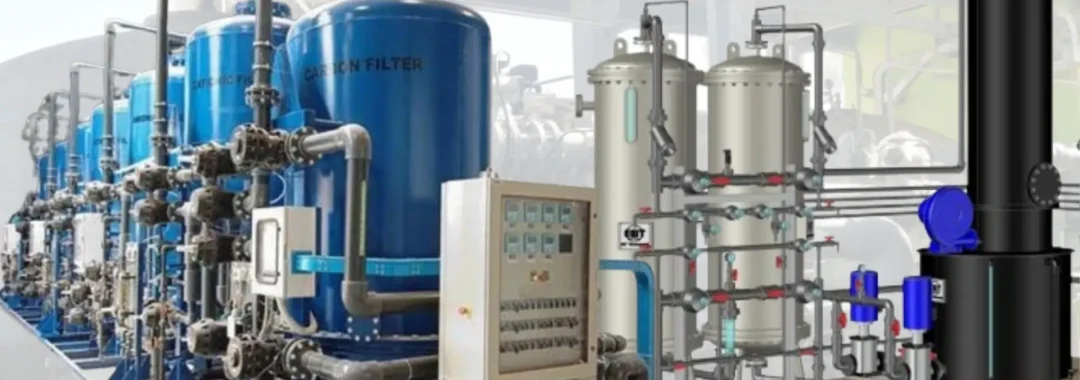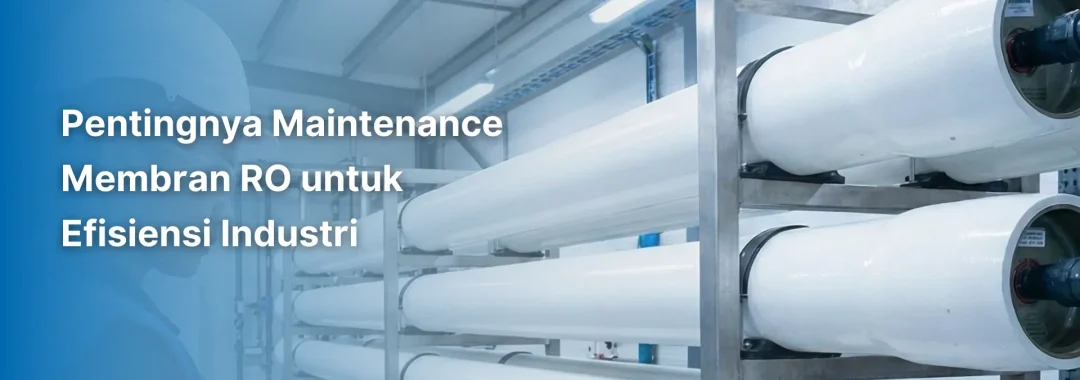
Teknisi memeriksa sistem pemrosesan garam industri dan membran RO di fasilitas water treatment modern.

Sistem Pemrosesan Garam Industri: Efisiensi & Pemurnian Tinggi

Sistem Pemrosesan Garam Industri: Kunci Efisiensi dan Resource Recovery

Bagi para pemangku kepentingan di sektor manufaktur dan fasilitas industri, sistem pemrosesan garam industri bukan sekadar pelengkap utilitas, melainkan aset strategis. Di tengah ketatnya regulasi lingkungan dan kebutuhan efisiensi biaya, kemampuan untuk mengelola air asin (brine) dan memurnikan garam industri menjadi penentu keberlanjutan operasional.

Artikel ini akan mengupas tuntas bagaimana teknologi pemrosesan yang tepat dapat meningkatkan profitabilitas Anda dan mengapa bermitra dengan ahli yang tepat adalah keputusan investasi terbaik.

Tantangan Utama dalam Pengelolaan Garam dan Brine Industri

Industri kimia, tekstil, hingga makanan dan minuman sering kali menghadapi tantangan ganda: kebutuhan akan pasokan garam industri berkualitas tinggi dan kewajiban mengelola limbah brine hasil sampingan dari proses desalinasi atau manufaktur.

Tanpa sistem pemrosesan garam industri yang andal, perusahaan menghadapi risiko operasional yang signifikan. Fluktuasi kualitas air baku dapat mengganggu proses produksi, sementara pembuangan limbah air asin yang tidak sesuai standar dapat berujung pada sanksi lingkungan yang berat.

Risiko Inefisiensi pada Metode Konvensional

Metode penguapan kolam terbuka atau sistem termal konvensional sering kali memakan lahan luas dan energi yang sangat besar. Selain itu, metode ini sulit mencapai konsistensi kemurnian yang dibutuhkan oleh standar industri modern. Inefisiensi ini secara langsung menggerus margin keuntungan perusahaan akibat biaya energi yang membengkak dan downtime akibat perawatan peralatan yang terkorosi.

Komponen Vital dalam Sistem Pemrosesan Garam Industri Modern

Untuk menjawab tantangan tersebut, diperlukan pendekatan terintegrasi yang menggabungkan teknologi membran dan termal. Sistem pemrosesan garam industri modern dirancang untuk bekerja secara kontinyu dengan efisiensi energi yang optimal.

Peran Membran Reverse Osmosis dalam Prakonsentrasi

Langkah awal yang krusial dalam sistem ini adalah pemekatan larutan garam. Di sinilah peran teknologi membran menjadi sangat vital. Penggunaan teknologi Reverse Osmosis Membrane memungkinkan pemisahan air murni dari larutan garam secara efisien sebelum masuk ke tahap kristalisasi.

Dengan menggunakan membran berkualitas tinggi, volume air yang harus diuapkan dapat dikurangi secara drastis. Hal ini tidak hanya menghemat energi termal, tetapi juga mempercepat siklus produksi. Untuk aplikasi dengan salinitas air payau, pemahaman mengenai BWRO Membrane Performance sangat penting untuk memastikan sistem pra-perawatan berjalan optimal dan mencegah fouling dini pada sistem utama.

Teknologi Kristalisasi untuk Kemurnian Maksimal

Setelah melalui tahap prakonsentrasi, larutan garam jenuh (brine) akan masuk ke unit kristalisasi. Teknologi ini memisahkan kristal garam dari cairan induknya dengan presisi tinggi. Hasilnya adalah garam industri dengan tingkat kemurnian yang konsisten, siap digunakan kembali dalam proses produksi (seperti pada industri Klor-Alkali) atau dikemas sebagai produk bernilai jual.

Keunggulan sistem yang terintegrasi ini sejalan dengan keunggulan sistem air RO pada umumnya, yaitu modularitas, efisiensi ruang, dan kontrol kualitas yang ketat.

Mengubah Limbah Menjadi Nilai dengan Resource Recovery

Konsep ekonomi sirkular kini menjadi standar baru dalam manajemen fasilitas. Sistem pemrosesan garam industri yang canggih memungkinkan implementasi Zero Liquid Discharge (ZLD). Dalam skema ini, limbah cair brine dari instalasi Desalinasi Air Laut (SWRO) tidak dibuang kembali ke laut yang berpotensi merusak ekosistem, melainkan diolah lebih lanjut.

Melalui proses resource recovery, mineral berharga seperti natrium klorida, magnesium, atau litium dapat diekstraksi kembali. Ini mengubah pusat biaya (pengolahan limbah) menjadi pusat keuntungan (pemulihan bahan baku).

Catatan Penting: Implementasi teknologi ini memerlukan keahlian teknis mendalam, mulai dari desain proses hingga pemilihan material yang tahan korosi ekstrem.

Mengapa Memilih PT. Gapura Liqua Solutions sebagai Mitra Anda?

Memilih vendor untuk sistem pemrosesan garam industri adalah keputusan jangka panjang. Anda memerlukan mitra yang tidak hanya menjual alat, tetapi memberikan solusi end-to-end.

PT. Gapura Liqua Solutions (GLS) hadir sebagai mitra strategis bagi industri di Indonesia. Dengan keahlian inti dalam Seawater Reverse Osmosis (SWRO) dan pengolahan air payau, GLS menawarkan layanan lengkap mulai dari rekayasa (engineering), pengadaan (procurement), hingga operasional jangka panjang.

Mengapa GLS?

  • Fokus pada Bisnis Inti: Kami menangani utilitas air dan garam Anda, sehingga Anda bisa fokus sepenuhnya pada produksi utama tanpa pusing memikirkan ketersediaan air atau kepatuhan limbah.
  • Ketersediaan Suku Cadang: Dukungan purna jual yang kuat dengan ketersediaan komponen yang mudah diakses, termasuk melalui kanal digital resmi kami di Tokopedia.
  • Rekam Jejak Terbukti: GLS aktif terlibat dalam proyek-proyek strategis nasional dan industri swasta, memberikan solusi yang disesuaikan dengan kondisi air lokal di Indonesia.

Anda dapat melihat salah satu update terbaru mengenai aktivitas proyek dan wawasan industri kami melalui tautan berikut: LinkedIn Update GLS.

Kesimpulan

Investasi pada sistem pemrosesan garam industri yang andal adalah langkah krusial untuk mengamankan masa depan operasional pabrik Anda. Dari penghematan energi melalui membran RO hingga penciptaan nilai tambah melalui resource recovery, manfaatnya sangat nyata bagi bottom line perusahaan.

PT. Gapura Liqua Solutions siap menjadi mitra terpercaya Anda dalam mewujudkan sistem utilitas air dan pemrosesan garam yang efisien, patuh regulasi, dan menguntungkan. Jangan biarkan masalah kualitas air menghambat pertumbuhan bisnis Anda.

Apakah Anda siap meningkatkan efisiensi fasilitas Anda? Hubungi Kami untuk Konsultasi Gratis

FAQ Section

Q: Apa keuntungan utama menggunakan sistem pemrosesan garam industri modern dibandingkan metode tradisional? A: Sistem modern menawarkan efisiensi energi yang jauh lebih tinggi, jejak lahan (footprint) yang lebih kecil, kualitas produk garam yang konsisten dan kemurnian tinggi, serta kemampuan untuk mematuhi regulasi lingkungan yang ketat melalui Zero Liquid Discharge.

Q: Apakah sistem ini bisa diterapkan untuk mengolah air laut menjadi garam industri? A: Ya, sistem ini sangat ideal untuk diintegrasikan dengan Seawater Reverse Osmosis (SWRO). Brine (air buangan) dari SWRO yang biasanya dibuang dapat diproses lebih lanjut untuk menghasilkan garam industri, memaksimalkan pemanfaatan sumber daya.

Q: Bagaimana GLS menjamin keberlanjutan operasional sistem ini? A: GLS tidak hanya membangun sistem, tetapi menawarkan layanan operasional dan pemeliharaan jangka panjang. Kami memastikan pasokan suku cadang, monitoring kinerja membran, dan optimalisasi proses secara berkala agar klien dapat fokus pada bisnis inti mereka.

Q: Apakah GLS menyediakan suku cadang untuk sistem membran? A: Tentu. Kami menyediakan berbagai komponen vital seperti membran RO, pressure vessel, dan bahan kimia pendukung yang orisinal dan berkualitas tinggi.

Follow us on Social Media

Facebook Instagram LinkedIn
An industrial-scale demineralized water system for a power plant, featuring a row of large blue carbon filter tanks, a central control panel, and stainless steel polishing vessels, with the Gapura Liqua Solutions logo.

Demineralized Water Power Plants: Optimizing Assets & OPEX

Demineralized Water Systems Power Plants: A Technical Guide to Asset Reliability and Operational Efficiency

The Critical Role of Demineralized Water (Demin Water) in Modern Power Plant Operations

In the high-stakes environment of power generation, water is not merely a utility. Instead, it is an engineered fluid. It is a critical component that directly impacts plant performance, asset longevity, and financial returns. The purity of this water, specifically demineralized water, is therefore paramount. A modern demineralized water system for a power plant is not a peripheral unit. In fact, it is a core component of operational integrity. Its applications are fundamental to the power generation cycle.

  • Boiler Feedwater for Heat Recovery Steam Generators (HRSG): In a combined-cycle power plant, the HRSG is the heart of efficiency. Ultra-pure demin water is essential to produce high-pressure steam that drives the steam turbine. Any impurity can lead to catastrophic failures.
  • NOx Emission Control in Gas Turbine Generators (GTG): Demin water is injected into gas turbine combustors to lower temperatures and control the formation of nitrogen oxides (NOx), ensuring compliance with stringent environmental regulations.
  • Cooling Systems & Other Applications: High-purity water is also used in closed-loop cooling systems, hydrogen generation, and solar panel cleaning on solar energy farms to prevent spotting and efficiency loss.

Ultimately, water purity is directly and inextricably linked to plant efficiency (MW output), operational reliability (uptime), and the lifespan of multi-million dollar assets.

Risks and Inefficiencies: The Hidden Costs of Sub-Optimal Water Quality

Failing to maintain the specified water purity introduces immense technical and financial risks. These are not minor operational hurdles. On the contrary, they are significant threats to the plant’s core function and profitability.

Corrosion and Silica Scale: The Primary Threats to Turbines and HRSG

Silica is particularly insidious. Under high pressure, it can volatilize and carry over with the steam. As the steam expands and cools in the turbine, the silica deposits onto the turbine blades. This scaling disrupts the blade’s precise aerodynamics, which consequently causes imbalance and reduces efficiency. Ultimately, this can lead to catastrophic blade failure and unscheduled shutdowns that cost millions in lost revenue and repairs. Similarly, silica scale in boiler tubes acts as an insulator. This drastically reduces heat transfer efficiency and forces the system to consume more fuel for the same steam output.

  • Dissolved Minerals (Salts): Ions like chloride and sulfate are highly corrosive to metal surfaces at high temperatures and pressures, leading to premature failure of boiler tubes and other critical components.
  • Silica (SiOâ‚‚): Silica is particularly insidious. Under high pressure, it can volatilize and carry over with the steam. As the steam expands and cools in the turbine, the silica deposits onto the turbine blades. This scaling disrupts the precise aerodynamics of the blades, causing imbalance, reducing efficiency, and potentially leading to catastrophic blade failure and unscheduled shutdowns costing millions in lost revenue and repairs. In boiler tubes, silica scale acts as an insulator, drastically reducing heat transfer efficiency and forcing the system to consume more fuel for the same steam output.

Balancing the Financial Equation: How to “Optimize CAPEX and OPEX”

Decision-makers often face the challenge of capital expenditure (CAPEX) versus operational expenditure (OPEX). A water treatment system with a low initial purchase price (low CAPEX) can appear attractive. However, this is often a financial trap. Such systems typically lead to exorbitant long-term costs (high OPEX) through:

  • High consumption of chemicals for regeneration and cleaning.
  • Frequent replacement of consumables like membranes and resins.
  • Increased labor for monitoring and maintenance.
  • The highest cost of all: unplanned downtime of the entire power plant.

The true goal is to achieve the lowest Total Cost of Ownership (TCO). This requires a strategic investment in a well-engineered system that balances CAPEX with reliability and minimal OPEX.

Designing Robust Demineralized Water Systems for Power Plants: Key Technologies

A reliable demineralization plant is not a single piece of equipment. Rather, it is a multi-stage, integrated process. Each stage is engineered to remove specific contaminants and protect the subsequent, more sensitive stages. A complete demineralized water system for a power plant depends on every stage functioning perfectly.

Pre-Treatment: The Foundation for Long-Term Performance

The longevity and performance of the entire demin system depend on the robustness of its pre-treatment stage. This initial phase is designed to remove suspended solids, colloids, and organic matter from the raw water source. Key technologies include:

  • Multimedia Filtration (MMF): Removes larger suspended particles, silt, and sediment.
  • Ultrafiltration (UF): Utilizes a membrane barrier to remove much finer particles, bacteria, viruses, and colloids. A well-designed UF system is the best defense for protecting the downstream Reverse Osmosis membranes from fouling, ensuring their long-term performance. The principles of applying these effective pre-treatment strategies are crucial across all industries requiring high-purity water.

Two-Pass Reverse Osmosis (RO): The Workhorse of Demineralization

Following pre-treatment, the water enters the core demineralization process. A Two-Pass RO system is the industry standard for power plant applications.

  • First Pass: Removes the bulk (typically >99.5%) of Total Dissolved Solids (TDS) from the water.
  • Second Pass: Takes the permeate (product water) from the first pass and processes it again, achieving an even higher level of purity and significantly reducing the ionic load on the final polishing stage. This design provides redundancy and ensures consistently high-quality water.

Polishing: Electrodeionization (EDI) vs. Mixed Bed for Ultimate Purity

The final “polishing” step removes the last traces of dissolved ions. This is done to achieve the ultra-pure specifications required, which is often <0.1 µS/cm conductivity.

  • Traditional Mixed Bed Ion Exchange: This method uses cation and anion resins in a single vessel. While effective, it is a batch process. As a result, it requires periodic shutdown for chemical regeneration using strong acids and alkalis. This creates hazardous waste streams and requires significant operator intervention.
  • Electrodeionization (EDI): This is the modern, superior alternative. EDI uses electricity, ion exchange membranes, and resin to continuously remove ions. Crucially, it does this without the need for chemical regeneration. The benefits are substantial. They include continuous operation, no hazardous chemical handling, and minimal waste. Furthermore, it provides a highly stable and predictable water quality. For new power plants, EDI is the preferred technology due to its safety, reliability, and lower OPEX.

The Financial Benefits of a Well-Engineered System

Investing in a properly designed demineralized water system for a power plant, particularly one incorporating modern technologies like UF and EDI, provides direct and measurable financial returns.

“Reduce Annual Operational Cost” Through Automation and Efficiency

A modern demin plant is designed for efficiency. For example, the adoption of EDI eliminates the significant recurring cost of regeneration chemicals. Advanced automation and PLC controls also minimize the need for operator oversight, reducing labor costs. In addition, efficient system design can include a resource recovery application service to treat and reuse certain waste streams. This minimizes water loss and disposal costs, directly contributing to a healthier bottom line.

Protecting Multi-Million Dollar Assets and Ensuring Maximum Uptime

The capital investment in a demin water system is a fraction of the cost of the assets it protects. It should be viewed as an essential insurance policy for the plant’s core revenue-generating equipment—the gas turbines, steam turbines, and HRSG. By preventing corrosion and scaling, the system ensures these assets operate at peak efficiency for their entire designed lifespan and, most critically, prevents unplanned shutdowns that result in massive revenue loss.

Gapura Liqua Solutions: Your EPC Partner for Energy Industry Water Solutions

Choosing the right partner to design and build your demineralization plant is as critical as the technology itself. Gapura Liqua Solutions operates as a full-service EPC partner, providing a single point of responsibility for your critical water infrastructure. As specialists in demineralized water systems for power plants, we understand the demands of your industry. Our focus is on delivering automated, reliable systems optimized for the lowest total cost of ownership. Ultimately, this ensures your plant operates safely, efficiently, and profitably.

Our end-to-end capabilities cover everything from initial raw water analysis, detailed process engineering and design, procurement of world-class components, to professional construction, commissioning, and long-term service. We have a proven track record in industrial applications and possess a deep understanding of the stringent water quality specifications and reliability demands of Indonesia’s power generation industry. Our focus is on delivering automated, reliable systems that are optimized for the lowest total cost of ownership, ensuring your plant operates safely, efficiently, and profitably.


Discuss your demin water requirements for your power generation facility. Contact our engineering team at Gapura Liqua Solutions to schedule a technical audit and initial system design consultation.