Elevating Industrial Utilities with Singapore International Water Week 2026
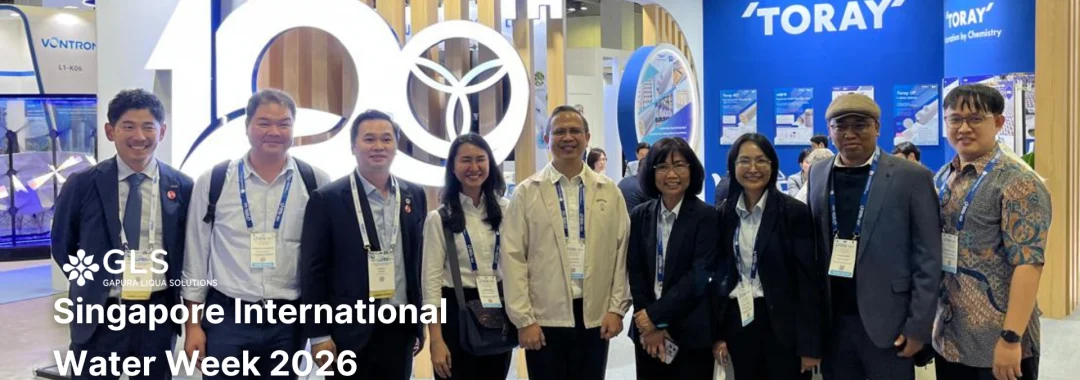
As industrial facilities face unprecedented environmental and economic pressures, relying on outdated water management strategies is simply no longer viable. To bring world-class innovations directly to Indonesia, the PT. Gapura Liqua Solutions (GLS) engineering team actively participated in Singapore International Water Week 2026. Because this premier global event convenes thousands of water leaders, experts, and practitioners, it provided critical insights into solving the most pressing urban and industrial water challenges. Consequently, we discovered actionable strategies to mitigate higher energy costs, manage increasing water demand, and overcome the severe limitations of ageing urban water systems.
Furthermore, the exhibition served as a vital platform for deep knowledge sharing. Therefore, instead of merely observing, our engineers actively evaluated breakthrough technologies to enhance our local Engineering, procurement, and long-term operations.
Global Challenges Addressed at Singapore International Water Week
The recent exhibition and convention, held at the Sands Expo and Convention Centre, highlighted the severe realities of modern water management. For Indonesian B2B stakeholders, these global themes perfectly mirror our local operational bottlenecks.
Tackling Higher Energy Costs and Ageing Water Systems
Across Southeast Asia, utilities and factories struggle immensely with ageing urban water systems and unsustainable water extraction practices. Consequently, these systemic inefficiencies lead to severe non-revenue water (NRW) losses and significantly higher energy costs. During Singapore International Water Week, global experts emphasized that overcoming these carbon-heavy operations requires immediate digitalization and robust pre-treatment upgrades. Indeed, facilities must move away from reactive fixes and embrace continuous operational control to remain competitive.
Managing Water-Intensive Industries and Extreme Weather Patterns
Moreover, the rapid growth of water-intensive industries, such as data centres and advanced manufacturing, strongly exacerbates local water scarcity. When this rising demand is paired with climate impacts originating from extreme weather patterns and rising sea levels, traditional water supplies become highly unreliable. Therefore, adopting a holistic, integrated approach to industrial water solutions is now absolutely mandatory to secure long-term operational continuity.
Innovations Discovered at Singapore International Water Week
To effectively address these complex challenges, Singapore International Water Week showcased breakthrough technologies focusing specifically on municipal water solutions, coastal resilience, and industrial efficiency. PT. Gapura Liqua Solutions thoroughly evaluated these advancements to seamlessly integrate them into our service portfolio.
Singapore International Water Week Insights on Resource Recovery
Currently, throwing away complex industrial wastewater is increasingly viewed as a massive financial and environmental loss. At the Water Convention, numerous technical sessions heavily focused on used water management, reuse, and resource circularity. Specifically, by implementing advanced waste water treatment and resource recovery systems, facilities can reclaim valuable byproducts and safely recycle the majority of their effluent. Ultimately, this circular approach drastically reduces a facility’s reliance on vulnerable raw water sources while ensuring strict regulatory compliance.
High-Recovery SWRO and Decarbonization
Another major focal point of the event was optimizing energy consumption in desalination networks. Because seawater desalination capacity continues to expand globally, the energy efficiency of Reverse Osmosis (RO) systems relies heavily on effective upstream pretreatment. By deploying high-recovery SWRO and BWRO systems equipped with premium Reverse Osmosis Membranes, industries can simultaneously achieve essential decarbonization and total water security. Moreover, optimizing BWRO membrane performance ensures that Indonesian facilities maintain high permeate yields without incurring unexpectedly higher energy costs.
Applying Singapore International Water Week Solutions to Indonesian Industries
By explicitly bridging the gap between global innovations and local necessities, PT. Gapura Liqua Solutions empowers Indonesian industries to overcome their most daunting water challenges. The keunggulan sistem air RO modern designs we deploy directly combat the unsustainable water extraction practices highlighted extensively at the convention. Because we handle the complex engineering, procurement, and long-term operations, you can focus entirely on your core business. You can follow our ongoing journey of technology implementation through our latest industrial project updates on LinkedIn.
Conclusion: Bringing Global Reliability to Your Facility
In summary, the critical insights gained from Singapore International Water Week 2026 proved invaluable for advancing industrial water resilience. By actively engaging with global experts on pressing issues like rising sea levels, higher energy costs, and complex industrial wastewater, PT. Gapura Liqua Solutions ensures that Indonesian industries do not get left behind. We explicitly link these global discoveries in seawater desalination, resource recovery, and high-efficiency treatment to your long-term operational reliability.
Do not let ageing infrastructure compromise your operations. Contact PT. Gapura Liqua Solutions today to discuss how these proven global innovations can securely transform your facility.
FAQ Section
Q: What were the main themes at Singapore International Water Week 2026? A: The 2026 event focused heavily on Municipal Water Solutions, Coastal and Flood Resilience, and Industrial Water Solutions. Key technical discussions revolved around decarbonization, resource circularity, managing water-intensive industries, and mitigating higher energy costs.
Q: Why did PT. Gapura Liqua Solutions participate in this event? A: GLS participated to perform deep knowledge-sharing and to investigate the newest global breakthroughs in desalination, advanced pretreatment, and wastewater recovery. This ensures we bring the most advanced, climate-resilient technologies directly back to our clients in Indonesia.
Q: What is the most pressing problem facing industrial water users today? A: According to global experts at the convention, industries are heavily burdened by ageing water infrastructure, unsustainable extraction practices, and significantly higher energy costs, all exacerbated by extreme weather patterns.
Q: How can Indonesian factories benefit from these global innovations? A: By partnering with GLS, facilities can replace wasteful, ageing systems with modern High-Recovery RO and advanced Resource Recovery architectures. This immediately protects expensive equipment, cuts electrical and chemical usage, and builds critical climate resilience.
Follow us on Social Media