Pipa pembuangan air limbah industri yang keruh, mengilustrasikan urgensi sistem pengolahan limbah pabrik tekstil dan teknologi water recycle yang patuh regulasi dari Gapura Liqua Solutions.

Pengolahan limbah pabrik tekstil & Water Recycle

Pengolahan Limbah Pabrik Tekstil: Strategi Efisiensi dan Kepatuhan Regulasi

Industri tekstil dan garmen merupakan salah satu penyumbang terbesar bagi ekonomi manufaktur Indonesia. Namun, sektor ini juga dikenal memiliki jejak air yang masif. Bagi pemilik pabrik dan manajer fasilitas, pengolahan limbah pabrik tekstil bukan lagi sekadar kewajiban administratif, melainkan benteng pertahanan operasional. Kegagalan dalam mengelola air limbah dapat berujung pada sanksi berat, pencabutan izin, hingga penutupan paksa akibat pencemaran lingkungan.

PT. Gapura Liqua Solutions (GLS) memahami bahwa tantangan Anda bukan hanya membuang air, tetapi bagaimana mengelolanya secara efisien agar tidak membebani biaya produksi (cost of production).

Tantangan Utama dalam Pengolahan Limbah Pabrik Tekstil

Air limbah tekstil memiliki karakteristik yang kompleks dan fluktuatif, tergantung pada proses produksi seperti pencelupan (dyeing), pencucian (washing), atau finishing. Oleh karena itu, pendekatan pengolahan limbah pabrik tekstil yang konvensional sering kali gagal memenuhi standar modern.

Menangani Beban Organik dan Zat Warna

Masalah terbesar dalam limbah tekstil adalah tingginya kadar Chemical Oxygen Demand (COD) dan zat warna sintetis yang sulit terurai. Pewarna azo, misalnya, tidak dapat dihilangkan sepenuhnya hanya dengan sedimentasi fisik. Jika sistem biologi Anda tidak optimal, efluen yang dihasilkan akan tetap berwarna pekat, yang menjadi indikator visual utama pencemaran bagi inspektur lingkungan.

Kepatuhan Terhadap Standar Baku Mutu Baru

Pemerintah Indonesia, melalui Kementerian Lingkungan Hidup dan Kehutanan (KLHK), terus memperketat baku mutu air limbah. Pengolahan limbah pabrik tekstil harus mampu menurunkan parameter polutan hingga ke level yang sangat rendah. Ketidakmampuan menyesuaikan diri dengan regulasi ini menempatkan perusahaan pada risiko peringkat PROPER Merah atau Hitam, yang berdampak buruk pada reputasi bisnis di mata pembeli internasional.

Solusi Modern untuk Pengolahan Limbah Pabrik Tekstil

Menghadapi tantangan tersebut, teknologi konvensional perlu ditingkatkan. Solusi masa depan tidak hanya membuang air, tetapi memanfaatkannya kembali (resource recovery).

Teknologi Membran untuk Water Recycle

Salah satu metode paling efektif dalam pengolahan limbah pabrik tekstil modern adalah integrasi teknologi membran. Dengan menggunakan Ultrafiltrasi (UF) dan Reverse Osmosis Membrane, pabrik dapat memproses kembali air limbah yang sudah diolah menjadi air proses berkualitas tinggi.

Langkah ini menawarkan dua keuntungan sekaligus: mengurangi volume limbah cair yang dibuang ke sungai dan memangkas biaya pembelian air baku secara drastis. Dalam banyak kasus, pabrik tekstil dapat mendaur ulang hingga 70% air limbah mereka.

Menuju Zero Liquid Discharge (ZLD)

Bagi industri yang berada di zona merah atau area dengan kelangkaan air ekstrem, konsep Zero Liquid Discharge (ZLD) menjadi relevan. Dalam sistem ini, pengolahan limbah pabrik tekstil dilakukan sedemikian rupa sehingga tidak ada cairan yang dibuang ke lingkungan. Seluruh air didaur ulang, dan limbah padat dipisahkan untuk dibuang secara aman. Meskipun investasi awalnya lebih tinggi, ZLD memberikan jaminan keamanan operasional jangka panjang dari risiko regulasi.

Mengapa Bermitra dengan Kontraktor Berpengalaman itu Penting

Membangun atau merenovasi Instalasi Pengolahan Air Limbah (IPAL) bukanlah proyek “coba-coba”. Diperlukan perhitungan engineering yang presisi untuk menangani fluktuasi debit dan beban polutan harian.

PT. Gapura Liqua Solutions hadir sebagai mitra strategis Anda. Kami tidak hanya menyediakan peralatan, tetapi memberikan solusi end-to-end mulai dari audit sistem eksisting, desain rekayasa, hingga penyediaan bahan kimia khusus. Tim kami memastikan bahwa sistem pengolahan limbah Anda berjalan stabil, efisien, dan patuh hukum.

Untuk kebutuhan mendesak seperti suku cadang pompa atau membran pengganti, kami juga menyediakan akses cepat melalui toko resmi kami di Tokopedia, memastikan downtime pabrik Anda tetap minimal.

Kesimpulan

Keberlanjutan industri tekstil sangat bergantung pada manajemen air yang cerdas. Dengan menerapkan pengolahan limbah pabrik tekstil yang mengintegrasikan teknologi daur ulang, Anda mengubah beban limbah menjadi aset sumber daya air.

Jangan tunggu sampai sanksi datang. Lindungi bisnis Anda dan lingkungan sekarang juga. Hubungi PT. Gapura Liqua Solutions untuk konsultasi mengenai optimalisasi IPAL dan solusi daur ulang air limbah industri Anda.

Q: Apakah air limbah tekstil bisa didaur ulang menjadi air bersih?

A: Ya, sangat bisa. Dengan teknologi lanjutan seperti Ultrafiltrasi dan Reverse Osmosis, air hasil pengolahan limbah pabrik tekstil dapat dimurnikan kembali hingga jernih dan bebas warna, sehingga aman digunakan kembali untuk proses pencucian atau cooling tower.

Q: Apa parameter terpenting dalam limbah tekstil?

A: Parameter kunci yang harus dipantau ketat meliputi pH, COD (Chemical Oxygen Demand), BOD, TSS, zat warna, dan logam berat (seperti Kromium). Sistem IPAL harus didesain spesifik untuk menurunkan parameter-parameter ini sesuai baku mutu daerah setempat.

Q: Mengapa sistem IPAL saya masih menghasilkan air berwarna?

A: Air berwarna biasanya menandakan bahwa proses dekolorisasi tidak berjalan optimal. Hal ini bisa disebabkan oleh dosis koagulan yang tidak tepat, kegagalan bakteri pengurai pada bak aerasi, atau jenis pewarna yang resisten. Diperlukan audit teknis untuk menemukan akar masalahnya.

Follow us on Social Media

Facebook Instagram LinkedIn
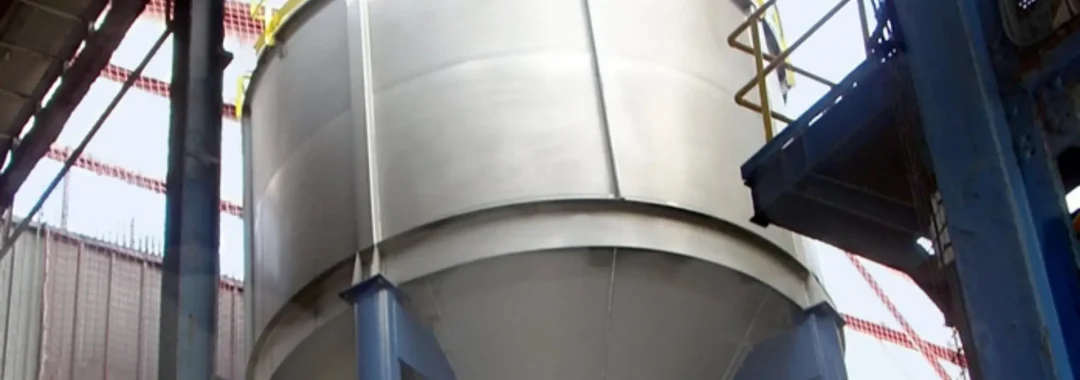
A low-angle shot of a large, cylindrical, stainless steel industrial decant tank with a conical bottom, supported by blue steel beams inside a factory setting. A yellow safety railing runs along the top edge of the tank.

Industrial Decant Tank Applications: From Costs to Strategic Assets

A Complete Guide to Industrial Decant Tank Applications

Published on July 22, 2025

Industrial decant tank applications are a critical component of modern wastewater management, especially within Indonesia’s dynamic industrial landscape. For Facility Managers and Power Plant Operators, the challenge is constant: how to handle industrial effluent effectively without succumbing to high operational costs, process downtime, and compliance risks. At the heart of this challenge consequently lies a deceptively simple yet critical piece of equipment: the industrial decant tank.

In fact, viewing this tank as a mere holding vessel means missing a significant opportunity. A well-designed, properly maintained decant tank becomes a strategic asset that enhances separation efficiency, reduces costs, and safeguards your operations. We designed this comprehensive guide for Indonesian industrial leaders to provide technical insights into the applications, design, and best practices that turn a mandatory cost into a competitive advantage.

Why an Optimized Industrial Decant Tank is More Than Just a Holding Vessel

For any Head of Procurement or Facility Manager under pressure to cut budgets, investing in quality equipment requires clear justification. An underperforming decant tank, for example, directly contributes to major pain points:

  • Inefficient Separation: This leads to high suspended solids (TSS) in the clarified effluent, risking non-compliance with wastewater regulations.
  • Process Downtime: Additionally, unplanned shutdowns due to decanter clogging or mechanical failure can halt production and lead to significant financial losses.
  • High Disposal Costs: Moreover, poor sludge compaction results in higher volumes of sludge, dramatically increasing transportation and disposal expenses.
  • Tank Corrosion & Failure: Finally, improper material selection leads to premature equipment failure, causing safety hazards and costly emergency replacements.

Therefore, an optimized system designed by a reliable supplier transforms these risks into returns. It ensures consistent compliance, minimizes operational interruptions, and optimizes the entire wastewater treatment process, directly contributing to your goal of maximizing uptime and reducing production costs.

Core Industrial Decant Tank Applications

Decant tanks are pivotal in processes that require the separation of solids from liquids via gravity sedimentation. As such, the range of industrial decant tank applications is widespread, with each industry leveraging them for specific purposes.

Wastewater Treatment Plants (WWTP) & Sequencing Batch Reactors (SBR)

This is the most common application. For instance, in an SBR system, the decant tank is integral to the batch process. After aeration and sedimentation phases, a decant arm mechanism activates to remove the treated upper layer of liquid, known as the supernatant, without disturbing the settled sludge blanket at the bottom. A well-designed system ensures the clarified effluent meets discharge standards.

Mining and Mineral Processing

The mining industry uses large-scale decant tanks and industrial clarifiers to separate valuable solids from slurry or to clarify process water for reuse. Indeed, efficient gravity separation is crucial for recovering materials and minimizing the environmental footprint of mining operations.

Food and Beverage Production

Wastewater from food and beverage plants often contains high levels of organic matter and suspended solids. In this case, operators use decant tanks as a primary treatment step to reduce the load on downstream systems, handling high Chemical Oxygen Demand (COD) and TSS before further biological treatment.

Critical Design Considerations for a High-Performance Industrial Decant Tank

The difference between a reliable decant tank and a source of constant problems lies in its design and fabrication. For this reason, as a leading produsen tangki industri (industrial tank producer) in Indonesia, we focus on several critical factors across all industrial decant tank applications.

Material Selection: Combating Corrosion and Ensuring Longevity

The choice of material is your first line of defense against tank corrosion. Options include:

  • Stainless Steel (SS304, SS316L): This material offers excellent corrosion resistance, ideal for aggressive industrial effluent.
  • Carbon Steel with Epoxy Coating: This is a cost-effective solution providing a durable protective barrier against corrosion.
  • Fiber-Reinforced Plastic (FRP): Similarly, FRP is lightweight and highly resistant to a wide range of chemicals.

Sizing and Retention Time: The Science of Separation

Proper sizing is essential for effective sedimentation. Specifically, the tank’s volume and geometry must provide sufficient retention time for solids to settle according to Stokes’ Law, which describes the settling velocity of particles in a fluid.

The following formula gives the terminal settling velocity (\(v_s\)):

\[v_s = \frac{2}{9} \frac{(\rho_p – \rho_f)}{\mu} g R^2\]

Where \(\rho_p\) is the particle density, \(\rho_f\) is the fluid density, \(\mu\) is the fluid viscosity, and \(R\) is the particle radius. This principle dictates that a sufficient retention time at a given flow rate (m³/h) is non-negotiable for achieving clear effluent. A well-designed decanter can achieve over 95% solids-liquid separation efficiency.

Decanter Mechanism: Fixed vs. Floating Decant Arms

The decant arm mechanism is the active component that removes the supernatant.

  • Fixed Decant Arms: These are simpler in design, but can be less precise if water levels fluctuate.
  • Floating Decant Arms: In contrast, these adjust to varying water levels, ensuring supernatant is always drawn from just below the surface to prevent floating solids from escaping. This design is superior for processes with variable inflow.

Furthermore, fabricators must ensure all design and construction adhere to recognized industry standards like API 650 for welded tanks to ensure structural integrity and safety.

Best Practices for Operation and Maintenance to Maximize Uptime

To ensure long-term success, operators must pair a robust design with disciplined operational practices.

Effective Sludge Level Management

Regularly monitor the level of the sludge blanket. Allowing excessive sludge accumulation reduces the effective settling volume and retention time, leading to poorer effluent quality. For this reason, you should integrate the decant tank operation with your sludge dewatering system for efficient solids management.

Routine Monitoring of Effluent Quality

In addition, periodically test the clarified effluent for key parameters like Total Suspended Solids (TSS) and COD. This data provides early warnings of process inefficiencies or decanter clogging, allowing for corrective action before compliance issues arise.

Implementing a Preventive Maintenance Schedule

Work with your provider to establish a schedule for preventive maintenance services. Critically, this should include inspecting the decant arm mechanism, checking for signs of corrosion or fouling, and servicing moving parts to prevent unexpected mechanical failure.

PT. Gapura Liqua Solutions: Your Partner in Custom Decant Tank Solutions

Navigating the complexities of wastewater treatment requires a partner with proven expertise and reliability. At PT. Gapura Liqua Solutions (GLS), we understand the pressures faced by Indonesian industries. We go beyond being a mere equipment supplier; we act as your dedicated solutions partner.

Our expertise in water treatment and desalination informs our approach to every project. We offer comprehensive Jasa Fabrikasi Tangki (Tank Fabrication Services), providing custom tank fabrication tailored to your specific process requirements, flow rates, and effluent characteristics. From initial design and engineering to tank installation and commissioning and long-term maintenance, GLS delivers turnkey wastewater systems that transform your operational challenges into strategic advantages.

Don’t let an inefficient decant tank dictate your plant’s performance. Partner with GLS to engineer a reliable, compliant, and cost-effective solution.

FAQ – Frequently Asked Questions About Industrial Decant Tanks

What is the main difference between a decant tank and a clarifier?

While both use gravity separation, a clarifier typically operates in a continuous flow system. A decant tank, on the other hand, is primarily used in batch processes, like a Sequencing Batch Reactor (SBR), where the liquid is held for a set period to allow settling before the decant phase begins.

How often does an industrial decant tank need to be cleaned?

There is no one-size-fits-all answer. The frequency depends on the sludge accumulation rate, the nature of the solids, and the tank’s design. Ultimately, it requires regular inspection, and cleaning should be scheduled as part of your preventive maintenance plan to prevent fouling and capacity loss.

Can an existing, underperforming decant tank be upgraded?

Absolutely. GLS specializes in retrofitting and upgrades for existing systems. This can include installing more efficient floating decant arms, adding sensor-based automation, or applying protective coatings to extend the tank’s service life.

What is the role of a polymer dosing unit with a decant tank?

Engineers often use a polymer dosing unit before the decant tank. Specifically, it introduces flocculants or coagulants that help smaller suspended particles clump together into larger, heavier flocs. As a result, this dramatically accelerates the settling process as described by Stokes’ Law, resulting in a clearer supernatant and a more compact sludge blanket.

Follow us on Social Media