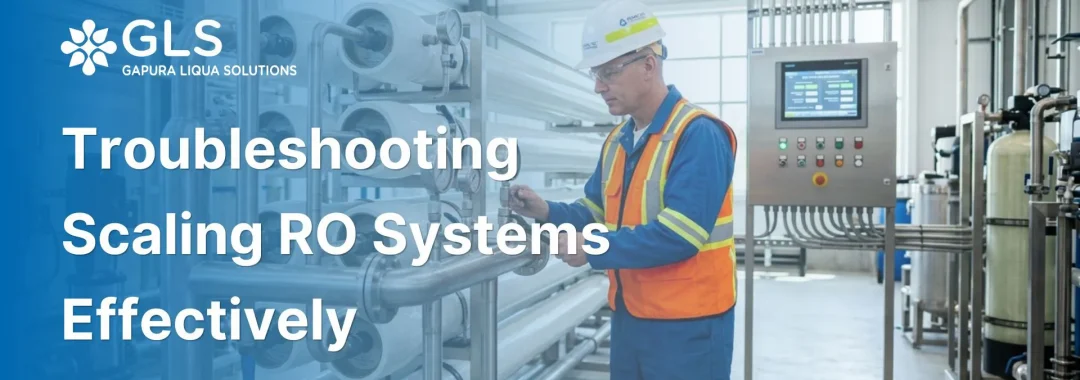
A Consultant’s Guide to Troubleshooting Scaling RO Systems
Industrial water availability heavily dictates operational continuity for businesses across Indonesia. Consequently, maintaining the efficiency of your desalination and purification infrastructure is paramount. Troubleshooting Scaling RO Systems is an essential operational skill that facility managers must prioritize to avoid costly downtime. Therefore, partnering with an experienced consultant like PT. Gapura Liqua Solutions (GLS) allows you to focus on your core business without worrying about water quality or compliance.
Understanding the Causes of Reverse Osmosis Membrane Scaling
Typically, reverse osmosis (RO) scaling occurs when dissolved minerals in the feed water exceed their natural solubility limits. As a result, these supersaturated minerals precipitate and form hard crystals on the RO membranes. Furthermore, this localized fouling blocks the membrane pores, drastically reducing system efficiency. Because operators often push systems for higher recovery rates, the concentration of these dissolved solids naturally increases in the reject stream, accelerating the scaling process.
Common Mineral Deposits in BWRO and SWRO
Specifically, different water sources produce different types of scale. For instance, brackish water treatment (BWRO) often struggles with calcium carbonate, calcium sulfate, and silica scaling. Meanwhile, seawater desalination (SWRO) facilities frequently encounter complex biological fouling mixed with mineral deposits. Understanding the exact water chemistry through comprehensive testing is the first crucial step in preventing these severe operational bottlenecks.
Best Practices for Troubleshooting Scaling RO Systems
When you begin Troubleshooting Scaling RO Systems, operators must adopt a highly proactive approach. First, engineers must regularly analyze the Langelier Saturation Index (LSI) or Stiff-Davis Stability Index (S&DSI) of the feed water. Because these indices predict the likelihood of mineral precipitation, they serve as vital diagnostic tools. Additionally, adjusting the system’s pH or modifying the antiscalant dosing rates can instantly mitigate scaling risks before they escalate.
Tracking Performance Indicators
Moreover, monitoring your daily operational data reveals the true health of your membranes. Facility managers should meticulously track the normalized permeate flow and differential pressure. If the normalized permeate flow drops by 10% to 15%, or if the differential pressure increases by 15%, scaling has likely initiated. Consequently, catching these early warning signs allows maintenance teams to act swiftly, preventing irreversible membrane damage.
Implementing Effective Corrective Actions
If severe scaling does occur, operators must execute an immediate Clean-In-Place (CIP) protocol. Thus, applying targeted acidic chemical cleaners helps dissolve hardened mineral scales safely. Furthermore, optimizing your pretreatment stages—such as multimedia filtration and chemical dosing—provides a long-term safeguard against recurring issues.
PT. Gapura Liqua Solutions: Your Expert Water Treatment Consultant
Managing complex industrial utilities requires dedicated, specialized expertise. Fortunately, PT. Gapura Liqua Solutions delivers end-to-end water treatment systems designed for absolute reliability. We handle the engineering, procurement, and long-term operations of your facility. Whether your project involves resource recovery, wastewater treatment, or advanced RO membrane maintenance, our technical team ensures seamless commercial-scale performance. Additionally, you can explore current industry insights regarding water utility management via this recent professional update from our network. To understand wider compliance standards, facility managers often reference guidelines provided by the U.S. Environmental Protection Agency (EPA) and technical frameworks from the American Water Works Association (AWWA).
Conclusion on Troubleshooting Scaling RO Systems
In conclusion, sustaining peak operational efficiency requires diligent, proactive maintenance. Mastering the process of Troubleshooting Scaling RO Systems ultimately protects your capital investment and guarantees uninterrupted production. Therefore, if your facility requires reliable, long-term engineering and operational support, trust PT. Gapura Liqua Solutions to serve as your dedicated water treatment partner.
FAQ Section
Q1: What is the main cause of scaling in RO systems? A: Scaling is primarily caused by dissolved minerals, such as calcium and silica, exceeding their solubility limits and precipitating directly onto the RO membrane surface.
Q2: How often should I conduct maintenance to prevent scaling? A: Facility managers should monitor normalized data daily. CIP (Clean-In-Place) procedures should be initiated whenever normalized permeate flow drops by 10% to 15%.
Q3: Can GLS handle the long-term operations of my desalination plant? A: Yes, PT. Gapura Liqua Solutions specializes in the engineering, procurement, and long-term operations of both SWRO and BWRO systems across Indonesia.