Strategic Industrial Utility Management: Designing a Brackish Water Treatment System
Water security remains a critical operational pillar for manufacturing plants, commercial facilities, and utility providers across the Indonesian archipelago. Consequently, many industrial zones heavily rely on groundwater that fluctuates in quality and mineral content. Installing an advanced brackish water treatment system allows facilities to seamlessly convert high-salinity raw water into reliable, process-grade feed water.
Therefore, partnering with an expert consultant like PT. Gapura Liqua Solutions (GLS) is essential. By delivering end-to-end water management solutions, GLS ensures that industrial companies achieve uninterrupted production without worrying about raw water scarcity or costly utility downtime.
The Growing Industrial Threat of High Salinity Groundwater
Identifying Groundwater Salinization in Coastal Hubs
Rapid industrialization and intense groundwater extraction near coastal regions drastically accelerate seawater intrusion into freshwater aquifers. As a result, industrial wells that previously yielded clean fresh water now deliver brackish water characterized by high chloride and sodium concentrations. Industrial facilities relying on this untreated water risk severe operational downtime due to immediate chemical imbalances. According to guidelines from the World Health Organization (WHO), monitoring dissolved mineral levels is crucial for maintaining both environmental safety and industrial utility standards.
Equipment Degradation from Total Dissolved Solids (TDS)
Brackish water typically exhibits Total Dissolved Solids (TDS) levels ranging between 1,000 mg/L and 10,000 mg/L. Furthermore, feed water containing elevated TDS causes rapid, destructive scaling on heat exchangers, boilers, and cooling towers. Additionally, untreated chloride ions cause pitting corrosion on standard stainless-steel piping networks. Ultimately, this aggressive corrosion significantly decreases equipment lifespan and inflates annual maintenance budgets.
Core Components of a Brackish Water Treatment System
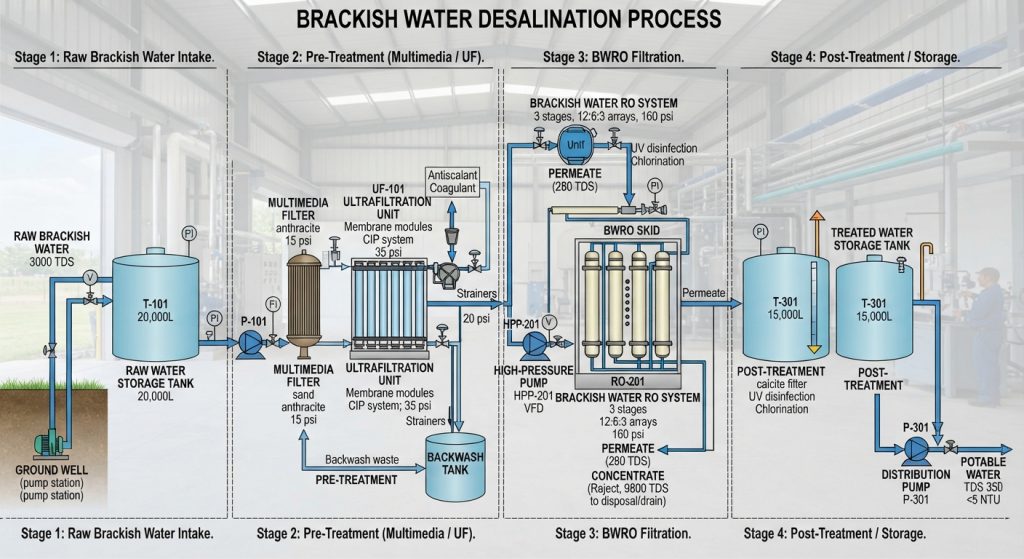
Designing a robust brackish water treatment system requires a systematic, multi-barrier engineering approach. Conversely, a poorly configured system quickly leads to rapid membrane fouling, frequent chemical cleanings, and premature media degradation.
Comprehensive Pre-Treatment and Filtration
First, pre-treatment acts as the primary defensive shield for the downstream Reverse Osmosis (RO) units. Raw water initially passes through multi-media filters or automatic backwash strainers to eliminate suspended solids and turbidity. Subsequently, ultrafiltration (UF) membranes remove colloidal matter, bacteria, and fine particulates. Achieving a stable Silt Density Index (SDI) below 3.0 before RO entry drastically extends membrane longevity and preserves hydraulic throughput.
High-Efficiency Reverse Osmosis (BWRO) Desalination
Second, the core desalination phase utilizes specialized polyamide thin-film composite BWRO membranes. Operating at medium hydraulic pressures, these advanced membranes successfully strip up to 99.5% of dissolved salts, heavy metals, and silica from the feed stream. Therefore, selecting the appropriate membrane chemistry ensures maximum permeate recovery while keeping operational energy requirements strictly minimal. Resources from the Water Environment Federation (WEF) highlight the importance of matching membrane flux rates to specific feed water characteristics to avoid premature fouling.
Post-Treatment for Industrial Compliance
Finally, permeate water produced by reverse osmosis often exhibits low pH and minimal mineral content, which makes it chemically aggressive to industrial piping. Therefore, post-treatment units apply precision dosing systems for pH neutralization, remineralization, and UV disinfection. This guarantees that the finished product water aligns perfectly with specific industrial process criteria.
Partnering with a Reliable Water Treatment Consultant
Engineering and Lifecycle Operation & Maintenance (O&M)
Navigating water treatment complexities requires deep technical knowledge and execution discipline. PT. Gapura Liqua Solutions provides complete lifecycle support, spanning initial raw water analytics, customized engineering design, procurement, and full Operation & Maintenance (O&M) services. Consequently, industrial plants can focus entirely on their core commercial outputs while GLS expertly manages raw water supply risks.
Achieving Compliance and Cost Efficiency
Industrial discharge and water extraction standards in Indonesia grow stricter each year. As a specialized local industry consultant, GLS engineers custom utility solutions that consistently fulfill environmental compliance frameworks. You can explore our latest industrial project milestones and corporate announcements on the official PT. Gapura Liqua Solutions LinkedIn page.
Conclusion
Managing high-salinity groundwater effectively requires a strategic, engineered approach rather than temporary reactive fixes. Developing a highly optimized brackish water treatment system ensures long-term operational resilience, reduces costly equipment degradation, and keeps industrial facilities compliant with strict environmental regulations. Ultimately, partnering with an experienced consultant like PT. Gapura Liqua Solutions empowers industrial plants to optimize their utility operations, lower lifetime costs, and achieve sustainable water management.
FAQ Section
Q1: What is the main purpose of a brackish water treatment system? A: It is designed to remove high levels of dissolved salts (TDS) and impurities from groundwater or surface water, converting it into high-quality, process-grade water for industrial use.
Q2: Why is pre-treatment so important in BWRO systems? A: Pre-treatment removes suspended solids, colloids, and biological matter that would otherwise quickly foul or damage the sensitive reverse osmosis membranes, ensuring long-term system efficiency.
Q3: How does PT. Gapura Liqua Solutions help industrial clients? A: GLS acts as a comprehensive water treatment consultant and EPC partner, providing custom engineering, system procurement, and long-term Operation & Maintenance (O&M) so clients can focus on their core business.
Follow us on Social Media


