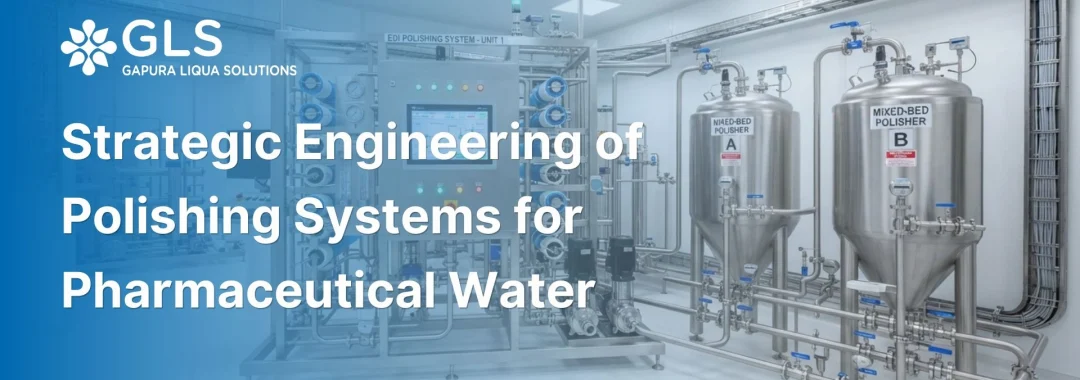
Strategic Engineering of Polishing Systems for Pharmaceutical Water
Producing safe medical products requires strict control over utility resources, especially purified water. Consequently, facility managers must implement robust polishing systems for pharmaceutical applications to meet global quality standards. Because standard reverse osmosis (RO) cannot remove every trace ion, secondary purification remains absolutely critical. Therefore, selecting the right engineering consultant ensures long-term operational success. Indeed, PT. Gapura Liqua Solutions (GLS) stands ready to optimize your industrial water treatment infrastructure.
Understanding the Demand for Ultrapure Water
First, manufacturing facilities rely heavily on highly purified water (PW) and Water for Injection (WFI) for their daily operations. However, raw water sources constantly fluctuate in mineral and microbial content. As a result, deploying dedicated polishing systems for pharmaceutical production mitigates severe operational risks.
The Risk of Trace Contaminants in Manufacturing
Specifically, trace contaminants like silica, endotoxins, and dissolved organics threaten product integrity directly. Furthermore, even minor fluctuations in water conductivity can ruin an entire production batch. Consequently, facilities face massive financial losses if bioburden levels exceed acceptable thresholds. Thus, advanced separation processes become indispensable for active risk management.
Regulatory Compliance and Pharmacopeia Standards
In addition, strict regulatory bodies demand rigorous validation of all water systems. For instance, organizations like the World Health Organization (WHO) issue stringent guidelines regarding safe manufacturing practices. Moreover, the United States Pharmacopeia (USP) sets specific limits for total organic carbon (TOC) and electrical conductivity. Therefore, designing a fully compliant system protects your facility from costly compliance audit failures.
Core Technologies in polishing systems for pharmaceutical
Second, a modern polishing sequence incorporates multiple sophisticated technologies. Generally, these steps immediately follow primary reverse osmosis (RO) filtration. Let us explore the core components utilized heavily within these industrial setups.
Electrodeionization (EDI) Integration
Initially, Electrodeionization (EDI) serves as the primary continuous polishing method. This technology uses electrical current to drive ions through specialized membranes, which continuously regenerates the internal resin. Consequently, EDI completely eliminates the need for hazardous chemical handling on site. Furthermore, it consistently produces ultrapure water with extremely low conductivity. According to the International Society for Pharmaceutical Engineering (ISPE), EDI provides a highly sustainable, chemical-free alternative to traditional regeneration methods.
Mixed Bed Ion Exchange Resins
Alternatively, mixed bed ion exchange resins provide an exceptional secondary polish. By combining cation and anion resins in a single vessel, this system removes the absolute last remaining trace ions. As a result, the product water achieves near-absolute purity. However, these resin beds require periodic chemical regeneration or off-site replacement, which maintenance teams must schedule proactively.
Advanced UV Sterilization and Ultrafiltration
Finally, biological control remains a paramount concern for manufacturers. Therefore, engineers install advanced ultraviolet (UV) sterilization units operating at specific wavelengths (such as 254 nm and 185 nm) to destroy microbial DNA and reduce TOC levels. Subsequently, ultrafiltration (UF) membranes catch any residual dead bacteria and endotoxins. Ultimately, this multi-barrier approach guarantees pristine product water output.
PT. Gapura Liqua Solutions as Your Water Treatment Consultant
Third, successfully integrating these complex technologies requires deep technical expertise. PT. Gapura Liqua Solutions proudly acts as your premier water treatment consultant in Indonesia. Indeed, our engineering team specializes in delivering end-to-end industrial utility solutions.
Tailored EPC Services and Long-Term O&M
Specifically, GLS provides comprehensive Engineering, Procurement, and Construction (EPC) services. Because no two manufacturing facilities share the exact same feed water profile, we design customized industrial water desalination solutions tailored uniquely to your specific site data. For example, by analyzing historical performance metrics, we actively optimize overall system recovery rates.
Ensuring Uninterrupted Utility Performance
Moreover, GLS delivers long-term Operation and Maintenance (O&M) support. Therefore, your internal production team can focus entirely on core manufacturing processes. By partnering with us, you effectively eliminate the stress of managing complex utilities. You can review our recent technical milestones and corporate insights directly on the PT. Gapura Liqua Solutions LinkedIn feed.
Conclusion
In conclusion, securing high-quality purified water remains strictly non-negotiable for modern medical manufacturing. Implementing highly engineered polishing systems for pharmaceutical use guarantees regulatory compliance, eliminates contamination risks, and protects your operational bottom line. Ultimately, relying on an experienced engineering partner ensures completely seamless utility management. Visit the PT. Gapura Liqua Solutions homepage today to schedule a comprehensive facility consultation.
FAQ Section
Q1: Why is reverse osmosis not enough for pharmaceutical water? A: While reverse osmosis effectively removes up to 99% of dissolved solids, the strict conductivity and TOC limits required by pharmacopeia standards demand secondary polishing to eliminate the remaining trace ions and endotoxins.
Q2: What is the main advantage of using EDI over Mixed Bed resins? A: Electrodeionization (EDI) uses electrical current to continuously regenerate its internal resin, eliminating the need to store and handle dangerous regeneration chemicals on site, which significantly improves facility safety.
Q3: How does PT. Gapura Liqua Solutions ensure water system compliance? A: GLS provides end-to-end EPC and O&M services, engineering systems with multi-barrier technologies (RO, EDI, UV, UF) that strictly adhere to international USP and WHO guidelines for Purified Water and Water for Injection.
Follow us on Social Media


