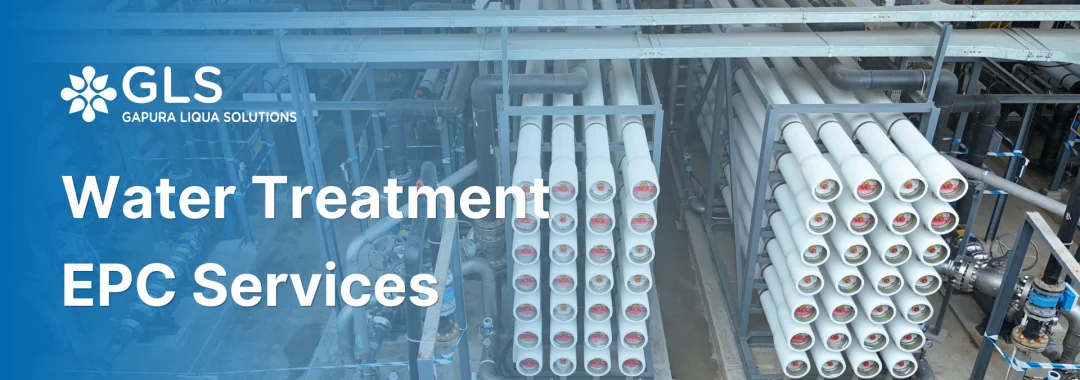
A high-angle view of a large-scale industrial Reverse Osmosis plant with extensive piping and pressure vessel arrays, showcasing water treatment EPC contractor services by PT. Gapura Liqua Solutions.

Water Treatment EPC Contractor Services

Transforming Utilities: Partnering with a Water Treatment EPC Contractor

For many procurement executives and facility managers in Indonesia, water management is mistakenly viewed as a passive, unchangeable monthly utility bill. However, this outdated paradigm actively conceals massive, highly controllable operational expenses (OPEX). Instead of patching up failing systems piecemeal, forward-thinking industries must treat their water infrastructure as a strategic, high-yield investment. Consequently, navigating this complex transformation requires specialized expertise. Specifically, partnering with an experienced water treatment EPC contractor ensures that your facility transitions seamlessly from wasteful legacy systems to highly efficient, modern operations.

If your factory continuously battles skyrocketing OPEX and unplanned downtime, the root cause likely stems from poor system integration. Let us explore why a comprehensive Design & Build approach is the ultimate solution for securing your industrial utility network.

Why Ignoring a Water Treatment EPC Contractor Leads to Fragmented Upgrades

In the industrial water sector, attempting to upgrade facilities through fragmented, multi-vendor approaches frequently creates disastrous operational bottlenecks. Unfortunately, many factories still rely on severely outdated system designs that quietly drain corporate profitability.

How an EPC Contractor Fixes the “Leaking Bucket” of Filtration

Traditionally, hospitality resorts and manufacturing plants utilize silica sand filters as their primary barrier. Nevertheless, relying solely on conventional sand filters is like ignoring a “leaking bucket” in your profitability. Sand filters frequently suffer from channeling and bacterial slime accumulation. As a result, massive amounts of clean water are wasted during mandatory backwash cycles. An expert water treatment EPC contractor immediately identifies these inefficiencies and replaces them with bio-resistant media, preventing fine micro-particles from carrying heavy organic loads directly into your core facility infrastructure.

Protecting Downstream Assets with an Expert Water Treatment Contractor

What happens when this poorly filtered water travels further into your facility? Those fine particles will immediately trigger severe boiler feed water problems. Consequently, escaped mineral particles cause boiler scaling and chiller clogging, drastically reducing thermal efficiency. Additionally, if the water feeds into a purification system, it will rapidly cause RO membrane failure through irreversible fouling. Repairing these heavy machines requires incredibly expensive downtime that could have been completely avoided by utilizing a professional water treatment EPC contractor for proper front-end engineering.

The Strategic Value of a Dedicated Water Treatment EPC Contractor

To definitively halt this massive waste, facilities must abandon piecemeal upgrades and embrace a unified strategy. Engaging a professional water treatment EPC contractor ensures that every component of your water infrastructure is designed to work in perfect harmony.

End-to-End Design & Build Integration by a Trusted EPC Partner

The core advantage of this partnership is the Design & Build (EPC) methodology. EPC stands for Engineering, Procurement, and Construction. By consolidating these three critical phases under one expert water treatment EPC contractor, facilities eliminate the communication gaps and technical mismatches that plague multi-vendor projects. From the initial 3D CAD design and rigorous raw water analysis to the final commissioning of the plant, the contractor takes absolute accountability. Therefore, your internal team can focus entirely on your core manufacturing or hospitality business without worrying about project delays.

Implementing Advanced Sustainability Architecture via EPC Services

Furthermore, a top-tier EPC partner does not just install equipment; they implement Advanced Sustainability Architecture. By combining bio-resistant Activated Filter Media (AFM) pre-treatment with premium Reverse Osmosis Membranes, the water treatment EPC contractor builds a system customized for extreme efficiency. Whether your facility requires complex seawater desalination or advanced industrial wastewater recycling—similar to processes explained in our guide on how a DAF system works for wastewater—the EPC approach guarantees that precision filtration is embedded perfectly into the architectural design.

Achieving an 18–24 Month ROI with Your Water Treatment EPC Contractor

Many decision-makers initially assume that hiring an end-to-end contractor is overly expensive. However, this perspective is entirely incorrect. Executing a turnkey Design & Build project with a reliable water treatment EPC contractor is an incredibly high-yield investment.

Because the EPC approach flawlessly integrates Advanced Sustainability Architecture, the operational savings are immediate. The system drastically reduces clean water waste, eliminates the need for excessive chemical dosing, and prevents heat-insulating scale from forming inside your chillers. Ultimately, the cumulative reduction in energy consumption and emergency maintenance consistently generates a clear Return on Investment (ROI) within just 18 to 24 months.

PT. Gapura Liqua Solutions: Your Premier Water Treatment EPC Contractor

Transitioning your utility network toward zero-waste, highly profitable operations requires an elite engineering partner. PT. Gapura Liqua Solutions (GLS) is Indonesia’s premier water treatment EPC contractor, delivering flawless end-to-end systems. We manage the entire lifecycle of your water infrastructure—from precision engineering and global procurement to construction and long-term operational maintenance. You can witness our uncompromising dedication to engineering excellence directly through our latest national industrial project updates on LinkedIn.

For facilities looking to immediately upgrade specific components while planning a larger overhaul, our premium parts are always accessible through our official Tokopedia store.

Conclusion: Securing Your Future with the Right Water Treatment EPC Contractor

In summary, treating utility infrastructure as an afterthought brings devastating financial impacts to your facility. By comprehensively understanding the value of a dedicated water treatment EPC , you not only prevent heavy machinery damage but also actively transform uncontrollable cost burdens into measurable OPEX efficiency. Ultimately, PT. Gapura Liqua Solutions stands as your trusted expert partner, explicitly integrating seawater desalination, dynamic resource recovery systems, and long-term operational reliability. Do not let a “leaking bucket” destroy your factory’s profits; contact PT. Gapura Liqua Solutions today to initiate your Design & Build transformation.

FAQ Section

Q: What exactly does a water treatment EPC contractor do? A: An EPC (Engineering, Procurement, and Construction) contractor handles the entire lifecycle of a water treatment project from start to finish. They design the technical architecture, source all necessary materials and membranes globally, and construct the physical plant, ensuring a seamless, turnkey handover to the client.

Q: Why is the Design & Build approach better than hiring separate designers and installers? A: Hiring separate vendors often leads to miscommunication, technical mismatches, and delayed timelines. A Design & Build approach consolidates all accountability under one expert company. This ensures the system is built exactly as engineered, reducing OPEX leaks and preventing catastrophic equipment failure.

Q: Can upgrading through an EPC contract actually provide an ROI? A: Yes. By implementing Advanced Sustainability Architecture, an expert EPC contractor eliminates the “leaking bucket” effect. The new system will slash backwash water waste, lower the electrical load on high-pressure pumps, and prevent scaling in boilers—typically delivering an ROI within 18 to 24 months.

Q: Does PT. Gapura Liqua Solutions offer services beyond the construction phase? A: Absolutely. Alongside our core Design & Build (EPC) services, PT. GLS provides comprehensive, long-term Operations & Maintenance (O&M) contracts. We ensure that your facility continuously meets required water quality and environmental compliance standards for years to come.

Follow us on Social Media

Facebook Gapura Liqua Solutions Instagram Gapura Liqua Solutions LinkedIn Gapura Liqua Solutions
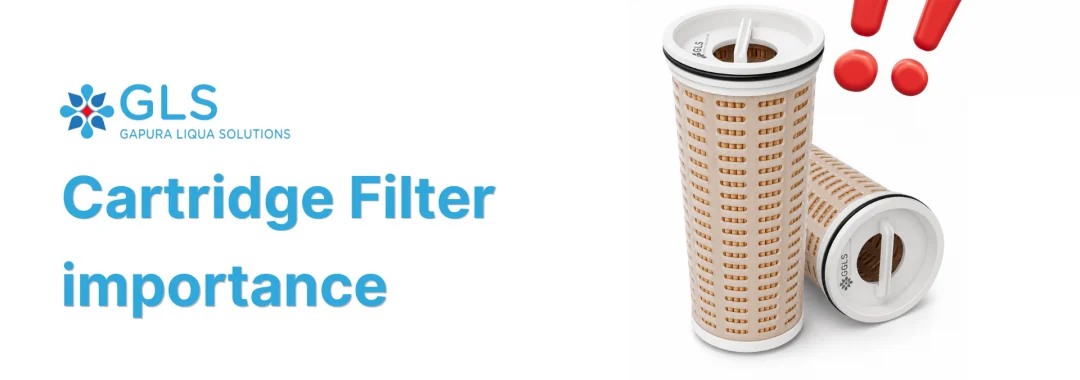
An educational graphic from PT. Gapura Liqua Solutions illustrating GLS cartridge filter importance, featuring a 3D rendering of two industrial cartridge filters alongside red exclamation marks to highlight their critical role.

GLS Cartridge Filter Importance for Industries

Preventing OPEX Leaks: Understanding GLS Cartridge Filter Importance

For many facility managers and procurement executives in Indonesia, managing water is often viewed simply as paying a monthly utility bill. However, this paradigm hides massive operational expenses (OPEX) that are highly controllable. Instead of focusing on passive billing, industries must begin treating their water infrastructure as a strategic investment. Therefore, we need to examine one of the most underestimated yet crucial components in the treatment cycle. Specifically, this article explores GLS cartridge filter importance as the final line of defense before water enters multi-million dollar machinery.

If your factory frequently experiences industrial water pump failures or clogged cooling systems, the root cause likely lies in your pre-treatment stage. To maintain technical reliability and zero downtime 24/7, facilities must explore how a seemingly small component can save the entire utility network.

The Hidden Costs of Ignoring GLS Cartridge Filter Importance

In the industrial water treatment sector, even the smallest error early in the process creates a devastating domino effect downstream. Unfortunately, many factories still rely on severely outdated system designs, failing to recognize GLS cartridge filter importance.

Why Sand Filters Alone Cannot Protect Your Equipment

Traditionally, hospitality and manufacturing facilities utilize silica sand filters as their primary barrier. Nevertheless, relying solely on conventional sand filters is like ignoring a “leaking bucket” in your hotel’s profitability. Sand filters frequently suffer from channeling and bacterial slime accumulation. As a result, fine micro-particles easily bypass the sand bed, making it impossible to meet healthy clean water TDS standards. Subsequently, water carrying these fine sediments directly impacts highly sensitive downstream equipment.

How Skipping Precision Filters Creates a “Leaking Bucket”

What happens if you completely skip secondary filtration after the sand tanks? Those fine particles will immediately clog your Reverse Osmosis Membrane. Consequently, the membrane experiences severe fouling, pump pressure spikes dramatically, and electricity consumption skyrockets. Furthermore, escaped mineral particles trigger scaling that slowly destroys your boilers and chillers. While dosing an industrial antiscalant provides chemical protection, it cannot dissolve physical sediment. Repairing heavy machines damaged by physical fouling requires incredibly expensive downtime.

Exploring GLS Cartridge Filter Importance for Utility Reliability

To halt this massive waste, facilities must implement Advanced Sustainability Architecture. One of the foundational pillars of this modern architecture is absolute precision filtration.

Critical Functions of High-Quality Cartridge Filters

The primary function of this component is to act as the ultimate “traffic cop” for micro-particles. Whether your plant processes raw well water or reclaims industrial effluent through complex methods—which you can learn about in our guide on how a DAF system works for wastewater—polishing the water is mandatory. By utilizing a high-quality GLS Cartridge Filter, you ensure that dust, sediment, or sand down to 1 micron is completely captured. The usage method is highly specific: these cartridges are placed inside stainless-steel housings right before high-pressure water is pumped into the Reverse Osmosis (RO) system. Therefore, installing this filter absolutely protects the highly sensitive pores of the RO membrane.

The Operational Risks of Low-Quality Cartridge Filtration

Naturally, some companies attempt to cut costs by purchasing cheap, unverified cartridge filters. However, this action is fatal for industrial operations that demand maximum 24/7 performance. Low-quality filters easily tear or collapse when subjected to high water pressure. When a filter experiences a “blow-out,” all the accumulated dirt instantly releases into the RO membrane simultaneously. As a result, RO elements worth thousands of dollars can be permanently destroyed in minutes. That is exactly why GLS cartridge filter importance lies in its robust durability against pressure drops and its highly consistent pore structure.

Calculating ROI by Recognizing GLS Cartridge Filter Importance

You might assume that replacing filters regularly simply adds to your operational costs. However, this perspective is entirely incorrect. Utilizing industry-standard cartridge filters is an essential step for effectively lowering water TDS and represents a high-yield investment.

By combining Activated Filter Media (AFM) pre-treatment with precision cartridge filtration, the lifespan of your RO membranes can easily double or triple. Furthermore, because the system remains free from blockages, the electricity consumption of high-pressure pumps drops significantly, alongside a reduction in cleaning chemicals. Ultimately, these combined savings consistently generate a clear Return on Investment (ROI) within just 18 to 24 months.

Achieving Zero Downtime with PT. Gapura Liqua Solutions

Transitioning your utility network toward zero-waste operations requires a highly experienced partner. PT. Gapura Liqua Solutions (GLS) delivers end-to-end systems so that our clients can focus entirely on their core business. We manage everything from engineering and procurement to long-term operations, ensuring clients never worry about water quality or environmental compliance. You can witness our dedication to operational excellence directly through our latest national industrial project updates on LinkedIn.

Additionally, to support daily maintenance needs, our premium filter and membrane components are always accessible through our operational consulting channels.

Conclusion: Securing Your Utility Future

In summary, underestimating the pre-filtration stage brings devastating financial impacts to your facility. By comprehensively understanding GLS cartridge filter importance, you not only prevent heavy machinery damage and ensure zero downtime but also actively transform cost burdens into profitable efficiency. Ultimately, PT. Gapura Liqua Solutions stands as your trusted expert partner in Indonesia, explicitly integrating seawater desalination, resource recovery systems, and long-term reliability. Do not let a “leaking bucket” destroy your factory’s profits; contact our engineers today to audit and secure the future of your utilities.

FAQ Section

Q: What is the primary function of a cartridge filter in an industrial water treatment system? A: Its primary function is to filter out fine suspended particles (ranging from 1 to 5 microns) that escape from sand or multimedia filters. The cartridge filter acts as the final gatekeeper to ensure the water entering high-pressure pumps and RO membranes is completely free from destructive debris.

Q: What happens if a factory skips using cartridge filters to reduce costs? A: Skipping this component is a fatal mistake. Sediment particles will directly foul the pores of the Reverse Osmosis membrane. Consequently, clean water production will plummet, electrical pressure will spike sharply, and you will be forced to replace RO membranes worth thousands of dollars long before their expected lifespan ends.

Q: How often should industrial cartridge filters be replaced? A: The lifespan of a cartridge filter depends heavily on the raw water quality and the effectiveness of the preceding sand filters. Generally, in the industrial sector, this component is replaced when there is a pressure drop of 10 to 15 psi across the filter housing, which typically occurs every 1 to 3 months.

Q: Why should I choose Cartridge Filter products from PT. Gapura Liqua Solutions (GLS)? A: PT. GLS provides filters with exceptionally strong structural integrity to ensure technical reliability and zero downtime. Substandard filters are prone to tearing under high pressure, which massively releases dirt into the system. GLS filters are specifically designed to withstand high-pressure fluctuations in harsh industrial environments, ensuring your facility’s operational reliability never falters.

Follow us on Social Media

Facebook Gapura Liqua Solutions Instagram Gapura Liqua Solutions LinkedIn Gapura Liqua Solutions