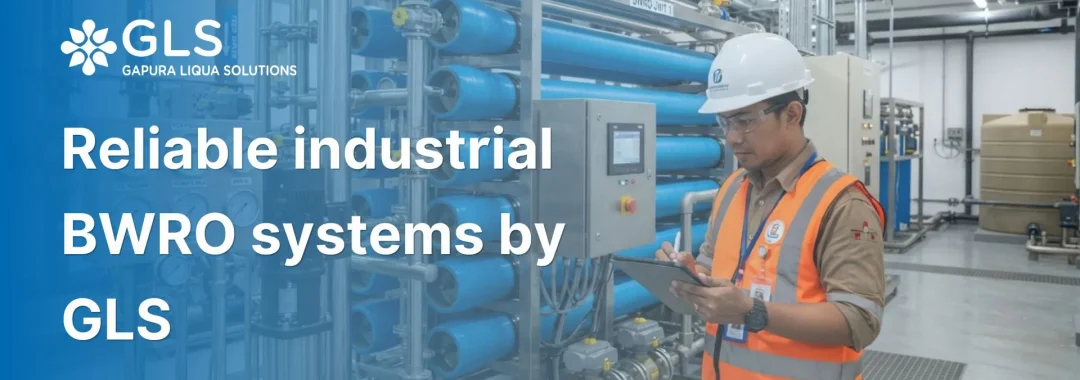
An Indonesian industrial engineer inspecting high-pressure reliable industrial BWRO systems in a modern manufacturing plant.

Reliable industrial BWRO systems by GLS

Maximizing Plant Uptime with Reliable Industrial BWRO Systems

Managing factory utilities requires strict attention to raw water quality. Often, industrial facilities rely heavily on deep well or brackish water sources. However, untreated groundwater contains high levels of dissolved salts and minerals. Consequently, unprotected boilers and cooling towers face rapid degradation. Therefore, investing in reliable industrial BWRO systems is an absolute necessity. Furthermore, these specialized systems protect heavy machinery from premature failure. Ultimately, your facility achieves optimal performance and steady production output.

The Hidden Challenges of Brackish Water in Factories

Brackish water presents severe chemical and physical challenges for industrial equipment. Unlike clean municipal supplies, brackish sources carry heavy mineral loads. As a result, untreated water introduces constant operational hazards.

Mineral Scaling and Membrane Fouling Risks

When brackish water passes through standard filters, heavy ions remain active. Under high operational pressure, calcium and silica form stubborn mineral scales. Akibatnya, these deposits block internal piping and destroy membrane surfaces. Moreover, biological fouling degrades water flow rates quickly. Without proper treatment, plant engineers face unexpected shutdowns and costly emergency repairs.

Engineering Core of Reliable Industrial BWRO Systems

Modern industrial plants demand robust engineering standards to withstand harsh environments. Therefore, basic filtration units are never enough for heavy-duty applications. Instead, facilities require reliable industrial BWRO systems built for endurance.

High-Recovery Membranes and Anti-Corrosion Design

State-of-the-art Brackish Water Reverse Osmosis units utilize advanced membrane configurations. Additionally, structural skids feature heavy-duty, corrosion-resistant stainless steel. Because of this robust design, the system withstands aggressive chemical cleaning cycles. Furthermore, smart automation controls maintain consistent output water quality. Ultimately, your plant secures high technical reliability and protection against unexpected failures.

Business Benefits and Long-Term Utility ROI

Upgrading utility infrastructure requires a clear financial justification for management executives. Fortunately, advanced brackish water treatment delivers exceptional economic returns. Here are the primary business advantages for your facility:

  • Significant OPEX Reduction: Lower chemical consumption and energy optimization reduce monthly utility expenditures.
  • Zero Unplanned Downtime: Heavy-duty engineering prevents catastrophic equipment failures during peak production cycles.
  • Extended Equipment Lifespan: Pure, treated water protects boilers and heat exchangers from corrosive scaling.
  • Rapid Investment Recovery: Operational savings deliver a clear return on investment within 18 to 24 months.

Consequently, integrating reliable industrial BWRO systems transforms a utility expense into a profit driver.

Securing 24/7 Operations with PT. Gapura Liqua Solutions

Deploying complex water treatment infrastructure demands an experienced engineering partner. In this regard, PT. Gapura Liqua Solutions (GLS) stands as your premier industry expert. We design custom desalination and brackish water plants tailored for heavy industries. Furthermore, we guarantee absolute technical reliability across all operational phases.

End-to-End Engineering Expertise for Industrial Plants

Our engineering team manages every project phase from initial water testing to long-term maintenance. As evidence, you can review our latest industrial engineering updates on LinkedIn. Therefore, partnering with GLS eliminates technical uncertainties in your utility management.

Conclusion: Future-Proofing Your Industrial Water Supply

In conclusion, ignoring brackish water contamination leads to severe financial and operational losses. Conversely, deploying reliable industrial BWRO systems safeguards your entire production line. Ultimately, PT. Gapura Liqua Solutions remains ready to optimize your industrial water infrastructure. Oleh sebab itu, reach out to our engineering experts today to schedule a comprehensive utility audit. With this step, your facility guarantees uninterrupted 24/7 operational excellence.

FAQ Section

Q: What makes industrial BWRO systems different from standard commercial filters? A: Industrial units handle high salt concentrations under extreme operational pressures. Furthermore, reliable industrial BWRO systems utilize heavy-duty, anti-corrosion materials designed for continuous 24/7 factory demands.

Q: How do these systems prevent membrane scaling and fouling? A: Advanced systems integrate proper pretreatment steps alongside high-recovery membrane designs. As a result, mineral precipitation is minimized, protecting the core filtration elements from rapid damage.

Q: What is the typical return on investment (ROI) timeframe for an industrial BWRO installation? A: Most facilities achieve full investment recovery within 18 to 24 months. This rapid return stems from reduced chemical cleaning costs, energy savings, and eliminated downtime losses.

Q: Why partner with PT. Gapura Liqua Solutions for brackish water projects? A: GLS provides comprehensive EPC and O&M services tailored for heavy industry. Therefore, we ensure absolute technical reliability and long-term operational success for your facility.

Follow us on Social Media

Facebook Gapura Liqua Solutions Instagram Gapura Liqua Solutions LinkedIn Gapura Liqua Solutions
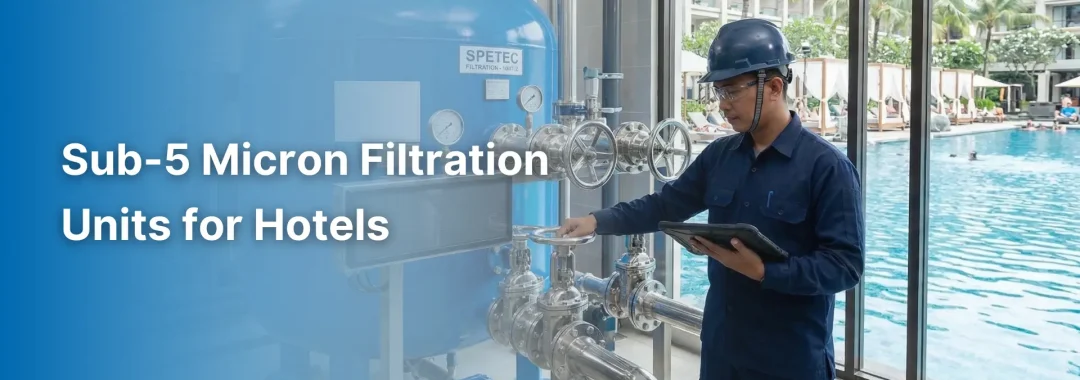
A technical cross-section of sub-5 micron filtration units utilizing AFM to provide crystal-clear water for a luxury resort.

Sub-5 Micron Filtration Units for Hotels

Sub-5 Micron Filtration Units: Why Modern Luxury Hospitality Demands Precision

In the competitive landscape of luxury hospitality, “perfection” is a standard, not a goal. While high-end resorts focus heavily on interior aesthetics and service, the silent engine of the guest experience—the water utility—is often overlooked. Unfortunately, many 5-star properties still rely on 50-year-old sand filtration technology. This reliance creates a significant vulnerability. Transitioning to professional sub-5 micron filtration units is no longer a luxury; it is a critical necessity to protect assets and maintain brand prestige.

Standard silica sand filters generally capture particles down to 20 or 40 microns. Consequently, millions of microscopic particles and biological precursors pass through the system, eventually damaging expensive downstream infrastructure.

The Failure of Standard Sand Filtration in Luxury Standards

The hospitality sector in Indonesia, particularly in high-demand areas like Bali and Jakarta, faces unique raw water challenges. Traditional sand filters create a “leaking bucket” for hotel profits.

The 20-Micron Barrier and Bio-fouling Risks

Sand is not just physically limited; it is biologically unstable. Within weeks, bacteria colonize the sand grains, creating a biofilm that leads to “channeling.” This allows unfiltered water to bypass the media entirely. Specifically, sand cannot capture the fine particles that cause cloudy water or the organic precursors that react with chlorine to create trichloramines. Therefore, hotels using sand often suffer from that unpleasant “pool smell” and skin irritation among guests. By contrast, implementing sub-5 micron filtration units provides a bioactive, precise barrier that standard sand simply cannot match.

Precision Water: The Power of Sub-5 Micron Filtration Units

To achieve truly “Precision Water,” facility managers must utilize media that is physically and chemically superior. The shift toward Activated Filter Media (AFM) represents the current gold standard in the industry.

Activated Filter Media (AFM) vs. Traditional Mined Sand

AFM is an upcycled, activated glass media that possesses a permanent negative surface charge. While sand traps dirt mechanically, AFM attracts it electrostatically. Consequently, sub-5 micron filtration units utilizing AFM can remove up to 95% of all particles down to 1 micron. This level of purity is virtually impossible for silica sand. For a deeper technical analysis of these differences, you can review our AFM S vs NG Media comparison.

Protecting High-Value Assets: Chillers, Boilers, and RO Membranes

Effective filtration is the most robust insurance policy for your hotel’s mechanical room. When fine particulates bypass primary filtration, they cause scale buildup in chillers and boilers, leading to massive energy inefficiency. Moreover, they cause rapid fouling of your Reverse Osmosis Membrane. Ensuring consistent BWRO membrane performance requires the ultra-clean feed water that only sub-5 micron filtration units can provide. By removing the load before it hits the RO, you drastically extend the life of your membranes and reduce the frequency of expensive chemical cleanings.

Enhancing the Guest Experience: Beyond Aesthetics

In a luxury setting, water must be more than “safe”—it must be “superior.” Sub-5 micron filtration results in water with significantly lower turbidity, creating a crystal-clear appearance in pools and spas. Furthermore, because these units remove more organic matter, the demand for chlorine drops by up to 30%. This reduces the chemical smell and provides a gentler experience for guests. Understanding the keunggulan sistem air RO alongside precision filtration ensures that every touchpoint, from the shower to the swimming pool, reflects 5-star quality.

Partnering with Gapura Liqua Solutions for Operational Continuity

Managing a modern resort requires a partner who understands the total water loop. PT. Gapura Liqua Solutions (GLS) provides end-to-end engineering and long-term operations to ensure your facility remains compliant and efficient. We specialize in high selective filter media that protects your ROI and enhances guest satisfaction.

Our proven expertise is visible in our latest project updates on LinkedIn, where we showcase the transformation of hospitality utilities across Indonesia. Additionally, for immediate maintenance needs, we offer premium filtration components through our official Tokopedia store.

Conclusion: The Future of Hospitality Water Management

Ultimately, the choice of filtration technology determines the lifespan of your facility’s most expensive assets. By adopting sub-5 micron filtration units, you protect your physical infrastructure, reduce water and chemical waste, and deliver a guest experience that meets modern luxury standards. PT. Gapura Liqua Solutions remains the ideal partner for the Indonesian hospitality sector, explicitly linking advanced resource recovery with long-term reliability.

Stop washing your hotel’s profits away with outdated sand technology. Contact PT. Gapura Liqua Solutions today to audit your utility room and implement a precision water solution.

FAQ

Q: Can sub-5 micron filtration units save money on electricity? A: Yes. By preventing fine particulates and scale from reaching your chillers and boilers, the equipment operates at peak heat-exchange efficiency, reducing energy consumption by up to 10–15%.

Q: Is it difficult to switch from sand to AFM in our hotel? A: Not at all. Sub-5 micron filtration units using AFM act as a “drop-in” replacement. You simply remove the old sand and replace it with the activated glass media without needing to change your existing filter tanks or pumps.

Q: How does this technology help with “Green Hotel” certifications? A: Advanced media reduces backwash water waste by up to 50% and chemical usage by 30%. These metrics contribute directly to EarthCheck or Green Globe certification requirements.

Q: Does GLS provide maintenance for these filtration systems? A: Absolutely. PT. Gapura Liqua Solutions offers Management Service Agreements to ensure your systems perform optimally year-round.