Transforming Utility Costs Through Estuarine Environment Water Treatment
Hospitality and industrial facilities located in coastal areas face unique operational hurdles. Frequently, operators draw their raw supply from dynamic zones where freshwater rivers meet the sea. Understanding what brackish water is remains the first step in addressing these fluctuating salinity levels. Unfortunately, many decision-makers treat the resulting water management challenges as fixed utility bills. Instead, facility managers must frame this as a highly controllable operational expense (OPEX). Implementing proper estuarine environment water treatment completely shifts the financial narrative from reactive spending to proactive asset protection.
Consequently, relying on outdated filtration technologies creates a massive financial drain. Transitioning to modern engineering solutions not only protects the environment but significantly boosts long-term profitability.
The Hidden Costs of Coastal Hospitality Operations
Coastal resorts and manufacturing plants demand massive volumes of pristine water daily. When raw water sources carry variable organic loads and dissolved solids, basic filtration mechanisms simply fail to perform efficiently.
Why Traditional Sand Filtration is a “Leaking Bucket”
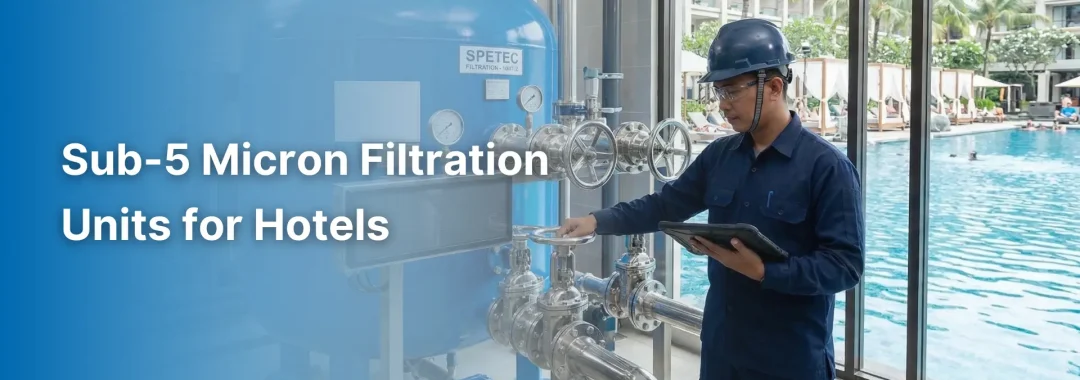
Traditional silica sand filtration represents a literal “leaking bucket” for hotel profits. Specifically, sand filters are biologically unstable and highly susceptible to bacterial fouling. When bacteria colonize the sand bed, they create channeling effects that allow contaminated water to bypass the filtration media entirely. Therefore, operators must initiate backwash cycles constantly. This frequent backwashing wastes thousands of liters of processed water and heavily spikes electricity consumption. Furthermore, dealing with high organic loads often requires understanding how a DAF system works for wastewater to manage the heavy suspended solids effectively before they ruin the primary filters.
Equipment Destruction and High Chemical Loads
Inefficient filtration directly harms the most expensive downstream equipment in any facility. Because fine particulates and hardness minerals bypass the sand filters, they aggressively attack chillers and heating networks. Over time, these minerals form rock-hard scale inside heat exchangers. Consequently, facility engineers face constant boiler feed water problems. Scale acts as a thermal insulator, forcing heating and cooling systems to work twice as hard. Thus, energy bills skyrocket, and the lifespan of critical machinery diminishes drastically. Additionally, attempting to mitigate this poor filtration requires excessive chemical dosing, further driving up OPEX.
Implementing Advanced Estuarine Environment Water Treatment
To halt these financial leaks, forward-thinking facilities are transitioning toward Advanced Sustainability Architecture. This comprehensive approach systematically upgrades estuarine environment water treatment to ensure maximum efficiency and minimum waste.
Activated Filter Media (AFM) for Superior Pre-Filtration
The foundation of this advanced architecture is the replacement of mined silica sand with Activated Filter Media (AFM). Because AFM is manufactured from upcycled glass and features a bio-resistant surface, bacteria cannot adhere to it. Consequently, biofilm formation and channeling are completely eliminated. Therefore, AFM requires up to 50% less water for backwashing and captures far finer particles than sand. This superior pre-filtration drastically reduces the organic and particulate load sent to downstream equipment.
High-Recovery Reverse Osmosis Integration
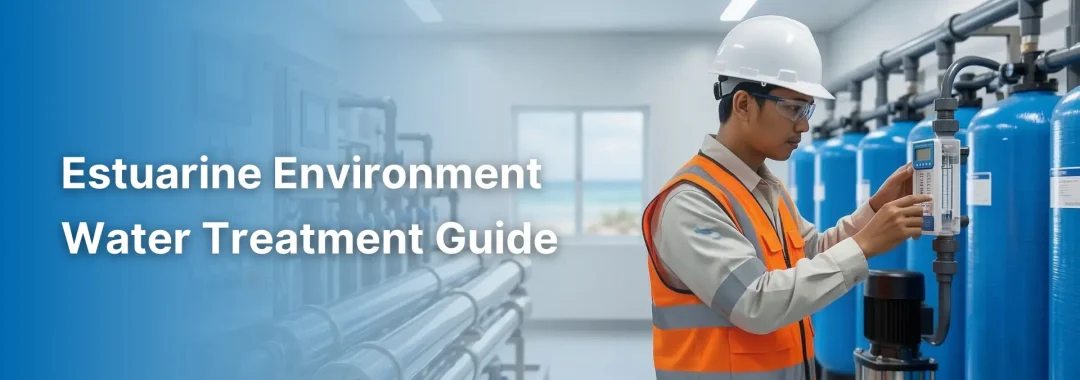
Following pristine pre-filtration, the water enters a high-recovery Reverse Osmosis (RO) system. Coastal facilities desperately need strategies for lowering water TDS effectively. By utilizing clean feed water from the AFM units, the RO membranes operate at peak performance without premature fouling. Indeed, exploring how to reduce water TDS efficiently proves that clean feed water is the secret to membrane longevity. This dynamic combination of AFM and high-recovery RO perfectly handles the fluctuating demands of coastal water sources, ensuring that guests experience luxury water quality while operations run seamlessly.
The Financial Impact: Achieving an 18–24 Month ROI
Many procurement heads view advanced water systems purely as environmental initiatives. However, Advanced Sustainability Architecture is a high-yield financial investment. Because this system slashes backwash water waste, reduces chemical consumption by 30%, and optimizes the electricity used by chillers and boilers, the operational savings are immediate. Furthermore, protecting RO membranes from premature failure saves tens of thousands of dollars in replacement costs. Ultimately, the cumulative OPEX reduction provides a clear Return on Investment (ROI) within just 18 to 24 months.
Partnering with Gapura Liqua Solutions for Operational Continuity
Executing a flawless transition to Advanced Sustainability Architecture requires deep technical expertise. PT. Gapura Liqua Solutions (GLS) delivers end-to-end engineering, procurement, and long-term operations tailored precisely for the Indonesian market. We empower our clients to focus entirely on their core hospitality or manufacturing business without worrying about utility compliance or water availability. To see our commitment to engineering excellence in action, you can view our latest industrial project updates on LinkedIn.
For facility managers looking to explore our solutions or discuss specific site challenges, we encourage you to contact us directly. We also invite ambitious professionals to review our current career opportunities as we expand our engineering teams across the archipelago.
Conclusion: Sustainable Reliability and Resource Recovery
In summary, coastal operators must abandon the mindset that water is merely an uncontrollable utility bill. Upgrading your estuarine environment water treatment is the definitive strategy for capping operational expenses and protecting high-value mechanical assets. PT. Gapura Liqua Solutions stands as the premier expert partner in Indonesia, explicitly linking seawater desalination, dynamic resource recovery, and long-term reliability. By transitioning to our Advanced Sustainability Architecture, your facility will achieve unparalleled operational continuity while securing a highly profitable ROI.
FAQ Section
Q: Why is treating water from an estuary more difficult than treating deep well water? A: Estuaries represent dynamic zones where river water mixes with seawater. Consequently, the water experiences rapid fluctuations in salinity, turbidity, and organic content. This variability requires an adaptive estuarine environment water treatment system, combining robust pre-filtration like AFM with high-recovery RO.
Q: How exactly does replacing sand with AFM save money on electricity? A: Because AFM captures much finer particles than sand, it prevents microscopic debris and hardness minerals from passing into your boilers and chillers. Clean heat exchangers operate at peak thermal efficiency. Therefore, your HVAC and heating systems consume significantly less electricity to achieve the desired temperatures.
Q: Does upgrading to Advanced Sustainability Architecture disrupt daily hotel operations? A: Not typically. In most retrofits, AFM acts as a direct “drop-in” replacement for silica sand inside your existing pressure vessels. Thus, our engineering teams can phase the upgrade process to ensure zero interruption to your facility’s daily water supply.
Q: How does this system contribute to “Green Hotel” certifications? A: Advanced Sustainability Architecture slashes backwash water waste by up to 50% and reduces chemical dependency by roughly 30%. These highly measurable reductions in water intensity and chemical usage directly satisfy the strict criteria for global certifications like EarthCheck and Green Globe.
Follow us on Social Media